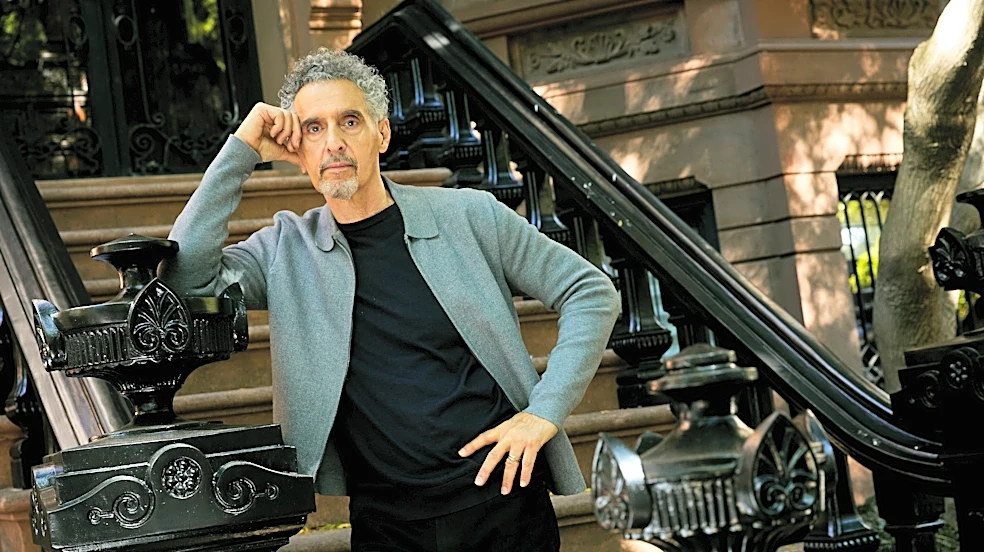






NEW YORK (AP) — John Turturro grew up in Hollis, Queens, and has lived in Park Slope, Brooklyn, since 1988. Through his life as a New Yorker, his most reliable reservoir of inspiration has been the sidewalks and subway cars around him.
“You see the variety and diversity,” Turturro says. “It’s always around you. When I’m on the train, there are so many different kinds of people. Especially the 7 train. I get a lot of things from the 7 train.”
Turturro’s
Pino, the racist pizzeria worker of “Do The Right Thing,” came from guys Turturro grew up around. His Brooklyn-born trash-talking bowler Jesus Quintana from “The Big Lebowski” was based on a Lower East Side man Turturro met just after the man got out of jail. Turturro liked his voice.
“I interview a lot of people and I take things from them. They know I’m going to,” Turturro says. “Sometimes I keep in touch with certain people, but sometimes you feel kind of bad about that. Like a thief in the night.”
Sitting outside at a cafe around the corner from his Park Slope brownstone, Turturro chuckles. The symmetry with his latest New York character is almost too perfect. In “The Only Living Pickpocket in New York,” Turturro stars as Harry Lehman, an aging pickpocket in an increasingly cashless and digital New York.
The film, which Sony Pictures Classics releases in select theaters Friday, is a fitting capstone for the 69-year-old Turturro, a shape-shifting character actor who has always worked best when you don’t see him working.
“The whole skill of it is that the person doesn’t know,” Turturro says of pickpockets. “I used to make a list of everything I had in common and everything I didn’t have in common with a character. A lot of things resonated with me. People don’t look at you anymore.”
“The Only Living Pickpocket in New York,” written and directed by Noah Segan, is an elegiac ode not just to a bygone, analog New York but to a rich generation of New York actors. Steve Buscemi co-stars as a pawnshop owner and Giancarlo Esposito plays a police detective. A lot of the movie’s joy is seeing such archetypal New York performers on their home turf.
Turturro’s soulful performance has brought him something rare for the much-loved but relatively seldom-honored actor: Oscar buzz. “The Only Living Pickpocket in New York” could land him his first nomination.
“I worked so hard and long before that it’s wonderful when things actually come together,” says Turturro. “It’s rarer than people think, you know what I mean?”
Turturro could just as easily be talking about the New York Knicks, whose championship he’s still basking in. “Miraculous,” he says, smiling. The sun was also shining on Turturro on a recent bright autumn day in Brooklyn. “The Only Living Pickpocket” had just played at the New York Film Festival, where many of Turturro’s longtime friends and collaborators, like Joel and Ethan Coen, came to support him. The moment has made him reflective.
“When I first started, I thought: I don’t know if I’m going to work. I feel like I have the ability, but I don’t look like Robert Redford,” says Turturro.
Ironically, it was a film with Redford, 1994’s “Quiz Show,” that Turturro attributes to him and his wife of 40 years, Katherine Borowitz, being able to stay in New York.
“I got ‘Quiz Show’ and I was going to get paid,” recalls Turturro. “I said, ‘Well, maybe we have enough.’ So we stayed here.”
Since then, Turturro has played street-wise New York hustlers, high-minded intellectuals and world-weary schlubs. He’s played a corner store owner (“Jungle Fever”), an NYPD hostage negotiator (“The Taking of Pelham 123”), a court-appointed defense attorney (“The Night Of”), a mob boss (“The Batman”), a scriptwriting playwright (“Barton Fink”) and a gigolo ( “Fading Gigolo,” which he directed). Like few actors, he has captured the city, from Broadway to the Bowery to Bayside.
The kinds of characters Turturro has made a living capturing can feel like an endangered species in a more sanitized, high-priced New York. Turturro grants that the city has changed. Cab drivers, he notes, no longer tell you their life story while barely keeping an eye on the road. But regardless of the number of pickpockets left, Turturro finds the same spirit is alive.
“There are different people now in New York. But if you go to certain pockets, you can find them,” he says. “We were in neighborhoods for this and I was like, ‘Wow, this is a whole other world.’ We shot way out past Coney Island. Sometimes I had a dressing room in a hair salon. I’d watch the clientele.”
So Turturro can often be spied walking around Brooklyn like he always has been. He takes the subway home after Knicks games. For the most part, people are cool.
“Everyone treats me the same, and that’s the way I like it. I can understand people who are like superstars. But that does really reduce your options in life. It removes you from life, like, taking the train home after a game,” says Turturro. “If you lose yourself, what do you have? You don’t have anything.”
___
This story was updated to correct the name of Turturro's new movie in the headline.