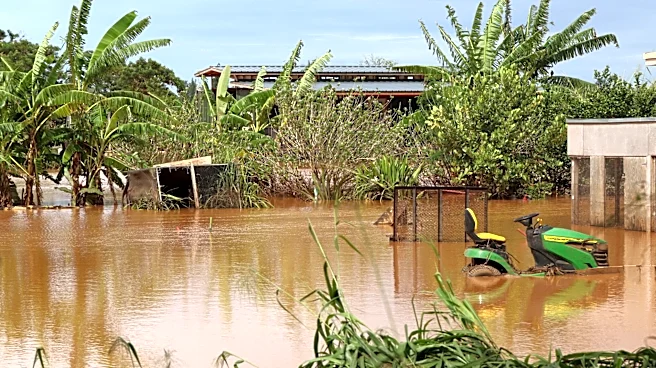





In photo after photo, video after video, North Shore residents are painted in mud, scraping it off driveways, sweeping it out of kitchens and heaving it into trucks along with their household debris. With agriculture surrounding them, it’s impossible not to wonder: Are they exposing themselves to toxic farm chemicals amid the muck and sludge?
Upstream agricultural operations are the source of greatest concern, their use of pesticides linked with myriad
health effects, from neurological and respiratory illnesses to cancers.
Although the state is still awaiting test results, so far officials say there is little to worry about. The sheer amount of water that fell from the sky during the Kona low storms – about 2 trillion gallons statewide – would have significantly diluted the chemicals everywhere.
Such assurances are unlikely to quell the community’s decades-long experience with polluted runoff, however, and small farmers say that runoff could also present a food safety problem and threaten to set back years of organic farming practices.
The anxiety among residents in the wake of the storm is coming on the heels of state lawmakers killing a list of bills aimed at strengthening restrictions on farmers spraying certain chemicals to kill weeds and pests even as the federal government is moving to cut red tape and protect agrochemical companies from state rules and lawsuits.
The potential that chemicals from upstream industrial agriculture operations might have been washed onto land around Waialua, in the form of sludge, is of particular concern to small farmers and other residents, said state Rep. Amy Perruso, who represents Wahiawā and Waialua.
Bacteria are a different matter. The state Department of Health has detected several pathogens in mud and water on the North Shore since the storms, which prompted the contaminated water advisories for more than two weeks in the areas affected by the severe flooding from late February through March.
E. Coli, salmonella and enterococcus have appeared in state sediment testing, which health officials said is consistent with expectations for the region. The state is still waiting on results for bacteria that cause staph and campylobacter.
Four sites have also been tested for 22 different legacy pesticides, a catch-all term for banned agricultural chemicals such as DDT or heptachlor. The department anticipates it will take two weeks to get those results back.
Experts say it’s unlikely any residue will be found in problematic concentrations on the North Shore, however, considering the 62 inches of rain that fell there.
Those floodwaters likely diluted pesticides beyond hazardous levels, said Qing Li, a professor at the University of Hawai‘i’s molecular bioscience and bioengineering department.
“The risk is not terribly high, based on my knowledge of the field,” said Li, who specializes in agricultural chemistry, food and human health. The greatest risk, he said, is bacteria.
The flood-carried mud and water that settled on North Shore farms destroyed more than just crops and machinery. It also threatens to compromise the ability of some farms to maintain their organic certification.
The University of Hawaiʻi College of Tropical Agriculture and Human Resilience is offering three months of free soil testing for flood-affected farmers so they can understand what’s in the mud that has settled on their land, including nutrients, disease and pesticide residue. The details are still being finalized and will be announced soon, college communications director Patrick Williams said.
Bacterial and chemical contamination are generally the two greatest post-flood hazards. As with any disaster situation, UH agriculture dean Parwinder Grewal said, “pesticides are definitely a concern.”
Organic farmers could lose their U.S. Department of Agriculture Organic Certification because of the flooding. Certification typically comes with a laundry list of requirements, including buffer zones, which are intended to shield their natural operations from pesticides that are often used with conventional agriculture. Buffers include everything from berms and lines of trees to prevent pesticide drift to 100-foot areas of untended land.
“This is such an extreme situation that some of those berms that work in normal rains probably didn’t,” said Christian Zuckerman, vice president of the Hawaiʻi Farmers Union.
Organic farmers may have to wait three years after they’ve cleared their land to regain their status, he said.
Asphalt and other contaminants from the roadways will also be a concern, Zuckerman said, because they can leach into soils.
Future harvests of leafy greens may be challenging because they generally take up significant nutrients from the soil and, with them, any pesticides that may have washed onto the fields from other farms, Hawai‘i pesticides branch manager Esther Riechert said.
“Not all crops will take up different contaminants in the soil,” Riechert said. “It all depends on the toxins and pesticides, which were diluted by the floodwaters anyway.”
The farmers union is working alongside the North Shore Economic Vitality Partnership, planning seminars for farmers to help them understand how to recover their farming operations.
Agriculture, pest control and cleaning companies have registered more than 8,000 restricted-use pesticides with the Hawai‘i agriculture department, which regulates their use statewide. The state does not hold information on where they are used or when, which advocates have wanted to change for years.
Several bills to increase restrictions have already been killed this legislative session, with a single measure to digitize reports still alive. Others would have increased reporting requirements, calling on users to disclose the location and the timing of use.
One bill would have banned a carcinogenic fumigant called 1, 3-dicholoropropene, commonly known as Telone, used by Dole Food Company Hawaiʻi. The measure died despite nearly 3-to-1 support for it in testimony.
“It shows you who has power and influence,” said Anne Frederick, executive director for Hawaiʻi Alliance for Progressive Action.
The advocacy group, part of the Safe Farms Safe Food coalition, offers clues to some of the chemicals that could have been in play during the recent storms. They found more than 400,000 pounds of carcinogenic fumigants and neurotoxic insecticides were used in the Wahiawā-Waialua region from 2020 to 2022.
About 300,000 pounds was used by Dole Food Company Hawai‘i on its pineapple lands between Wahiawā and Waialua, according to the safe food coalition. The fumigant has been linked to cancer, respiratory problems and neurological damage.
Dole currently uses the product on about 400 acres of its land. A ban would sink its operations in Hawai‘i by cutting productivity by almost 75%, according to Dole testimony on the bill.
At the federal level, Frederick said, there’s even more to be concerned about for Hawaiʻi if the Trump administration’s posturing is any indication.
Earlier this year, the federal government took steps to promote domestic glyphosate production. The agricultural chemical has been central to multibillion-dollar lawsuits and settlements due to its links to non-Hodgkin lymphoma and other cancers. It has also been a lightning rod in Hawaiʻi’s pesticide debate, with widespread use throughout the islands.
Republicans’ stance on pesticides has been a key point of contention in negotiations for the federal Farm Bill, which covers everything from food security programs to farm subsidies.
U.S. Rep. Jill Tokuda, who sits on the House Agriculture Committee, told Civil Beat that while the Farm Bill has progressed in recent months, with some Democrats supporting its passage, it remains lopsided in favor of Republican priorities.
The bill currently proposes relaxing pesticide labeling rules and the potential preemption of states suing big agrochemical companies in cases related to carcinogenic paraquat and glyphosate. It may hamper existing trials too.
“The pesticide provision was a poison pill,” Tokuda said.
Bayer, which owns Monsanto, announced a $7.25 billion national settlement in February for thousands of cases relating to Roundup, its brand name for glyphosate. The corporation has been fined millions of dollars in Hawaiʻi for illegally storing hazardous waste and spraying a banned pesticide on crops.
___
Civil Beat’s coverage of climate change and the environment is supported by The Healy Foundation, the Marisla Fund of the Hawai‘i Community Foundation and the Frost Family Foundation.“ Hawai‘i Grown ” is funded in part by grants from the Stupski Foundation, Ulupono Fund at the Hawai‘i Community Foundation and the Frost Family Foundation.
___
This story was originally published by Honolulu Civil Beat and distributed through a partnership with The Associated Press.