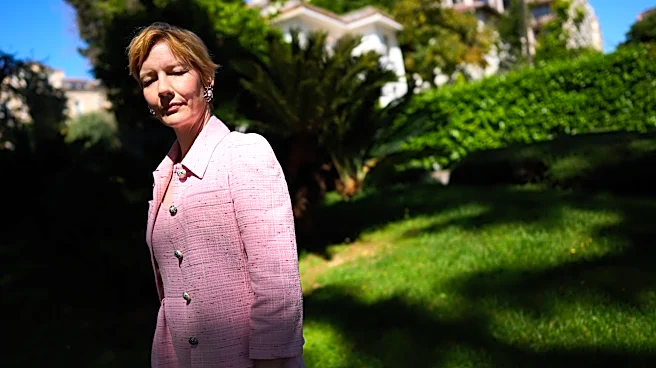

CANNES, France (AP) — For Sandra Hüller, eruptions of emotion don’t come naturally. She prefers to be quiet and calm, and often her screen presence radiates intensity when she’s simply watching. But when she explodes
— whether in grief or karaoke — she can be magnificent.
“It’s not something that I like to do, particularly,” Hüller says, sitting in a garden in Cannes. “Maybe I like the characters more who don’t erupt all the time because these are very annoying people, I don’t know.”
She takes a drag on a cigarette and considers it further.
“I like to observe more than I like being observed. When I do something big, of course I’m the center of attention. Maybe that’s the root of it. But you are not my therapist so we will not find out today,” Hüller says, and laughs.
The full range of Hüller’s talent is on full display this year in four films that run from big to small. Foremost among them is “Fatherland,” the Cannes Film Festival entry by Paweł Pawlikowski, the Polish director of “Ida” and “Cold War.”
In the first week of Cannes, “Fatherland” (which Mubi will release later this year) was widely acknowledged as a clear standout, and a possible Palme d’Or favorite. Like “Ida” and “Cold War,” it’s elegantly shot in black and white, uncommonly brief (82 minutes) and throbs with the pain of postwar Europe.
Hüller plays Erika, the daughter of the German author Thomas Mann (Hanns Zischler). They return to Germany in 1949 on a road trip, toggling between the American-controlled West Germany and the Soviet-ruled East Germany. Their former country no more, they are betwixt, as Thomas says, “Mickey Mouse or Stalin.”
For Hüller, who was born in East Germany, “Fatherland” follows her chilling turn in Jonathan Glazer’s “The Zone of Interest,” set near a concentration camp. In “Fatherland,” her character was staunchly opposed to the Nazis, but is now living amid their blithely unremorseful collaborators.
“A void is hard to portray, and I think it’s a big deal trying it,” says Hüller. “We talked about this in school. It’s part of our history classes. But I never got into the specifics of what it felt like. We know a lot of pictures of the women cleaning up the streets because the men were dead or somewhere in prison. But what it meant to not know the country you were born in anymore is something we weren’t familiar with.”
Several of Hüller’s performances have already been indelible parts of the Cannes Film Festival: the 2016 comedy “Toni Erdmann” and the 2023 Palme d’Or winner “Anatomy of a Fall.” “Fatherland” is likewise a standout, but it comes during the kind of year actors dream of.
At the Berlin Film Festival earlier this year, Hüller won best leading performance for “Rose,” a gender exploration set in the aftermath of the Thirty Years’ War. In the March box-office hit “Project Hail Mary,” she co-starred alongside Ryan Gosling and, at Gosling’s urging, performed one of the movie’s best scenes: a karaoke rendition of Harry Styles' “Sign of the Times.” She also co-stars in Alejandro G. Iñárritu’s much-anticipated “Digger,” due out later this year.
“I’m almost 50 now and I feel very blessed that I can have this experience right now,” Hüller says. “For some of my peers, it’s a gap in the journey or the end of the journey.”
If her character in “Fatherland” is torn between worlds, Hüller is moving frictionless between the movie realms of Europe and Hollywood.
“I’ve been looking at the things that came my way and I have been thinking about whether I can say yes to them or not, if I’m ready to do them,” she says. “There are some experiences coming my way that I’ve never had before and I would be very, very stupid if I wouldn’t use them.”
“Not so much for success reasons,” she continues. “It’s really more of a question of growth — and getting to know more spaces so you can move more freely through the world. There’s a lot of pleasure in this. It’s also dangerous. But it’s far out of my comfort zone.”
Still, success has come with a cost. Hüller considers herself a theater actor first, and is desperate to return to the theater collective she grew out of. She still directs with them, but her notoriety is too much to be part of an ensemble.
“I miss theater like a heartbroken person,” she says, her eyes welling up. “Even when I talk about it with you, I start crying.”
As pared away as Pawlikowski’s films are, he occasionally adds things, too. During filming, he had an idea for a scene where Erika, after quietly growing skeptical of her father’s optimism about a good Germany, shouts at him.
“I said, ‘Listen, if it’s bad, I’m not going to put it in, just do your best.’ And she did brilliant,” Pawlikowski says. “That was the luxury of an actress who can do so much. I was just watching, like, how did she do this? It’s so much better than what I imagined.”
Hüller didn't expect Pawlikowski's style to change her methods, but it did. Pawlikowski's frames leave a lot of space. She had to find how to exist in them without becoming a statue.
“It has a lot to do with presence and awareness and focus, and with a rich inner movement that’s not necessarily seen on the outside,” says Hüller. “But you can feel it, in some way. The more precise this inner movement is, the better it works in that very precise frame. That’s something I had to find out.”