






BRUSSELS (AP) — The European Union unanimously agreed on Monday to impose new sanctions on the leaders of the Palestinian militant Hamas group and the Israeli settler movement, diplomats said, a decision sparked by growing outrage over the devastation in Gaza during the Israel-Hamas war.
However, the foreign ministers of the 27-nation bloc meeting in Brussels stopped short of endorsing stronger economic measures against the Israeli government, sought
by some in Europe.
Though Monday's meeting resulted in political agreement, the EU still has to settle on which organizations and individuals will be hit with sanctions, and a committee will finalize the draft list.
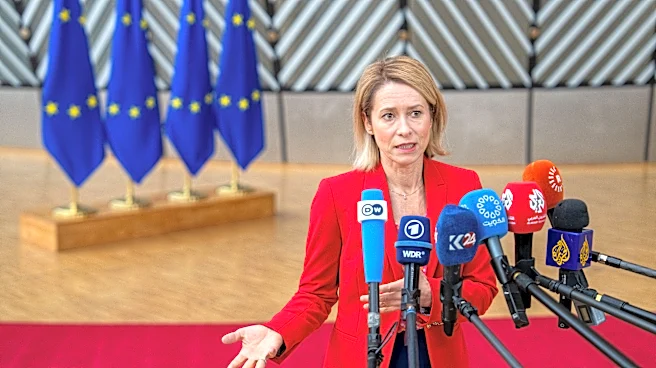
EU’s foreign policy chief Kaja Kallas posted on social media that the ministers agreed extremism and violence should carry consequences.
“It was high time we move from deadlock to delivery," she said.
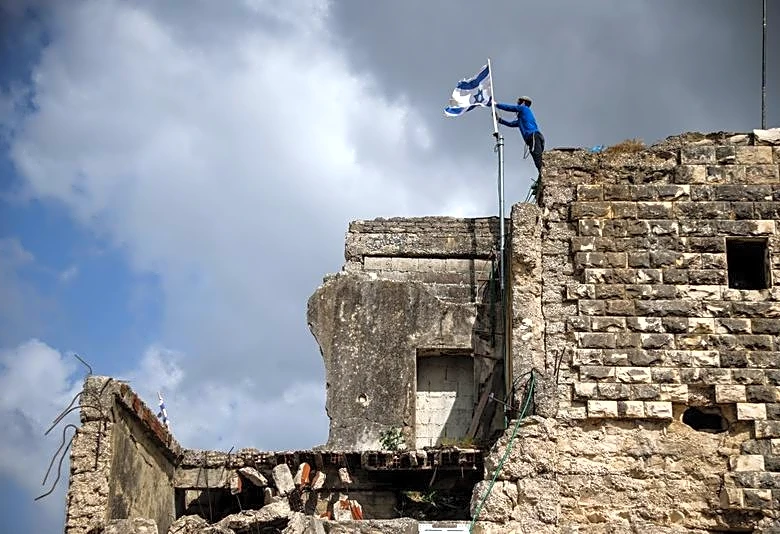
The EU has not released a draft list of those to be targeted but Israel's Haaretz newspaper said it includes settler organizations Amana, Nachala, Hashomer Yosh, Regavim and some of their leaders — Daniella Weiss, Meir Deutsch and Avichai Suissa.
Weiss, one of the leaders of Nachala and often regarded as the godmother of the Israeli settler movement, said she had received no formal notification of the sanctions and told The Associated Press that she did not understand the justification for them.
She described the sanctions as “ridiculous” and the situation as “banal,” saying that it would not stop the movement.
Regavim said the group considers it “a badge of honor” to be sanctioned by the EU and would “continue working to restore governance and sovereignty throughout all parts of our homeland.”
Israel’s government, dominated by far-right proponents of the settler movement, reacted defiantly.
Foreign Minister Gideon Saar said in a social media post that the sanctions were “arbitrary and political” and vowed that the government would “continue to stand for the right of Jews to settle in the heart of our homeland.”
Key settlers in Israel's government include Finance Minister Bezalel Smotrich, who formulates settlement policy, and Cabinet minister Itamar Ben-Gvir, who oversees the nation’s police force.
French Foreign Minister Jean-Noël Barrot said the ministers decided to sanction Hamas leaders and both leaders and organizations in the Israeli settler movement in the occupied West Bank.
“These most serious and intolerable acts must cease without delay,” he said in a social media post.
“It is sanctioning the main leaders of Hamas, responsible for the worst antisemitic massacre in our history since the Shoah during which 51 French people lost their lives, a terrorist movement that must imperatively be disarmed and excluded from any participation in the future of Palestine," Barrot said, using the Hebrew term to describe the Holocaust.
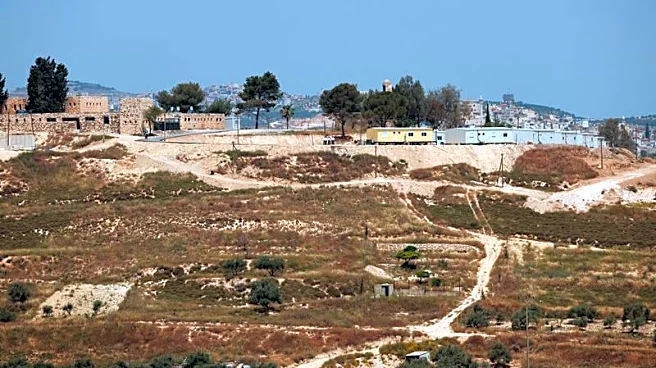
Palestinians, rights groups and international observers are increasingly warning about the worsening violence in the occupied West Bank, where young Palestinian men are being killed with increasing regularity amid a broader climate of arson, vandalism and the displacement of farming communities near settlements and outposts.
At least 40 Palestinians have been killed since the start of the year, according to the United Nations Office for the Coordination of Humanitarian Affairs, including a record 11 by settlers, two more than in all of 2025.
“The EU cannot be bystanders in the face of escalating violence and persistent breaches of international law,” posted Irish Foreign Minister Helen McEntee.
The Israeli human rights group Peace Now said the decision also was “a call to the Israeli public to open its eyes and see the reality we have created through decades of control and settlement in the occupied territories.”
The unanimous EU vote followed the ouster last month of Hungarian Prime Minister Viktor Orbán after 16 years in power in Budapest.
A staunch supporter of Israeli Prime Minister Benjamin Netanyahu, Orbán had repeatedly vetoed earlier attempts to sanction Israeli settlers over their actions in the West Bank. Orbán's loss in the April election to Péter Magyar paved the way for a the EU's agreement on the new sanctions.
Monday's move by EU's top diplomats "validates the notion that Orbán was blocking them single-handedly," said Martin Konečný, head of the Brussels-based European Middle East Project.
It could also herald a turning point in EU's Israel policy. Criticism of Netanyahu and his government's actions in Gaza, the West Bank, Lebanon, Syria and Iran had pushed many European governments, led by Spain, Ireland and the Netherlands, to seek penalties.
“You can’t just turn a blind eye,” Luxembourg Foreign Minister Xavier Bettel said earlier.
Still, the EU diplomats failed to agree on measures such as banning products from Israeli settlements in the West Bank or suspending a key trade agreement to pressure Israel.
“The EU’s narrowed the scope of action now to individuals and to a few entities, and in doing that it’s ignoring the far more systemic issues at play," said Hugh Lovatt, a fellow at the European Council on Foreign Relations.
“There’s so much that you can and should be doing," he added. Just “adding a few more settlers” to the sanctioned list “is missing the big picture.”
Human Rights Watch associate EU director Claudio Francavilla said the sanctions were “a step in the right direction" but there was much "more needed for the EU to comply with international law.”
Ahead of the Brussels meeting, Italian Foreign Minister Antonio Tajani said his government needed more time to study a French-Swedish proposal to sever West Bank settlers from EU markets, effectively withholding support despite mounting popular political pressure.
Individual nations could ban settlement goods on their own if the process stalls in Brussels, Dutch Foreign Minister Tom Berendsen said.
“We have been talking about measures for too long,” said Spanish Foreign Minister José Manuel Albares Bueno in Brussels. “Let’s move on to a vote and stop saying that there is no qualified majority for it. Let’s see how many of us are in agreement and who is not.”
___
Frankel reported from Jerusalem. Associated Press writer Sam Metz in Ramallah, West Bank, contributed to this report.