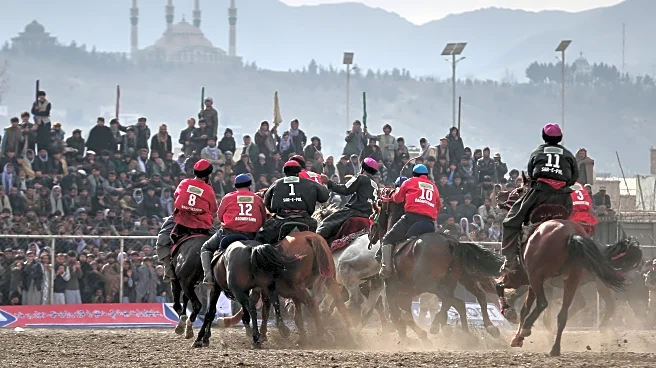

KABUL, Afghanistan (AP) — Through the dust kicked up by the pounding hooves of a scrum of horses and riders, a winner emerges. The victorious team gallops around the playing field, holding a flag aloft.
The final of Afghanistan’s hugely popular annual tournament of buzkashi, a traditional equestrian sport with few formal rules that is known for its often violent scrums, was played Monday.
Traditionally, riders from two opposing teams would compete to score goals using a goat carcass as a ball. A fake carcass is now used, made of leather and rope and stuffed with straw and weights to simulate the size and weight of a dead animal.
The players — 12 riders on each team — hang out of the saddle at impossible angles, swooping down to grab the fake carcass and gallop ahead of the rest of the riders toward the goal.
The game was banned during the Taliban’s first rule of Afghanistan in the late 1990s but reemerged after their ouster, and they have allowed it to continue since seizing power again in 2021, with government officials attending the matches.
Monday’s final, in which the northern province of Sar-e-Pul crushed the northeastern province of Badakhshan 7-0, was the 11th day of the national league tournament. The province of Baghlan came third and Kunduz fourth out of the 11 teams that participated.
Eight foreign players from Tajikistan and Kyrgyzstan also joined the teams, said Atal Mashwani, the spokesman of Afghanistan’s General Directorate of Physical Education and Sports.
A corporate sponsor — a gasoline company — ensures funding for the tournament, and there is a prize of a car for each of the first four teams, as well as cups, medals and certificates.
The tournament is wildly popular, with thousands of men and boys packing the spectator stands in the playing field in central Kabul. Some scrambled up trees or electricity pylons for a better view.
Restrictions placed on women and girls in Afghanistan mean they are not allowed to attend as spectators — although in the country’s conservative society, women attending such matches was frowned upon even when there were no formal restrictions on their movements.