

Kauai Coffee Company has been a Westside fixture since the late 1980s. It’s grown into a roughly 140-employee business that manages 4 million coffee trees across 3,100 acres, making it the largest coffee grower in the U.S. today.
But now there are conflicting reports about where the company is headed — if anywhere and Kaua‘i County Council Chair Mel Rapozo said he’ll be meeting with BBCP and Kauai Coffee in separate meetings later this week to try
to sort things out.
“My concern is the employees,” Rapozo said. “This state of uncertainty — or not knowing what’s going to happen — is a lot for them. I’m hopeful there will be some resolution.”
The company’s land lease is set to expire at the end of March, after nearly two years of attempted negotiations between parent company Massimo Zanetti Beverage Group, which has owned Kauai Coffee since 2011, and landowner Brue Baukol Capital Partners, the Colorado-based investment firm that bought the property from Alexander & Baldwin in 2022.
Earlier this month, Kauai Coffee notified state and county officials that it will permanently cease all operations and lay off 136 employees between March 14 and March 28.
“KCC is being forced out of business,” the company said in its Worker Adjustment and Retraining Notification Act notice.
However, BBCP said in a statement sent to Civil Beat that it is committed to retaining Kauai Coffee employees who want to continue working the land and that Kauai Coffee’s 3,700 acres that are designated as Important Agricultural Lands will continue to be used for agriculture in perpetuity.
“If Massimo Zanetti does not renew its lease, our plan is to keep people working as we move forward,” James Priestley, BBCP vice president, is quoted as saying in the statement. “Every employee who wants to keep working on the coffee farm will have that opportunity. Our focus is on caring for the land, supporting local jobs and being responsible stewards for Kauaʻi for the long term.”
BBCP has formed a Kauai Coffee Transition Task Force to ensure that planning for any transition is aligned with community, operational and regulatory considerations. It’s made up of representatives from human resources, field operations, legal, finance, government relations and more.
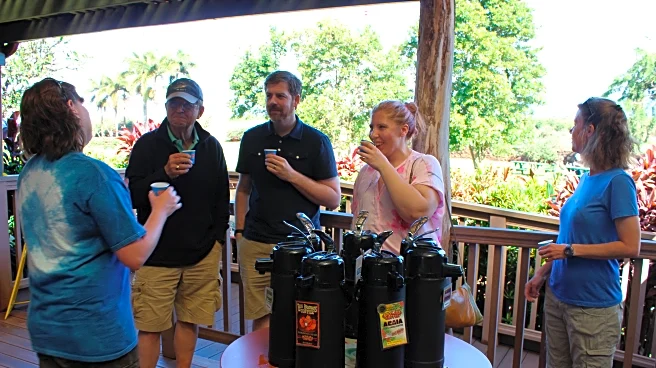
Word about Kauai Coffee’s unclear future began to spread in December after Wayne Katayama, a senior adviser for the company, announced at the annual open house that there would be no extension or renewal to its land lease.
Katayama served as Kauai Coffee’s president and general manager before retiring in 2016. On Jan. 7, he and 20 of his employees updated the Kaua‘i County Council at Rapozo’s request.
Rapozo said he asked Kauai Coffee to brief the council after hearing from several employees concerned about the land lease potentially ending. The company, he said, has been part of Kaua‘i’s community and culture, and he’d like to see coffee continue.
“Regardless of who the owner of the plantation is, making sure they are taken care of is my priority,” he said.
During the meeting, Katayama told council members that 30% of his employees have been with the company for over 10 years. Three have been with the company for 50 years.
In a handout about Kauai Coffee’s situation distributed in December, the company said most of its 141 employees are local residents, and 90% live on the Westside. Rapozo told Civil Beat that many have plantation roots.
“All our employees are in the communities,” Katayama said at the council meeting. “You’re probably related to some of them, you probably are friends with some of them, you know their families, and, certainly, you’ve come into contact with them through their community outreach.”
Katayama was outspoken about the situation up until a couple of weeks ago, then did not respond to Civil Beat’s requests for comment.
Kaua‘i Mayor Derek Kawakami, who has been involved in discussions with representatives of the farm operator and landowner, was unavailable for an interview. The county’s public information team said in a statement that his role has been to stay informed and understand potential impacts to workers and the West Kaua‘i community. Since the lease is a private matter, the county’s ability to directly intervene is limited.
State Rep. Dee Morikawa, whose district includes the Kauai Coffee lands, said the Legislature doesn’t have much ability to intervene, either. She’s seen Kauai Coffee come a long way in the 40 years she’s lived on the Westside and she described it as an important provider of jobs for the area. The company has also been a good neighbor, she said, and engages in sustainable farming practices.
While not certified organic, Kauai Coffee’s products carry certifications from Fair Trade USA, Rainforest Alliance and Non-GMO Project. They demonstrate that the company provides safe working conditions and sustainable livelihoods, follows environmentally friendly farming practices, and that its products are not genetically modified. Its farming practices have enabled it to retain more water and use less herbicides, according to its website.
Kauai Coffee’s employee-led Fair Trade Committee has given $373,000 back to the island since 2023, according to its website.
About half of Kauai Coffee’s employees belong to the International Longshore and Warehouse Union Local 142. In a Jan. 13 statement, President Chris West said the union was deeply concerned about the situation. He said agricultural lands are increasingly seen as opportunities for high-end development.
“This issue extends well beyond the coffee workers at Kauai Coffee Company and to the question of whether Kaua‘i gets turned into a playground for investors,” he said. “In the absence of transparency, the risk to working families is real and profound.”
BBCP, a private equity real estate investment firm, bought the land under Kaua‘i Coffee four years ago. Today it owns over 18,500 acres of conservation, agricultural and other land on Kaua‘i, according to its website. That includes the 1,000-acre Kukui‘ula luxury development on the island’s south shore.
The firm listed 4,713 acres of the Kauai Coffee lands for sale in 2024. According to the sale website, the acreage includes nearly 5 miles of oceanfront real estate from ‘Ele‘ele to Kukui‘ula to Po‘ipū, and about 695 acres that were designated for urban development within the West Kaua‘i Community Plan in 2020.
According to the Kaua‘i Planning Department, it was the 2018 General Plan that identified 600 acres of Kauai Coffee lands as provisional agriculture, a designation meant to allow the county to study whether upzoning for residential use made sense.
“When the West Kaua‘i Community Plan was adopted in 2020, after community outreach and engagement, it was determined that upzoning those lands was not appropriate,” the department said in an email. “The provisional agriculture designation was removed. With the exception of the 48 acres already in the state urban district, all Kauai Coffee field lands are designated as agriculture or Important Agricultural Lands.”
Priestley said in a statement that BBCP evaluated several options for the Kauai Coffee lands, including considering other coffee operators, farmers or agricultural-use tenants, or owner-operators.
“While the property has technically remained listed, a sale hasn’t been an active focus for more than a year,” he said. “Our priority has always been to ensure this land has the right long-term, agricultural steward.”
He added that BBCP apologizes that the language in its listing did not reflect the most current planning framework.
“Our intent has never been to suggest development beyond what is allowed or supported by County plans,” he said.
___
This story was originally published by Honolulu Civil Beat and distributed through a partnership with The Associated Press.