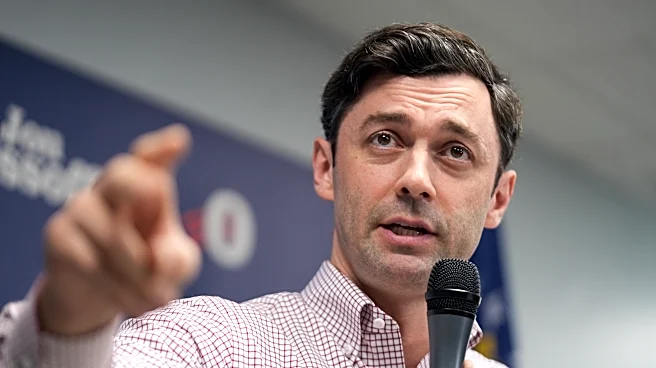


ATLANTA (AP) — Sen. Jon Ossoff is vying to win reelection Tuesday after a campaign framed by the Georgia Democrat’s relentless criticism of Donald Trump and the president’s choice of a Republican rival, Rep. Mike Collins.
Collins won Trump's backing during a drawn-out primary earlier this year, but the party soon lost hope that he would be able to defeat Ossoff, originally believed to be the most vulnerable Democratic incumbent in any Senate race this year.
In recent months, Republican organizations shifted money away from the state while Ossoff raised more than $109 million to lead all Senate candidates nationally.
“A wave is building,” Ossoff told his supporters ahead of Election Day, “the kind of wave that comes once a generation when people have been pushed too far, and they decide all together, all at once, to say enough is enough.”
Trump won Georgia in the 2016 and 2024 presidential campaigns, and his loss there in 2020 has long been central to his false claims about voter fraud. If Ossoff, 39, triumphs in the battleground state, it would intensify chatter that he may run for the White House in 2028, even though he's denied interest.
Ossoff has built his reelection pitch as a fight against broad political corruption, focusing on Trump and the first family's dramatic increase in wealth since the president's return to the White House.
He's tagged Trump “a failed president” profiting from the Oval Office and exacerbating distrust in government. “It’s not just the money that’s corrupted our politics,” Ossoff said. “It is a moral corruption, the cynical indifference of powerful people.”
The senator has lambasted Collins, a Trump acolyte who was elected to Congress echoing the president's 2020 election lies, for a “pathetic, childlike devotion to Donald Trump.” And he's repeatedly tagged Collins as a “bigot” who “brought dishonor to our state,” in part for having aides and a son-in-law who have met with white supremacists and circulated white nationalist propaganda online.
When asked, Collins has publicly condemned white supremacy and antisemitism and noted he fired those former staffers. But the controversy dogged him enough that he abruptly walked away from one campaign news conference when pressed about the matter.
Collins already faced the challenge of restitching the Republican coalition. Senate leaders wanted outgoing Georgia Gov. Brian Kemp to run for the seat. He declined, instead recruiting and backing former football coach Derek Dooley. Collins defeated Dooley in a June runoff, but only after Kemp spent weeks telling Republican voters that Collins could not win in November. Kemp did not endorse Collins until September.
The congressman has tried to emphasize his private sector experience as the owner of a trucking company started by his father, who was also a congressman. He has defended his support for Trump's agenda, including the Iran war, tariffs and Republicans' tax legislation, and he insists that Ossoff is the extremist in the contest. He blames Ossoff for lax border security and inflation.
“My opponent is a radical, and he has left our state less safe, more expensive, and worse off,” Collins said. “I’ll deliver. I’ll fight for our state, not against it.”
Both men have touted their work on Capitol Hill.
Collins leans heavily on his sponsorship of the Laken Riley Act, the 2025 law requiring that immigrants who are in the country illegally be detained when accused of certain crimes. It is named for a Georgia nursing student who was killed in 2024 by a Venezuelan man in the U.S. illegally.
Ossoff notes his Senate work in helping constituents, from hurricane relief and infrastructure projects to assisting local governments and individual citizens trying to navigate federal programs. He got endorsements from several local Republican officials.
But it's the senator's sweeping rhetoric and attacks on Trump that garnered national attention and fueled his prolific fundraising that outpaced Collins by more than 10-to-1.
Ossoff dismisses the chatter about running for president, but he's told Georgia voters they can send a national message. Victory, he said, will mean “we elected those who understood the moment and had the will to meet it.”