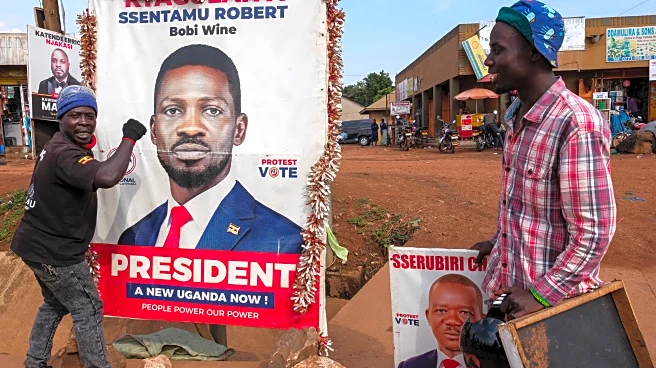




KAMPALA, Uganda (AP) — Where is Bobi Wine?
In a recent video shared from hiding, the Ugandan opposition leader walks in a family graveyard in central Uganda, taunting the army chief who has failed to find him and lamenting what he calls the injustice that has befallen him.
The 43-year-old musician-turned-politician has been evading a military hunt for over a week, infuriating Gen. Muhoozi Kainerugaba — the army chief and president's son — in what has become
a very public rivalry.
Wine went into hiding shortly after Uganda's disputed presidential election on Jan. 15. The vote was marred by an internet shutdown and the failure of biometric voter identification kits meant to prevent ballot stuffing.
Wine, whose real name is Kyagulanyi Ssentamu, has rejected the official results, according to which President Yoweri Museveni won a seventh term with 71.6% of the vote.
He has urged his followers to do whatever is legally possible to show the government has weaknesses despite the massive military presence that accompanied the election.
Ugandan soldiers raided Wine's house the day after the Jan. 15 vote, but the opposition leader had already gone into hiding, fearing for his life after campaigning for weeks in helmet and flak jacket at rallies where security forces were a constant presence.
Wine said his ability to evade the army shows that the government is not as strong as it appears.
“The whole army is looking for one person. It’s now coming to 10 days but they have failed to find me,” Wine said in a video posted on X on Monday. “That means they are not as strong as they tell you.”
That also “means that you, as a Ugandan, you can do whatever is possible without breaking the law. Yes, they call us outlaws, but we are not law breakers," he added.
The hunt for Wine is being led by Kainerugaba — the president’s presumptive heir — who has responded to Wine's taunts by calling him a coward, a “baboon” and a “terrorist.”
He has a yearslong habit of posting offensive tweets, which he often deletes later.
Kainerugaba said on X that Wine and other leaders of his National Unity Platform party are wanted for criminal offenses, but did not specify them.
Yet Ugandan police and government spokesman Chris Baryomunsi say Wine is not wanted and is free to return to his family.
Wine said in his most recent message to his followers that he went to his ancestral home to “to get some love.”
“Another day of hiding. Another day of injustice,” he said. “As I have always said, that in a country under family rule the ruling family is always above the law.”
The exchanges between Wine and Kainerugaba have raised tensions after the election, with many Ugandans worried that an attack on Wine could trigger unrest.
Wine, the most prominent of seven candidates who ran against Museveni, has a large following among young people in urban areas, many of them unemployed or angry with the government over official corruption and the lack of economic opportunities. Many want to see political change after four decades of the same leader.
The opposition were further angered by a Jan. 23 raid in which Wine’s wife Barbara Kyagulanyi says she was roughed up by soldiers at the couple’s house on the outskirts of Kampala, the capital, forcing her to be hospitalized for anxiety and bruises.
Kyagulanyi, who is affectionately known as Barbie, told reporters gathered around her hospital bed that she did not cooperate with the dozens of men in military uniform who demanded to know where Wine was.
She described “a swarm of men” behind masks who broke the door and windows to reach her and then attacked her by lifting her off the floor by her pajamas. One of the intruders banged her head against a pillar, demanding the password to a phone, she said.
Kainerugaba has taken responsibility for the raid but denies that Kyagulanyi was attacked.
“My soldiers did not beat Barbie,” he said on X. “We are looking for her cowardly husband not her.”
Museveni, the 81-year-old leader who is a long-time U.S. ally, has accused the opposition of trying to foment violence during the voting.
He will now serve a seventh term that would bring him closer to five decades in power.
His supporters credit him for the relative peace and stability that has made Uganda home to hundreds of thousands fleeing violence elsewhere in this part of Africa.
___
Follow AP’s Africa coverage at: https://apnews.com/hub/africa