




It only took a few seconds and a tug on a monofilament net for Kaua‘i farmer Fletcher Parker to find a dozen adult coconut rhinoceros beetles in a square foot of mulch on the island’s South Shore.
Over the next few hours, he and roughly 10 others found hundreds of the beetles in the broader mulch pile. Some were adults that had tried to burrow out of the net but lost their heads in the process. Others were wiggling, off-white larvae with large red head capsules.
Dozens of nearby coconut trees showed V-shaped cuts — a tell-tale sign of CRB feeding. Parker said the invasive pest’s damage on Kaua‘i is steadily getting worse. Areas that once had trees with minimal to no damage are now seeing harsher impacts.
“People should be sounding the alarms,” he said.
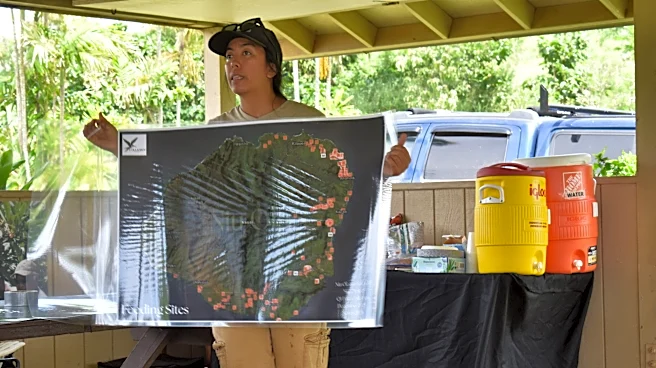
He’s one of a handful of Kaua‘i residents who have been tracking CRB’s spread, documenting impacted niu, or coconut trees, as well as breeding, treatment and trap sites, as part of a community mapping project funded by a $25,000 county innovation grant.
With CRB recently found on Moloka‘i for the first time and rediscovered on Maui, some say the Kaua‘i project is a model for other Hawai‘i community efforts in areas already inundated with the invasive pest.
“With the state resources limited, you know, it always comes down to the community anyway,” said Christine Chow, education and community coordinator for Nā Kahu o Hō‘ai, a nonprofit that maintains Prince Kūhiō Park in Po‘ipū and hosted a recent CRB community workday.
The Niu Ola Kauhale community mapping project is being led by E Ola Kākou Hawai‘i, a Kaua‘i nonprofit dedicated to preserving, protecting and restoring Hawai‘i’s natural resources. The group in 2025 hosted workdays where 20 to 30 participants would help sift through mulch piles to find CRB. Its map is expected to be updated quarterly.
The beetles spend most of their life in decaying plant material, and a single adult female beetle can lay up to 140 eggs in her lifetime. Over two months alone, the group found 166 eggs, 2,539 larvae, 29 pupa and 114 adults during workdays in Wailua, Po‘ipū, Līhu‘e and Anahola.
Nākai‘elua Villatora, the group’s po‘o pani or vice president, said the mapping project is meant to empower and mobilize the Kaua‘i community to collect evidence of CRB’s presence. The goal is that the evidence can help inform solutions, such as targeted mitigation efforts in hotspots.
“We all understand that it really does take all of us as a collective to combat such an invasive pest like CRB,” she said.
Under the project, a designated alaka‘i, or leader, is responsible for surveying in each of Kaua‘i’s four inhabited moku, or districts. They engage in the traditional practice of kilo, or observation. For feeding sites, they look at number of trees impacted, how severe the damage is and how long the damage has been present.
Between December and March, the alaka‘i had contributed over 700 data points to the map. About 70% of impacted trees showed low estimated damage levels, where only one to three fronds showed evidence of CRB feeding.
Their efforts will be supplemented with community-submitted data now that E Ola Kākou Hawai‘i released the first iteration of its public map. Morgan Mott, a Wailua resident, attended E Ola Kākou Hawai‘i’s recent community workday at Prince Kūhiō Park and has already submitted entries for a few damaged trees in her neighborhood.
“I’m excited to see the shift,” she said. “We can all be the change.”
One limitation of community-submitted data is that CRB damage and the pest itself can be mistaken for other things. E Ola Kākou Hawai‘i requires submissions to include photos so Villatora and another volunteer can verify findings. The nonprofit also plans to hold more community workdays and other community conversations so that it can help educate residents on what to look for when they contribute to the map.
Few maps of CRB’s spread exist in the state.
CRB Response, an organization managed through the University of Hawaiʻi, and various invasive species committees within UH’s Pacific Cooperative Studies Unit have maps for their detection trap networks, but little has been done to track feeding, breeding and treatment sites.
Sabrina Day of ‘Āina Ho‘okupu o Kīlauea on Kaua‘i’s North Shore said she admires E Ola Kākou’s ability to get the community moving and recruit key leaders in each part of the island to help spread out the work. The nonprofit received a 2024 Hawai‘i Department of Agriculture and Biosecurity grant to help increase community awareness of CRB.
O‘ahu nonprofit Aloha Organic has a community map, but it’s based on submissions from those who help its founder Daniel Anthony care for niu, around the Ko‘olau Range. While it is open to the public, Anthony said he hasn’t had the resources to do more with it.
He’s glad E Ola Kākou Hawai‘i was able to get grant funding to support its community map and plans to work with the nonprofit to share its model with other islands. Their work is important, he said, because it gives community members the tools to understand how bad of a situation their trees may be in and the potential ways forward, rather than relying on someone else to diagnose and solve the problem.
Arisa Barcinas, an outreach associate with CRB Response, said the Niu Ola Kauhale map is a model for communities in areas with large beetle populations. CRB is considered widespread on both O‘ahu and Kaua‘i.
“I think that’s what a lot of the community has been wanting but isn’t being mapped out too much by any one agency in covering all those things,” she said.
But for areas with little to no CRB, residents should report to the appropriate agencies, like the invasive species committees or the state’s (808) 643-PEST hotline, she said.
Much of Hawai‘i’s CRB response has been hindered by limited resources.
“We don’t have the necessarily resources to hit it on all fronts,” said Jonathan Ho, manager of HDAB’s plant quarantine branch. “It’s picking between bad or worse.”
On Kaua‘i, the department only has three plant quarantine and pest control staffers.
“We’re appreciative that the community is stepping up and biding time while the state is looking into biocontrol agents because that’s realistically the only landscape level solution for CRB,” Ho said. “We’re not going to spray our way out of this.”
Kaua‘i’s Kona moku stretches from Kekaha to Po‘ipū. Chris Ka‘iakapu, the moku alaka‘i, or leader, has been watching CRB spread and is now seeing the impacts hit closer to home. In Hanapēpē, he estimates 15% of trees have some damage.
He said E Ola Kākou Hawai‘i’s map builds on the findings of a two-day field survey conducted by a community group called Niu Now in November. Niu Now’s co-founder surveyed 1,200 coconut trees between Kekaha and Hā‘ena and found heavy CRB damage in Līhu‘e-Wailua, Wailua Homesteads and Kalāheo. One conclusion was that coordinated community efforts can slow or reverse the beetles’ spread.
Ana Espanola, sustainability coordinator with Kaua‘i’s Office of Economic Development, said one of the benefits of a such an effort is that a community group can reach people or areas who might not trust the government.
“It’s really leveraging what they are really good at, which is connecting with community, and we’re both aligned in trying to figure out how to deal with CRB,” she said. “Our weakness is also their strength, so it just makes sense to grant them this award.”
___
This story was originally published by Honolulu Civil Beat and distributed through a partnership with The Associated Press.