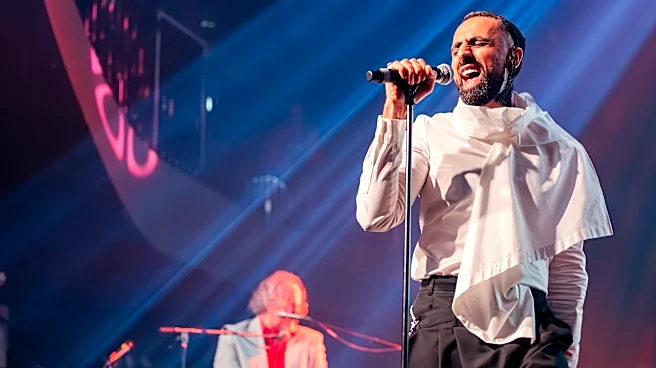






BRUSSELS (AP) — In an ornate Brussels concert hall, Palestinian songwriter Bashar Murad stood before hundreds and delivered a mournful performance of Nina Simone’s “I Wish I Knew How It Would Feel to Be Free” in English and Arabic. When the final notes faded, the audience erupted.
The performance Tuesday evening was part of a protest movement against this week’s Eurovision Song Contest in Vienna, with Israel’s participation sparking anger over its
devastating military campaign in Gaza and elsewhere.
Five nations, including Spain and Ireland, are boycotting the kitschy extravaganza as performers from 35 countries compete in Europe’s annual pop music competition, which marks its 70th anniversary this year. Ten countries including Israel and favorite Finland won places Tuesday in Saturday's final of the contest, whose motto is “United by Music.”
Alternative concerts are taking place across Europe this week, including the “United for Palestine” event in Brussels, where European musicians performed alongside Murad and other Palestinian artists.
“It’s always amazing to be in the same room with people who believe in the same things as you and people who believe that we can’t just let the show go on,” said Murad, who came close to being Iceland’s competitor in 2024.
Murad’s mother and father, a founding member of the influential Palestinian music group Sabreen, unsuccessfully petitioned the Geneva-based European Broadcasting Union, which runs Eurovision, to admit Palestine to the contest in 2007.
Since joining in 1973, Israel has won four times, giving the country visibility at a high-profile event that celebrates diversity. Many Israelis have said they feel they are being unfairly ostracized with the boycotts and other protests.
But Amnesty International secretary general Agnès Callamard said she believes Eurovision should throw Israel out of the competition like it did Russia in 2022 after its full-scale invasion of Ukraine.
“Songs and sequins must not be allowed to drown out or distract from Israel’s atrocities or Palestinian suffering,” she said.
Israel's place in the contest has become contentious as outrage has grown over the carnage in Gaza, the occupied West Bank, Lebanon and Iran, with massive popular protests and European Union politicians mulling new sanctions.
“We have to create an alternative because the participation of Israel is problematic," said Katrien De Ruysscher, founder of the activist group SOS Gaza, which organized the Brussels event along with rights group 11.11.11.
The 2024 Eurovision contest in Malmo, Sweden, and last year’s event in Basel, Switzerland, saw pro-Palestinian protests that called for Israel to be expelled and allegations that Israel's government broke the contest's rules to support its contestant.
Performers are judged by juries in participating nations and viewers around the world, and this year the broadcasting union tightened voting rules in response to the vote-rigging allegations.
But the broadcasting union declined to kick Israel out, spurring five countries — Spain, Ireland, the Netherlands, Slovenia and Iceland — to boycott. Israel's President Isaac Herzog welcomed the union's decision, saying at the time that “Israel deserves to be represented on every stage around the world.”
Organizers of the concert in Brussels said similar events are taking place in Austria, Germany, Slovenia, Italy and Spain.
Spanish public television — which in past years broadcast the Eurovision contest — plans to air alternative broadcasting on Saturday evening. It said the program titled “La Casa de la Música” will be a “tribute to the musical legacy” of the broadcaster, marking its 70th anniversary.
It will feature performances by 20 veteran and newcomer musicians including the winners of a Spanish contest, the Benidorm Fest, who would normally have gone to Eurovision.
However, none of the alternative events will boast an audience like the Eurovision contest, which drew 166 million viewers in 2025 and continues to draw enthusiastic fans this year.
Murad, the Palestinian musician, said he hoped the alternative events can spark some reflection of the pop cultural juggernaut's original mission to unite people through song.
“The purpose of these alternative programs that are happening is to remind Eurovision what it’s actually about and to try to hopefully bring it back, to correct its course and make it actually live up to the things that it claims to be about," he said. “A lot of people in the world feel that the competition has lost its meaning.”
___
Associated Press writer Teresa Medrano contributed from Madrid, Spain.