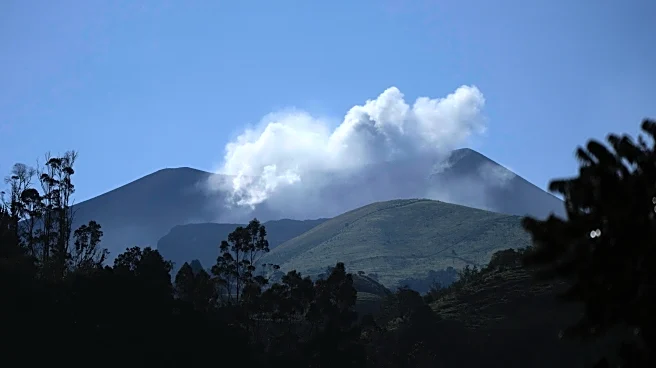

PUCARE, Colombia (AP) — Oliverio Quira often goes to check on his cattle on a plot of land he owns less than a mile from the Purace volcano in southwestern Colombia. There he sits and watches the billowing
ash column rising from the crater.
Despite a recent alert indicating that an eruption is likely in the coming days or weeks due to increased seismic activity at the volcano and the emission of ash columns reaching up to 900 meters (nearly 3,000 feet), he is not afraid.
“I’ve lived on the volcano, I grew up there … so I have no reason to fear it. I’ll keep going there, alert or not. I have to look after my animals,” Quira, 65, told The Associated Press. He is a member of the Purace Indigenous Reserve, a territory belonging to the Coconuco Indigenous people who have traditionally inhabited the volcano’s surroundings.
Still, since the alert issued on Nov. 29, the surrounding community has been on edge. Authorities have sought to prepare for a preventive evacuation of at least 800 people who live on the volcano’s periphery, in scattered homes among the mountains.
The Purace volcano, standing 4,640 meters (more than 15,000 feet) above sea level, is one of Colombia’s active volcanoes, with at least 51 eruptive events since the year 1400. Its most recent significant eruption was recorded in 1977, according to the Colombian Geological Service.
For the Coconuco people, the volcano is sacred and a protective spirit of their territory.
“The volcano is our master; we have no reason to fear it,” said Alfredo Manquillo, deputy governor of the Purace Indigenous Reserve. “That’s why we respect it and perform rituals in its name.”
Rituals include offering the crater corn, sweet plants and a traditional alcoholic drink made from fruit known as guarapo.
For the Indigenous community, the volcano sends them a message when it emits ash, asking for greater care of nature.
“The volcano is saying that we’ve exploited it too much … for about 60 years we took money from beneath it by extracting sulfur, and now with tourism we’re taking money from above it,” he said, referring to a sulfur mine that was closed a few years ago and to ecological hikes to the volcano. “It’s saying: ‘I’m the one in charge, I’m the one with the power.’”
Elders who have witnessed eruptions of the volcano have sought to reassure the younger members of the community who are seeing the volcano active for the first time.
Reinaldo Pizo, 75, was a child when the volcano erupted, hurling rocks. He recalls taking shelter under leafy trees or inside their thatched-roof homes.
His home is located in a risk zone, but he says he would only evacuate if the volcano were to emit poisonous gases.
Purace lacks the infrastructure and logistics needed for a full evacuation, so authorities are working to set up temporary shelters, according to Mayor Humberto Molano Hoyos.
But Manquillo said they also need water storage tanks, food and a solution to protect their livestock and domestic animals, which are vital to the agricultural and ranching community.
“As some of our companions say: ‘If we have to die here, we’ll die here. But we’re not going somewhere else just to die of hunger,’” Pizo said.