





BRASILIA, Brazil (AP) — Brazil’s Supreme Court suspended deliberations Tuesday in a case revolving around one of its justices that is shaking the run-up to the country’s presidential election in October.
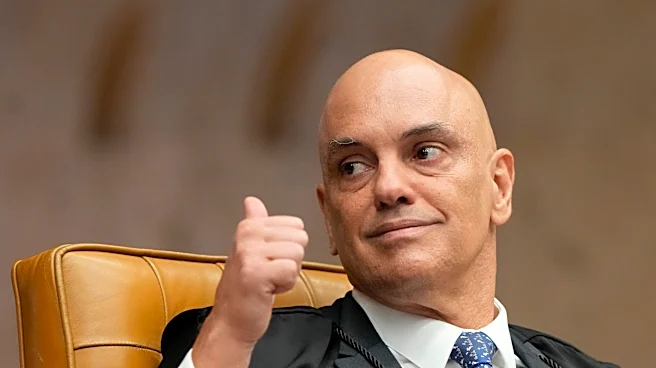
The court was set to decide on whether Justice Alexandre de Moraes, the man who led the trial against former President Jair Bolsonaro, should face an investigation in a graft case.
The session ended with the decision on de Moraes postponed possibly
until mid-December.
That would put it off until well after the vote that is set to have President Luiz Inácio Lula da Silva and Sen. Flávio Bolsonaro, the former president's son, as the most competitive candidates in what is expected to be a close election.
The two Supreme Court justices at the center of an unprecedented crisis at the top court are perceived as being at opposing ends of Brazil’s polarized political spectrum.
De Moraes is facing accusations raised by Justice André Mendonca, Bolsonaro appointee. The cases revolves around his connection to shuttered Banco Master, a case that has ensnared high-ranking politicians and judiciary members.
Mendonca unsealed documents last week showing that the head of Banco Master, Daniel Vorcaro, who is now in prison, sought legal advice from de Moraes as he was about to be arrested. The documents also showed the bank had a contract worth 130 million reais ($23 million) with the law firm of de Moraes’ wife.
Outside the court Tuesday, several dozen Bolsonaro supporters protested, calling for de Moraes to leave the court or be impeached by the Senate. Their presence waned as rain fell on capital Brasilia.
Many Brazilians spent their day glued to their TVs watching the heated discussions among justices, including friction between de Moraes and Mendonca.
In his remarks, de Moraes denied any wrongdoing. He also accused Mendonca of waging a vendetta against him for political reasons, prompting a brief shouting match between the two.
“(Mendonca) is working for a political group that tried to stage a coup in this country,” said de Moraes, who also accused his colleague of requesting the federal police to illegally investigate him and his family. Investigations into Brazilian Supreme Court justices must be authorized by the full court.
Mendonca denied the accusation and said he has acted following Supreme Court regulations.
To start the session, Chief Justice Luiz Edson Fachin read the federal police report previously unsealed by Mendonca. He said he scheduled Tuesday’s session to deal with “a difficult moment” for the court.
“Disagreements are legitimate. Personal confrontations are not,” Fachin said in his opening statements. “The decision is up to the full court, not a single justice.”
De Moraes argued that neither Brazil's federal police nor federal prosecutors had asked Mendonca to investigate him and the court should consider annulling the case against him.
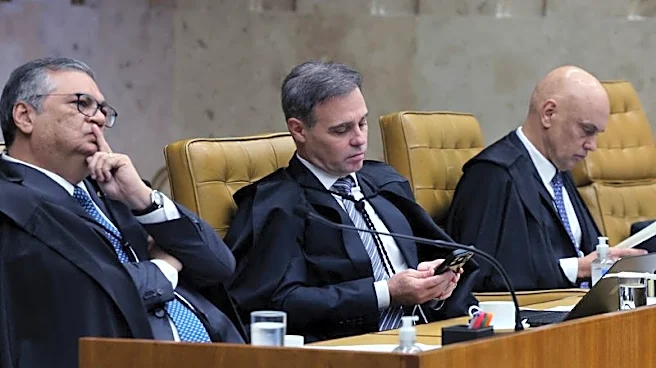
That debate sparked angry exchanges among different justices, which led Justice Flávio Dino to ask for the review that led to postponing the decision.
“I have to stop this situation,” Dino said. “We don't have any condition to decide. This atmosphere can only get worse, and society is watching something different from what the law commands.”
The court did not consider Tuesday whether Mendonca overreached and investigated de Moraes illegally, a claim that de Moraes himself and legal experts have made recently.
Two of the 10 Supreme Court justices requested not to vote on the decision to probe de Moraes.
Kassio Nunes Marques, who heads Brazil’s electoral court, said his position does not allow him to take part in the decision, because its result could impact the campaign trail.
José Dias Toffoli, who previously stepped down from overseeing the Banco Master case because of his links to Vorcaro, also refused to vote. Toffoli once again denied any wrongdoing in his connection with the banker.
Justice Carmen Lúcia, the only woman on the court, tried to steer away from the spats, including some directed at Fachin, who was publicly accused by some of his colleagues of failing to protect the court as chief justice.
“I find myself, like perhaps many of my colleagues, in a state of deep dismay and sadness,” Lúcia said at the end of the session. “I am sad, not only because of the issue that brings us here, but also because this Supreme Court, the guardian of the Constitution, has caused civic unease among all Brazilian citizens in recent days.”
____
Savarese reported from Sao Paulo.
___
Follow AP’s coverage of Latin America and the Caribbean at https://apnews.com/hub/latin-america