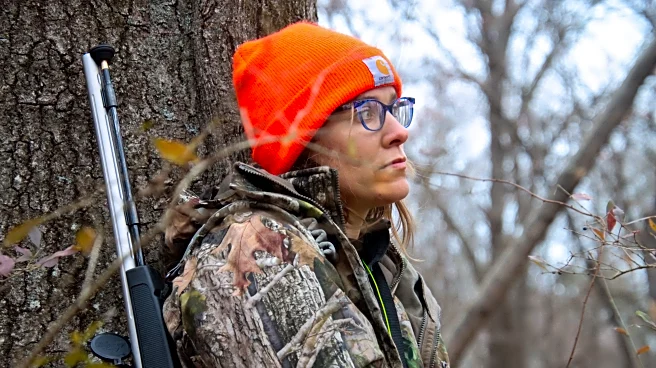




Masha Zabara marveled at what happened to the forest once deer weren’t around to decimate the understory. In the fenced 13-acre site in Southern Columbia County, in New York, wildflowers had become reestablished. Tupelo and sassafras trees rose head high. Red maple stump sprouts and oak saplings thrived.
“It was like stepping out to another planet,” Zabara said. “It was a really beautiful moment, but also a really sad moment.”
In that simple plot, Zabara
saw what ecologists have long warned: deer overpopulation is preventing the Hudson Valley’s forests from regenerating; without intervention, they warn, essential native species will vanish within decades.
Gazing at the forest plot, Zabara, who co-owns the Tivoli clothing store, Thrift 2 Fight, understood for the first time that hunting deer could be an important act for an environmentalist. Together with Red Hook-based native plant and landscape rewilding specialist Zoe Evans, Zabara founded Eco-Hunting Alliance Hudson Valley. The two describe themselves as “eco-hunters,” focused on hunting wildlife in ways that promote healthier ecosystems. Their goal is to bring new hunters into the fold, share sustainable practices with experienced hunters, like using copper rather than lead bullets, and push for regulatory changes that would meaningfully reduce deer populations.
While Evans and Zabara acknowledge that hunters have long served as conservationists, they contend that hunting priorities need to shift. Conservation should focus on the forest, not the deer, they say. Most traditional hunters favor big-racked bucks and kill few, if any, female deer, known as does, a practice that does little to reduce herd sizes. Conserving forests, they argue, requires killing more deer overall, particularly female deer.
Each year, the New York Department of Environmental Conservation (DEC) issues roughly 620,000 permits intended to control deer populations by allowing hunters to kill antlerless deer — a class that includes does and young bucks — yet only about 14% are filled. “That’s a drop in the bucket,” said Eli Arnow, who leads the Forest Health Task Force at the Partners for Climate Action Hudson Valley, a nonprofit that provides financial support to aid local climate resiliency efforts. Arnow plans to help launch a new organization in February, Wild Trust, to raise awareness of the deer crisis and encourage people to take action.
Other approaches to controlling deer populations, Arnow said, include the professional killing of deer in targeted areas, mass sterilization through surgery or birth control delivered by darts, and the reintroduction of natural predators, like wolves. All those options, however, come with limitations and have historically faced public resistance. Hunting, Evans and Zabara say, remains the least controversial way forward while also offering unique benefits. It can foster a deeper connection between hunters and the natural world and provide an inexpensive source of local, sustainable food. Hunters, they believe, can also play a bigger role in land management. Even as hunters need places to hunt, a growing number of landowners are frustrated by voracious plant-eating deer and want to restore ecological balance on their properties. “There is a solution right in front of our noses,” Zabara said.
While existing programs — such as those issuing Deer Management Assistance Permits, Deer Depredation Permits, and Deer Damage Permits — allow landowners and farmers to kill more deer than would otherwise be allowed on their property, many struggle to find hunters willing to fill the tags (meaning to use the permits by hunting deer), according to Evans. Eco-Hunting Alliance Hudson Valley hopes to connect landowners with hunting clubs and individual hunters seeking access to land. On its website, people can sign up in their roles as hunters, aspiring hunters, landowners, or hunting club leaders to receive relevant information.
A century and a half ago, the problem was too few deer, not too many. By the late 1800s, unregulated commercial hunting and forest clearcutting had nearly wiped out white-tailed deer from the Northeast. Early conservationists — many of them wealthy sport hunters — pushed for strict protections to rebuild game populations. New agencies were formed, including the predecessor to today’s DEC, and deer were reintroduced across the state. Their efforts worked.
“Restoring and managing game populations is considered a huge conservation success story,” Arnow said.
However, with little subsistence hunting and few significant predators left due to habitat loss, the deer population has exploded. “Deer populations are likely higher today than they have ever been historically,” Arnow said. Recent aerial drone surveys conducted by the Columbia Land Conservancy found that deer densities on two conserved properties in Southern Columbia County numbered between 65 and 115 deer per square mile — levels that vastly exceed the five to 10 deer per square mile typically needed for forest understories to recover and regenerate.
The result is visible on the ground. A 2020 Nature Conservancy study found that only about 16% of the forests sampled across the state had sufficient populations of seedlings and saplings to support basic regeneration. In testimony before the New York State Legislature, Jessica Ottney Mahar, the Conservancy’s policy and strategy director, identified deer overbrowsing as the most significant threat to forest recovery. The study shows conditions are particularly dire throughout the Hudson Valley.
“This has huge implications for us,” Arnow said. “Forests that can’t regenerate lose beauty, biodiversity — including pollinators and birds — climate resilience, carbon-sequestration potential, and their ability to support local economies.”
Deer overabundance also threatens human life. State data show that an estimated 65,000 deer–vehicle collisions occur in New York State each year.
To begin controlling deer populations, Arnow says more than 60% of does must be harvested (meaning killed for food) each year. “We’re nowhere near that,” he said. Killing does is more effective than killing bucks for population management because females are the primary reproductive members of the herd, birthing, on average, one to two fawns annually. In Western Dutchess County, an average of only about .7 antlerless deer were harvested per square mile last year, according to the DEC. Ecologists are calling for 50 times that in some areas.
The DEC has taken some modest steps toward herd reduction in recent years. Its 2021 deer management plan called for 25% population reductions in Dutchess County and other regions. The DEC has since added a week of bow and muzzleloader deer hunting in late December; allowed deer hunting an hour later in the day, from 30 minutes before sunrise until 30 minutes after sunset; established a nine-day mid-September window for antlerless deer hunting in parts of the state; and broadened opportunities, particularly for youth hunters, to earn additional antlerless tags. And this year, in response to frozen SNAP benefits during the government shutdown, the DEC issued a request for hunters to donate their venison to help food pantries meet rising demand.
The Dutchess County Federation of Fish and Game also runs a program called Hunters for the Hungry, which collects, processes, and distributes thousands of pounds of donated venison each year to those in need. Evans and Zabara applaud the effort since effective deer management will require killing more animals.
But getting hunters to take more female deer is challenging. The tradition of prizing bucks for their trophy antlers dates to early 20th-century efforts to rebuild deer populations. Traditional hunter advocacy groups, which are well-organized and politically connected, often oppose efforts to control the population.
Policy proposals and regulatory changes to encourage doe hunting include legalizing the sale of wild venison to incentivize higher harvests, adopting an “earn-a-buck” system requiring hunters to take a doe before shooting a buck, further extending the hunting season, eliminating bag limits, and creating tax incentives for landowners.
Yet, not all hunters support those ideas. Joseph Varlaro, a lifelong hunter, former owner of Northern Dutchess Archery in Rhinebeck, and longtime member of the Neighbors Gun Club hunting group, said wildlife must be kept in “balance” — and believes hunters have long played a crucial role in maintaining that balance. But he calls proposals like legalizing the sale of wild game, “a recipe for disaster” because of the potential for overharvesting. “You don’t want the numbers to drop to the point where there are no deer,” he said. For new hunters, he added, one of the most discouraging experiences is spending a day in the woods without seeing a deer.
Michael C. Mayes, a Clinton Corners resident who has been hunting since childhood, agrees with Evans and Zabara on the underlying issue: deer populations need to be controlled. He also believes that many hunting regulations are outdated. Mayes supports several of the reforms eco-hunters have proposed to modernize management and also stresses the humane side of herd reduction. “If you don’t control the herd, they will kill themselves by having no food,” Mayes said.
He added that he is drawn to hunting because of the challenge and his deep appreciation for deer as animals. “It’s not really about killing an animal,” he said. “It’s about learning about the deer.” Evans, too, has found developing a deeper understanding of deer and how they move through the environment to be deeply fulfilling. At a time when many people feel distant from the land and where their food comes from, the act of spending long, cold mornings in the woods — when the only thing to do is sit still, listen, and pay attention — has satisfied her craving for a closer, more reciprocal relationship with the natural world. She said many newcomers have been drawn to the sport for that reason, too.
But for Mayes, bucks — not does — remain the ultimate quarry. “I tend to go for the more mature bucks,” he said. “They’re smarter, they’re wiser. It’s more of a challenge.” He lets smaller bucks pass, hoping to see them grow into older, trophy-sized animals. If he has the option between a doe and a buck, he’ll almost always take the buck. If a doe is traveling with young fawns, he’s particularly hesitant to shoot.
As environmentalists call for more aggressive population control, Varlaro cautions that deer abundance is intensely local. Diseases such as Epizootic Hemorrhagic Disease (EHD), which peaked locally in 2021, have wiped out local herds in some pockets, said Varlaro, who hunts close to 40 days per year and previously worked with the DEC’s deer management operations. In many areas, the population has rebounded from the disease, but not everywhere, he said. In his view, the DEC should avoid broad-brush permit increases and instead manage deer on a zone-by-zone basis. Coyotes and bears, who eat deer, are also rebounding, he said, which may help control populations.
That’s why both ecological hunters and traditional hunters increasingly say New York needs better local modeling that tracks forest regeneration and deer populations. Only with that kind of data, they argue, can deer management be tailored to real conditions on the ground. “You can’t manage what you can’t measure,” Arnow said.
Zabara hopes the two camps — traditional and ecological hunters — don’t talk past each other. “There are more points that connect us than divide us,” Zabara said.
Evans, who started hunting last year, faced challenges as she first tried to enter the sport. She had been interested in hunting since childhood, but raised in New York City, she had no way to learn. “I didn’t grow up with a hunting family. I didn’t have hunting connections,” she said. “And I felt pretty intimidated.” The missions of local hunting clubs to collect trophies didn’t fully resonate.
After meeting Arnow, Evans found mentorship and a way forward. Once on her feet, she joined Neighbors Gun Club and came to see that the group’s mission, and that of many local hunting organizations, “is not that far off” from her own.
Bringing new people to hunting is particularly crucial for deer management because across the state, the number of hunters is dwindling. Today, just over 500,000 New Yorkers hold licenses for hunting deer and other animals, far below levels in the mid-20th century. Less than 3% of total New Yorkers hunt, and most are baby boomers, rapidly aging out of the activity. “We’re facing a hunter demographic cliff,” Arnow said.
Evans and Zabara want Eco-Hunting Alliance Hudson Valley to be an organization to which beginners turn for mentorship and community, as well as opportunities for workshops on gun safety, tracking animal movement, tanning hides, rituals of gratitude, and preparing venison.
Deer hunting is an experience more people should have, they believe. The first time Evans shot a deer, she was alone in the woods behind Arnow’s home. Overcome with adrenaline, she rushed toward the fallen animal. She only had 30 minutes to gut the animal before bacteria could start to grow. “All of my attention narrowed,” she said. “It’s probably the most present I’ve ever been.”
Evans sees ecological hunting as a modern expression of an older relationship to the land, one in which humans acted as stewards rather than passive observers. Humans have reshaped and degraded local ecosystems, and she believes they have a responsibility to play a hands-on role in restoring them. “The deer have changed, the landscape has changed, and the way we hunt has to change, too,” Evans said.
___
This story was originally published by The Daily Catch and distributed through a partnership with The Associated Press.