
BANGKOK (AP) — Asian shares advanced on Wednesday as strong buying of technology shares helped lift some benchmarks, while oil prices surged more than 1% after President Donald Trump ordered a blockade
of all “sanctioned oil tankers” into Venezuela.
Trump's move followed the seizure by U.S. forces last week of an oil tanker off Venezuela’s coast, an unusual move that followed a buildup of military forces in the region as his administration ramps up pressure on the country’s authoritarian leader Nicolás Maduro.
U.S. futures edged higher.
Tokyo's Nikkei 225 gained 0.3% to 49,512.28 as traders awaited a decision on an interest rate hike by the Bank of Japan later in the week.
Japan reported its exports rose 6% in November from a year earlier, as shipments to the U.S. rose for the first time since March. A trade deal with the Trump administration that set tariffs on imports from Japan at a baseline rate of 15%, down from the initial plan for a 25% helped boost exports of cars and chemicals, among other key manufactured goods.
Hong Kong's Hang Seng climbed 0.7% to 25,414.61, while the Shanghai Composite index jumped 1.2% to 3,870.28.
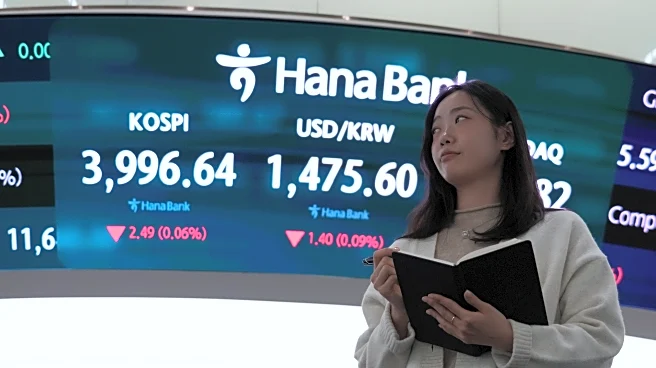
In South Korea, the Kospi advanced 1.4% to 4,056.41, lifted by computer chip maker SK Hynix, which gained 4%, and a 5% jump for Samsung Electronics.
Australia's S&P/ASX 200 gave up 0.2% to 8,585.20.
On Tuesday, U.S. stocks drifted through a mixed day of trading after reports on the U.S. economy did little to clear up uncertainty about where interest rates may be heading.
One report said the U.S. unemployment rate was at its worst level since 2021 in November, but employers also added more jobs last month than economists expected. A separate report, meanwhile, said an underlying measure of strength for revenue at U.S. retailers grew more in October than economists expected.
The S&P 500 slipped 0.2%, staying a bit below its all-time high set last week. The Dow Jones Industrial Average dipped 0.6% and the Nasdaq composite rose 0.2%.
The varied economic data left intact traders’ hopes that the Federal Reserve may continue to cut interest rates in 2026. What the Fed does with interest rates is a top driver for financial markets because lower rates can boost the economy and prices for investments, even if they also may worsen inflation.
A report coming on Thursday will show how bad inflation was last month, and economists expect it to show prices for U.S. consumers continue to rise faster than anyone would like.
A report released on Tuesday suggested price pressures are rising sharply, with average selling prices for businesses climbing at one of the fastest rates since the middle of 2022. The preliminary data from S&P Global also said growth for overall business activity slowed to its weakest level since June.
The sharpest losses on Wall Street came from companies in the oil business as prices for crude skidded. Expectations that companies are pumping more than enough oil to meet the world’s demand sent the price for a barrel of benchmark U.S. crude to its lowest level since 2021.
APA’s stock sank 5.2%. Marathon Petroleum sank 4.7% and Halliburton dropped 4.3%.
Early Wednesday, U.S. crude was up 86 cents, or 1.6%, at $56.13 per barrel. Brent crude, the international standard, picked up 84 cents, or 1.4%, to $59.76 per barrel.
Artificial-intelligence technology stocks were mixed. Oracle rose 2%, and Broadcom added 0.4%. They both logged sharp losses last week, despite reporting stronger profits for the latest quarter than analysts expected.
CoreWeave, which rents out access to top-of-the-line AI chips, fell 3.9%.
Questions remain about whether all the spending underway on AI technology will produce the kind of profits and productivity that will make it worth the expense.
In other dealings early Wednesday, the U.S. dollar rose to 155.46 Japanese yen from 154.73 yen. The euro slipped to $1.1707 from $1.1748.