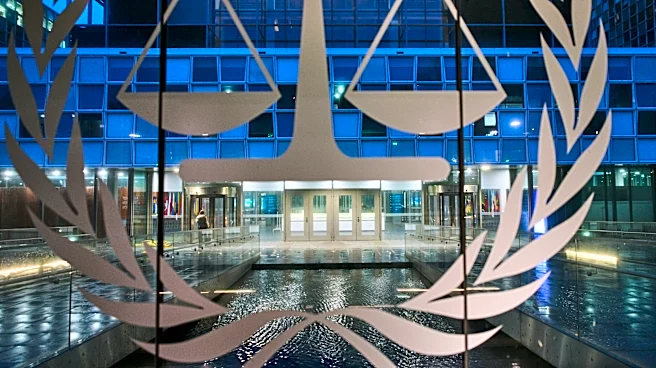









THE HAGUE, Netherlands (AP) — As member nations of the International Criminal Court prepare to vote Friday on whether to permanently remove the global tribunal's embattled chief prosecutor, concerns are emerging about the damage the drawn-out scandal has already inflicted on the already beleaguered institution.
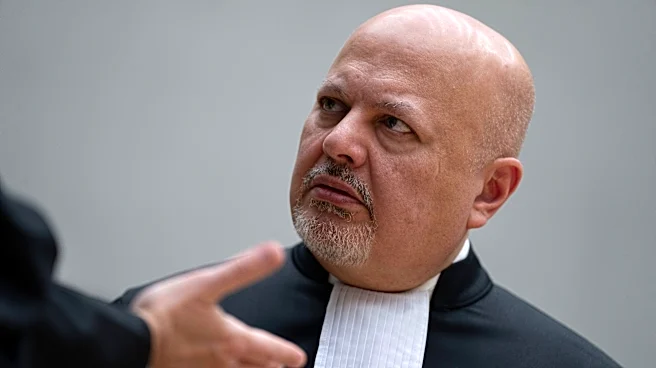
In a saga that has dragged on for more than two years, British barrister Karim Khan has been accused of sexual misconduct with a female aide,
as outlined by The Associated Press in a series of stories, allegations which he has steadfastly denied.
The lengthy and complicated process has pitted human rights advocates, staff and member states against one another at a time when the court is already facing daunting challenges, including a campaign by the United States to “ dismantle ” the ICC, which was established to prosecute people responsible for humanity's worst crimes.
The 56-year-old Khan was formally removed from his duties at the ICC in June after a report by the executive committee of the court’s oversight body found he had committed “serious misconduct.” According to documents seen by The Associated Press, Khan engaged in a sexual relationship with the woman and tried to prevent her from pursuing her allegations. Khan disputes those findings.
“There has been splintering over how the court has handled this,” Lucy Gaynor, a historian of international criminal tribunals at the University of Amsterdam, told The Associated Press.
Groups that support the court’s work have taken diverging positions. Last week, a group of Palestinian organizations issued a public letter, accusing the executive committee of “unwarranted political interference” and said it lacks “the independence, impartiality or legal expertise to make assessments.”
In June, the International Federation for Human Rights, Redress and Women’s Initiatives for Gender Justice with others said that the victim has been “publicly questioned, instrumentalized, and too readily dismissed as part of a political agenda.”
Staff members are also wary of the future. A group within the prosecutor’s office sent a letter to the oversight body expressing serious concerns about Khan’s potential return, writing that his “leadership has been materially diminished.”
Prominent international figures have also been voicing their views. In an opinion piece in Project Syndicate, former EU foreign policy chief Josep Borrell said the allegations are a plot against the court. “Khan’s enemies have managed to start a debate about his potential removal, with allegations of sexual misconduct serving as the tip of the spear,” the Spanish diplomat wrote.
Kenneth Roth, the former executive director of Human Rights Watch, has taken an entirely different stance, writing on social media that Khan “clearly does not” have “the moral authority and credibility to continue serving as prosecutor.”
Khan himself has given a series of interviews denying the allegations and arguing they are part of a conspiracy against him for his investigation into Israeli officials. In an interview with CNN last week, the female staffer strenuously denied this. A United Nations investigation report seen by the AP said that “multiple credible witnesses dismissed the notion that she was a spy.”
Now his future lies in the hands of the 125 nations who make up the court’s oversight body, the Assembly of States Parties. They are holding a special session in New York that will culminate in a vote where a majority would need to support a resolution to oust him.
The outcome of the vote, which is secret, is unclear. The court’s host state of the Netherlands will vote for his removal, as will France, the only two countries to have made their decision public.
In a letter to Parliament last week, Dutch Foreign Minister Tom Berendsen indicated that there was sufficient support to remove Khan. “Although the balance of power within the ASP is still evolving, the position of most contracting parties also appears to be in line with the recommendation of the ASP Office,” he said.
Whatever its member states decide, the court is facing more turbulent times ahead. The Trump administration, which has already sanctioned key ICC staff including Khan, seeks to further destabilize the 24-year-old tribunal that it claims is a challenge to US sovereignty.
Regardless of the outcome, “the court is going to walk away bruised and battered and wounded and less able to face the greater threats ” Iva Vukusic, a researcher at Utrecht University who has been following the process, told the AP.