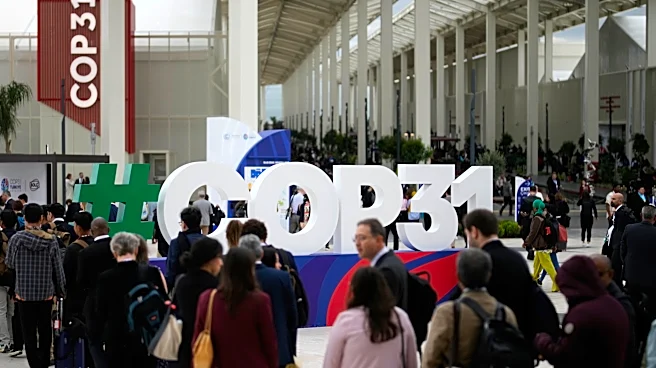





ANTALYA, Turkey (AP) — This year's U.N. climate talks are wrapping up in Turkey, with negotiators still debating how to address global warming and experts warning that only slashing fossil fuels can avert its most catastrophic effects.
Activists and country leaders were in an uproar Friday, the last scheduled day of the two-week summit known as COP31, after the term “fossil fuels” was left out of the final agreement’s draft.
Climate summits often end
with a final text, meant to address how the world will deal with climate change. Such agreements — often adopted by nearly 200 nations — are still voluntary and non-binding.
Negotiators, who pulled an all-nighter from Thursday into Friday, said they expect COP31 to go into overtime on Saturday.
Past COPs have failed to agree on how to transition away from fossil fuels — coal, oil and gas — that warm the planet, heat the oceans and worsen air quality. Climate change also intensified several of this year's disasters, like Europe’s deadly heat waves and Nepal’s devastating flooding.
If phasing out fossil fuels doesn't make it into the final agreement, this year’s summit runs the risk of being the “worst COP ever,” said Mohamed Adow, director of Power Shift Africa.
In a rare move, Panama vowed to “formally object” if the final agreement doesn’t add climate finance, cap oil production and acknowledge failing goals, among other demands. The country's Environment Minister Juan Carlos Navarro said the talks are being held hostage by a “petroleum mafia” and need to be reformed.
“The COPs have become an exercise in hypocrisy and futility,” he said. “What we have here is a contest to see who speaks the most, who blows the most hot air.”
In the lead up to COP31, the United Nations announced the world is dangerously close to missing its decades-old goal of limiting global warming to 1.5 degrees Celsius (2.7 degrees Fahrenheit) above pre-industrial temperatures.
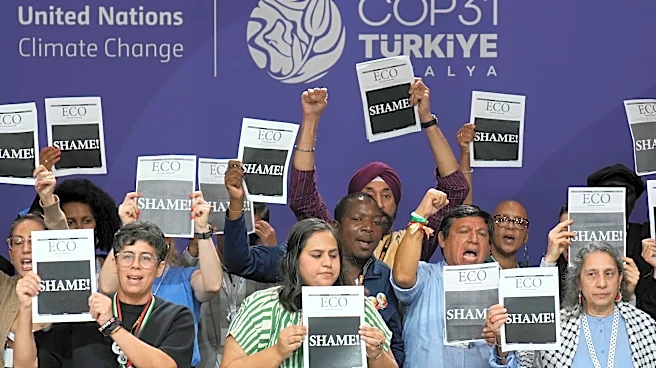
“There is nothing on the table that protects people, or addresses the priorities of the Global South,” said Tasneem Essop, executive director of Climate Action Network International, at a Friday event, where attendees chanted and held signs that read “SHAME!”
One of the main deals on the table at COP31 is an electrification goal to increase the share of electricity in total global energy consumption from roughly 21% today to 35% by 2035.
But the final draft doesn't spell out that this should be reached with renewable energy sources, like solar and wind — leaving the door open for fossil fuel power plants to be counted as part of an electrification push.
“At a time when the climate crisis demands decisive action, weakening commitments on fossil fuel phase-out risks undermining progress,” said Ghiwa Nakat, executive director of Greenpeace in the Middle East and North Africa.
The U.N. has hosted climate talks for more than 30 years but it was only in 2021 during COP26 in Glasgow, Scotland, that nations first acknowledged fossil fuels contribute to climate change.
Two years later during COP28 in Dubai, United Arab Emirates, countries explicitly called for a transition away from fossil fuels for the first time.
Turkey and Australia, co-hosts of COP31, are being roundly criticized for removing fossil fuels from the final text's draft.
“We are not here to discuss decisions at previous COPs,” said Turkey's Minister of Environment Murat Kurum, who is overseeing the summit held in the Turkish resort town of Antalya. The electrification push implies a transition away from fossil fuels, he said.
“Removing those words from a document will not remove the pollution from the atmosphere," said Adow of Power Shift Africa. “It simply exposes how far these negotiations have become detached from what is needed outside this conference center.”
Leaders from countries ravaged by climate change — mostly poorer, vulnerable nations that don't emit a lot of greenhouse gases — have said that rich countries are not providing previously agreed upon funds to deal with climate change.
They said that U.N. funds for adapting to climate risks, dealing with climate impacts and funds for clean energy infrastructure don’t match what the U.N. has said these countries need.
The draft agreement states the need to triple the amount of money for countries adapting to climate impacts, but it doesn’t specify how much. One of the draft's previous versions stated at least $120 billion would be needed annually.
Many of the world's most polluting nations did not participate directly at this year's talks, including the United States, the world’s largest economy and a major emitter.
It's richer nations, like the U.S., that vulnerable countries want funding from — and it's hard to ask for funds without American officials in the room.
Efforts to slow global warming have essentially stalled for the past five years, according to a recent report by the nonprofit Climate Action Tracker.
“Disappointment is rife," said Iskander Erzini Vernoit, an adviser to African negotiators in Turkey. Next year’s climate summit is scheduled to take place in Ethiopia’s capital, Addis Ababa, in November 2027.
“Hope is not lost, but absent a course correction, we are headed toward a low-ambition set of outcomes at COP31,” he said.
___
Delgado reported from Bangkok, Arasu from Bengaluru, India, and Milko from Islamabad, Pakistan. Associated Press writer Tammy Webber contributed to this report from Fenton, Michigan.
___
The Associated Press’ climate and environmental coverage receives financial support from multiple private foundations. The AP is solely responsible for all content. Find AP’s standards for working with philanthropies, a list of supporters and funded coverage areas at AP.org.