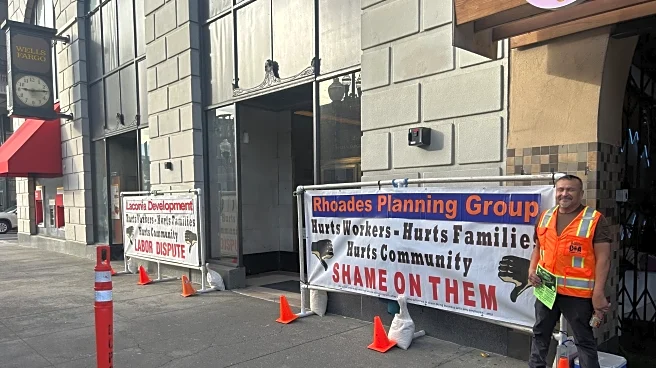




The Berkeley City Council reluctantly signed off Monday night on two proposed high-rise developments that use a state housing law to sidestep local labor standards.
Two labor groups had called for Berkeley leaders to approve the projects but reject their developers’ attempts to use California’s “density bonus” law to dodge a union-backed ordinance Berkeley adopted in 2023 mandating that builders of large projects provide health care coverage for workers
and apprenticeship programs. The state law requires cities to give builders exemptions from certain local regulations if their projects include affordable housing.
Developers Collab Home and Laconia Development say abiding by the ordinance would cost millions of dollars and mean they might never actually build the projects, a 20-story complex on Durant Avenue in the Southside neighborhood and a 23-story building on University Avenue in downtown Berkeley. Attorneys for the developers told the City Council that the state law grants them broad authority to bypass Berkeley’s mandates, and the city doesn’t have the power to block their use of it.
Council members, some of whom voted to approve the health care and apprenticeship requirements, said they were sympathetic to the appeal from the labor groups.
But several members agreed that the state law meant they couldn’t force the developers to follow the requirements, and were wary the companies could take the city to court if they tried to do so. At a time when Berkeley faces a budget deficit estimated at $30 million, the council wasn’t interested in picking that potentially costly fight.
“I don’t think the legal justification is there to deny the concessions,” Councilmember Rashi Kesarwani said. “The city is not in a position to take on the cost of expensive litigation, when we know at the outset that we are likely to fail.”
The debate Monday night centered on a 169-unit project at 2425 Durant Ave. from Berkeley-based Collab Home, and a project at 2029 University Ave. from Laconia, a Walnut Creek firm that proposed two versions of the project. One would include 240 units and have more studio and one-bedroom apartments; the other, with larger apartments, would have 160 total units.
A third project that also sought exemptions from the labor standards, at 2298 Durant Ave., was scheduled to be discussed Monday night but has been withdrawn by developer Valiance Capital, Mayor Adena Ishii said.
Plans for the 2425 Durant Ave. project call for including 32 units that would have below market rate rents, while the University Avenue project would have either 24 or 36 affordable units depending on which version of it is built.
Those affordable units allowed the projects to claim an array of deal-sweeteners under the density bonus law. Each requested exemptions from the health care and apprenticeship ordinance, known by the acronym “HARD HATS,” or Helping Achieve Responsible Development with Healthcare and Apprenticeship Training Standards.
The Durant Avenue project also sought to disregard another requirement supported by construction unions that projects in the Southside neighborhood pay workers prevailing wage. And the University Avenue project claimed an exemption from a mandate to use glass that is designed to prevent birds from flying into windows.
Laconia has said the requirements would add more than $5 million to the cost of its University Avenue project. And development consultant Mark Rhoades told the council Berkeley’s mandates would add $16.6 million in costs to the Durant Avenue project, including nearly $13 million from the prevailing wage requirement alone. Union officials disputed those estimates, which they said inflated the true cost of the requirements.
“This is an extreme, up-front cost that is difficult — impossible — to commit to,” Rhoades said.
Each project was approved by Berkeley’s Zoning Adjustments Board, but those decisions were appealed by the Building and Construction Trades Council of Alameda County and the Northern California Carpenters Regional Council. The groups argued Laconia and Collab Home were abusing the density bonus law, which they said was meant to apply to physical limitations on development, not labor standards.
In the weeks leading up to Monday’s meeting, union members protested outside City Hall and the downtown offices of Rhoades’ firm, holding signs and handing out fliers accusing the developers of seeking to exploit workers. Union members and officials in work vests attended the meeting, telling the council that Berkeley’s labor standards would ensure workers get quality training and have coverage if they’re injured on the job.
“I can afford to live in Berkeley, (which) I love, because I’ve been given these opportunities through apprenticeships, through a living wage, through health care,” carpenter Stephanie Lind said.
The Durant and University projects are some of the first that would be subjected to the HARD HATS ordinance, which applies to projects submitted since 2024, and union leaders fear other developers will follow their strategy of using the state law to nullify Berkeley’s mandate.
“The original legislative intent of the density bonus law was to allow developers to build more affordable units as a social good,” attorney Jolene Kramer, who represented the Building and Construction Trades Council, said Monday. “Allowing a developer to avoid a labor standards requirement will do the opposite.”
The developers’ attorneys said the density bonus was written with intentionally sweeping language that lets builders exempt themselves from costly mandates that would otherwise stifle housing production.
“Approval, in this instance, is mandatory,” attorney Todd Williams told the council.
Even if they couldn’t compel the developers to follow Berkeley’s mandates, some council members said they still weren’t willing to vote in favor of the projects.
“We all have red lines, this is mine — I cannot in good conscience support housing that will be built on the backs of the workforce,” said Councilmember Igor Tregub.
He and others said state lawmakers should pass new legislation to rein in how developers use the density bonus law and prevent future projects like the ones on Durant and University avenues.
State Sen. Jesse Arreguín, who as mayor of Berkeley led the push to pass the HARD HATS ordinance and drew on support from unions in the building trades during his run for Sacramento, backed the effort to force the projects to comply with the ordinance. In a statement provided by a spokesperson Tuesday, Arreguín wrote that he was disappointed by the council’s decision and is “considering introducing legislation to amend the state density bonus law to close this loophole.”
The council’s opposition to the projects proved only symbolic. The Durant Avenue project was approved with five votes in favor, from Ishii, Kesarwani, Brent Blackaby, Mark Humbert and Cecilia Lunaparra; Tregub joined Terry Taplin, Ben Bartlett and Shoshana O’Keefe in abstaining from the vote.
When the University Avenue project came up for a vote, five council members — Taplin, Bartlett, Tregub, O’Keefe and Blackaby — abstained, while Kesarwani, Lunaparra, Humbert and Ishii voted yes. Because the vote failed and the council officially took no action, the zoning board’s decision to approve the project with the concessions stands, and the development can move forward.
___
This story was originally published by Berkeleyside and distributed through a partnership with The Associated Press.