




ROME (AP) — Italy’s government passed a decree Thursday to place an upper limit on the number of students in each school classroom who have only limited Italian language skills and to ban face-covering Islamic veils in schools.
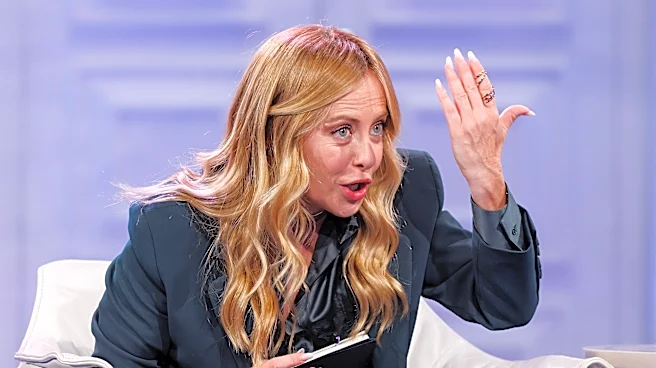
Premier Giorgia Meloni’s conservative government said the package is aimed at strengthening integration through language learning and has drawn support from right-wing allies.
Opponents including some educators, unions and opposition
parties warn that new rules could force students to attend schools far from their neighborhoods, while critics accuse the government of turning immigration into a political issue.
With elections possible as early as next spring, analysts say the measures allow the premier to reassert her credentials on issues central to her conservative base, even though their impact is likely to be limited and significant questions remain about how they would be enforced.
Under the plan, a limit of 30% of foreign students lacking sufficient Italian proficiency would be allowed in any individual classroom.
The government decree goes into effect immediately but needs to be endorsed within 60 days in parliament, where Meloni's coalition commands a majority.
Meloni wrote on social media that they are “common-sense measures that do not divide but help foster genuine integration, avoiding ‘ghetto’ classrooms and giving all students equal opportunities.”
The decree comes as Meloni faces mounting pressure on her right flank from a new hard-line challenger, retired army Gen. Roberto Vannacci, who has been seeking to capitalize on voter concerns over immigration and national identity.
Education Minister Giuseppe Valditara said local school authorities will coordinate student placements to avoid concentrations of non-Italian-speaking pupils, while schools unable to comply would be eligible for exemptions and additional language-support funding.
The minister says it would affect around 1,000 classrooms, about 0.3% of the total nationwide, and primarily those with high concentrations of recently arrived students with little or no Italian-language proficiency.
School principals questioned how the measure could work in areas with large migrant populations.
“From an educational perspective, the issue is well-founded and valid, but it’s difficult to turn it into a practical solution,” Antonello Giannelli, president of the National Association of Principals, said in public comments following the government’s proposal earlier this week.
Schools are required to enroll local children, he noted, asking: “If the majority of pupils in that area are foreign nationals, what are we supposed to do? Send them away?”
Teachers’ unions criticized what they called a lack of both consultation and resources for the measure. They argued that the government’s 14-million-euro ($16 million) funding package would not be enough to hire specialized language teachers and cultural mediators needed to support students.
According to Education Ministry data, students without Italian citizenship accounted for 11.2% of Italy’s school population in the 2022-23 academic year, while classes with more than 30% foreign students represented 7.6% of the total.
Foreign students who were born in the country would be exempt from the cap, along with those who attended Italian preschool or have already progressed through the school system.
The decree also bans burqas and niqabs in schools while continuing to allow hijabs.
The measure is narrower than restrictions adopted in some other European countries.
France banned full-face veils in public spaces in 2011, citing public security concerns, despite the small number of women affected. France also prohibits students from wearing conspicuous religious symbols, including Islamic headscarves, in public schools under its strict secularism doctrine.
Critics in Italy said the provision addresses a phenomenon rarely seen in Italian classrooms. Educators noted that while headscarves are common among some Muslim students, full-face veils are seldom seen in schools, and they argued that the provision risks becoming a symbolic political issue rather than an educational one.
Opposition parties also said the 30% threshold largely mirrors guidance already introduced by the Education Ministry in 2010, noting the government was repackaging an existing policy rather than investing in struggling schools. Center-left leader Elly Schlein accused the government of using schools to advance a political message on migration.
Valditara, the education minister, rejected those criticisms, saying the goal is integration through language acquisition and stronger educational support.
The decree provides additional teaching resources for schools where newly arrived foreign students exceed 20% of enrollment and additional language-learning funds for schools exceeding the 30% threshold.
It also would require some parents of foreign students to attend Italian-language courses when language barriers within families contribute to educational or behavioral difficulties.
Schools would refer eligible families to social services, which could enroll them in a tailored support program through adult education centers. Parents who fail to attend the courses could face fines ranging from 200 to 1,000 euros, although exemptions are included for those with certified age-related, medical or disability-related barriers to language learning.