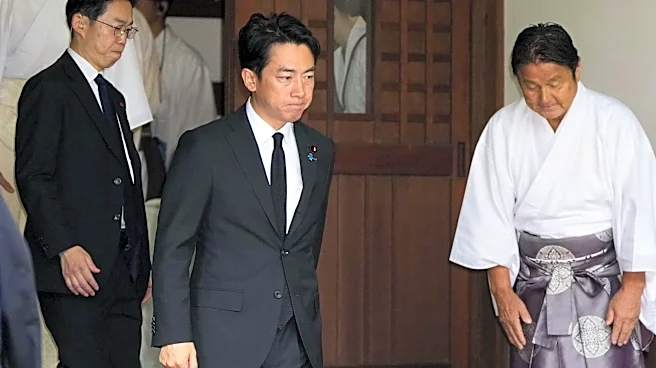






TOKYO (AP) — The Japanese defense minister on Saturday prayed at Tokyo’s Yasukuni Shrine, seen by Japan’s Asian neighbors as a symbol of the country’s past militarism. Prime Minister Sanae Takaichi, despite her repeated past pledges for a visit on the day marking Japan's surrender, is expected to stay away to avoid diplomatic tensions.
Visits by Japanese politicians to the shrine, which also commemorates World War II criminals, have been criticized
by China and South Korea. They see it as a move that shows their lack of remorse over Japan’s wartime atrocities.
Defense Minister Shinjiro Koizumi has regularly been at the controversial shrine to mark Japan's anniversary of the end of the war on Aug. 15 and other occasions. But as a defense minister pushing to increase Japan’s military capability and weapons sales under Takaichi’s hawkish government, his visit Saturday is seen as more contentious.
Koizumi did not comment on the visit and walked past journalists at the shrine.
He is the son of popular former Prime Minister Junichiro Koizumi, who outraged China when he visited Yasukuni as a serving leader in 2006.
Attention this week was on whether Takaichi, who has repeatedly said she would pray at the shrine on Aug. 15 despite the controversy, would keep her pledge and show up at Yasukuni on Saturday, when Japan marks its surrender that ended the war 81 years ago.
Earlier this week, Chief Cabinet Secretary Minoru Kihara said Takaichi would make an appropriate decision, followed by Japanese media saying she would stay away from the shrine to keep Japan’s already difficult ties with Beijing from further worsening and maintain good ties with Seoul.
The focus will shift later Saturday to how Takaichi describes the wartime history in her first address as prime minister at a national ceremony marking the surrender.
Takaichi has repeatedly resisted acknowledging Japan's wartime aggression and atrocities, and denied that coercion was used against Korean laborers and women held as sex slaves for Japanese troops. She was previously part of a campaign to remove references to wartime sexual slavery, euphemistically known as “comfort women,” from school textbooks.
She has said she is from the postwar generation who has no responsibility for Japan's past actions and that she has no intention to apologize.
The country has faced revisionist pushbacks since the 2010s under nationalistic former Prime Minister Shinzo Abe, who pushed to correct a “self-deprecating view” of Japan’s wartime history and regain national pride. Takaichi considers Abe a mentor.
Since 2013, Japanese prime ministers have stopped apologizing to Asian victims for wartime atrocities, under a precedent set by Abe. Last year, however, former Prime Minister Shigeru Ishiba expressed “remorse” over the war and called it a mistake, though he fell short of mentioning Japan's aggression across Asia or apologizing.