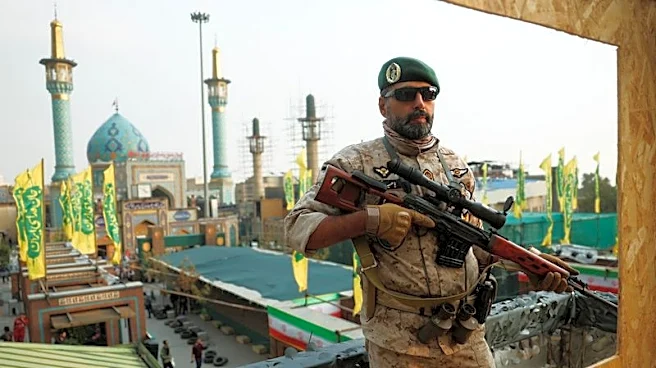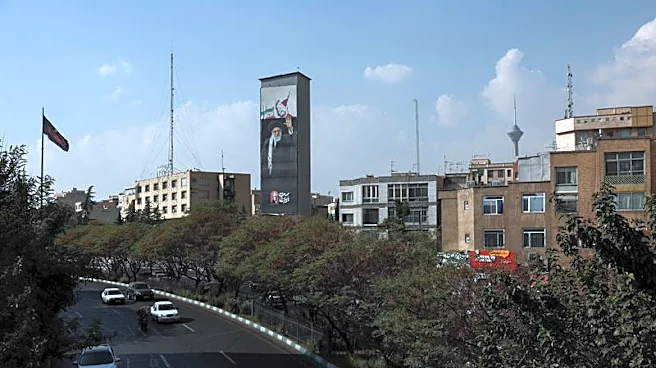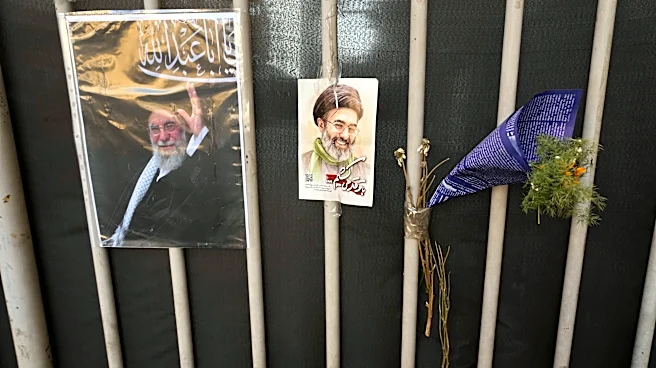




Iran’s top diplomat spoke with Persian Gulf leaders in a series of calls Thursday as the region remains tense over whether the U.S. will renew full-scale operations in the Iran War.
Russian President Vladimir Putin met Thursday with the head of Iran’s Supreme National Security Council. Meanwhile, U.S. President Donald Trump conferred with Iraqi Prime Minister Ali al-Zaidi about efforts to support regional stability, according to the prime minister's
office.
Here is the latest news from the Middle East on Thursday. Read our full coverage here.
Iran Foreign Minister Abbas Araghchi held phone calls on Thursday with Turkey and several Gulf leaders.
Araghchi spoke with Saudi Foreign Minister Faisal bin Farhan about efforts to improve security and stability in the region, according to the Saudi foreign ministry.
In a separate call, Araghchi talked with Qatar's foreign minister about coordinating to reduce tensions, the Qatari foreign ministry said. The Qatari leader stressed support for efforts to secure freedom of maritime navigation.
The safety of passages through the Strait of Hormuz was a main topic of discussions with Oman's foreign minister, its ministry said in a statement.
Araghchi also discussed de-escalation efforts with the foreign ministers of Kuwait and Turkey.
Russia’s President Vladimir Putin met Thursday with the head of Iran’s Supreme National Security Council, Mohsen Rezaei, the Kremlin said without offering details of the meeting.
Images released by the Kremlin showed that Kremlin foreign affairs adviser Yuri Ushakov and the chief of the Russian military intelligence, Igor Kostyukov, attended the meeting alongside Putin.
The Russian Foreign Ministry maintained its advice to citizens of Russia to refrain from traveling to Iran. “In light of the remaining risks of a new escalation around Iran, our recommendations to Russian citizens remain unchanged,” ministry spokesperson Maria Zakharova said at a briefing.
Iraq's prime minister spoke with Trump Thursday about “the evolving situation in the region, security developments, and prospects for the next phase,” Al-Zaidi's office said in a statement.
The prime minister told Trump that Iraqi territory shouldn't be used to launch attacks against neighboring countries and emphasized the need for peaceful solutions to protect the safety of the region, his office said.
Iran’s state TV said Thursday that two oil tankers and a towboat caught fire after striking mines in the Strait of Hormuz. It did not provide details about possible casualties or the vessels' flags. The claim could not be independently verified.
Quoting a statement by the Revolutionary Guard, the report said the Guard also seized two U.S. drones in the airspace over the strait. The Guard routinely makes similar statements about targeting vessels as well as damaging oil tankers in the strait.
Tehran closed the strait after the U.S. and Israel attacked Iran in February, launching the war.
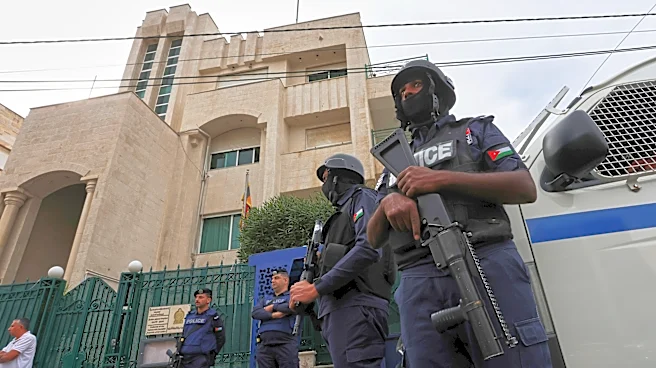
In Jordan, an assailant attacked and killed a security officer near the Sri Lankan Embassy in the capital, Amman, on Thursday, in what Jordanian authorities described as a terrorist act.
Jordan’s Public Security Directorate said a member of its forces was assaulted with a sharp object.
Jordan’s state-run Al-Mamlaka TV reported that the assailant, who was arrested, attempted to seize a weapon from the security officer. A second security officer intervened, and both the assailant and the second officer sustained injuries, Al-Mamlaka said.
Three Palestinians were killed in separate areas of the Gaza Strip on Thursday, according to health officials.
Israeli gunfire killed a boy in Bureij in the central part of the territory, according to Awda Hospital. A woman was fatally shot in another incident in Khan Younis, according to Nasser Hospital. An Israeli airstrike in Deir al-Balah killed one person.
The Israeli military said that they are aware of the airstrike in Deir al-Balah. The army didn’t immediately respond to a request for comments on the gunfire in Bureij and Khan Younis.
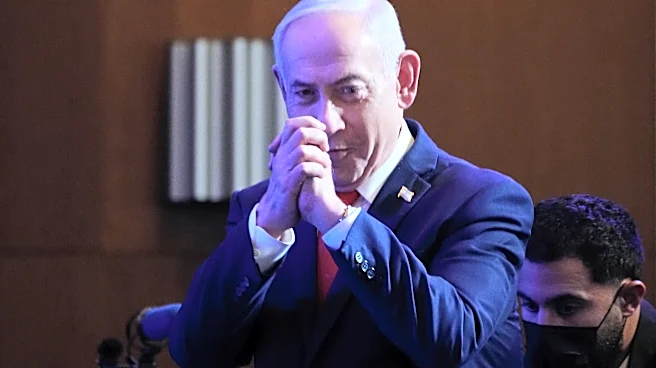
Israeli President Isaac Herzog held a second and final day of meetings Thursday with political parties to hear their recommendations on who should receive the first opportunity to form a coalition government.
The president chooses who gets the first chance — most likely current Prime Minister Benjamin Netanyahu or his main rival, former military chief Gadi Eisenkot.
Herzog’s office said the United Arab List, an Islamist conservative party, and the Joint List, which combines three major Arab parties, both recommended tasking Eisenkot with forming Israel’s next government.
Netanyahu's Likud, Israel’s major right-wing party, backed the prime minister, while two more factions recommended Eisenkot.
The ultra-Orthodox party United Torah Judaism refrained from a recommendation, likely tipping the scales in favor of Eisenkot.
___
This report will be updated throughout the day as new developments emerge.