






UMM AL-KHAIR, West Bank (AP) — As the FIFA World Cup gets underway on June 11, with Egypt, Iraq, Jordan, Qatar and Saudi Arabia among the Arab nations set to compete, soccer remains both a passion and a struggle for many Palestinians in the Israeli- occupied West Bank.
The Palestinian national team came agonizingly close to qualifying for the tournament but fell just short of reaching the 48-team field. Still, the World Cup will be closely watched
in the West Bank, where, for many young Palestinians, the game offers both an escape from daily pressures and the realities that surround them.
In the Bedouin village of Umm al-Khair, in the Masafer Yatta region south of Hebron, children play on a small soccer pitch bordered by barbed wire erected by Israeli settlers from the nearby Carmel settlement. During a recent game, a ball kicked toward the goal landed beyond the fence as young settlers passed by. The settlers took the ball away, ending the match.
Residents say such incidents are common. The community has lost dozens of soccer balls. Attempting to retrieve them can risk confrontation with settlers and, at times, Israeli soldiers.
Further north, in Nablus, children and teenagers from a local soccer academy train on a municipal stadium pitch that has fallen into disrepair. Along the sidelines, Palestinians from Gaza who held permits to work in Israel before the war watch the sessions as they hang clothes to dry. Stranded in the West Bank since the war broke out in October 2023, many have created makeshift homes in the stadium’s locker rooms, the facility's manager says, fearing they could be forced to return to Gaza.
The Palestinian Football Federation has halted league matches throughout the war, citing the precarious security situation in the West Bank, where the Israeli military frequently conducts arrest raids and has erected scores of checkpoints. Once-rowdy soccer stadiums are largely empty, with some neglected.
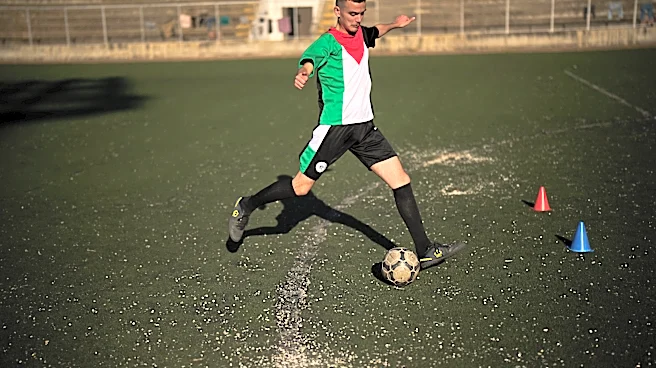
At Faisal Al-Husseini International Stadium in Al-Ram, home to the Palestinian national team, amateur players gather for training sessions. In Tulkarem, young players, some wearing national team jerseys, do the same. FIFA offered some funding to the Palestinian Football Association, but moved the national team's “home” matches to other countries, including Jordan, Qatar and Malaysia, due to security concerns.
In the absence of regular league play, training sessions have become one of the few remaining spaces for exercise, social interaction and a sense of normality.
As the world’s attention turns toward soccer’s biggest tournament, the game continues to provide moments of community, resilience and hope for Palestinians across the West Bank.
___
This is a documentary photo story curated by AP photo editors.