
Ships have stopped moving through the Strait of Hormuz, an intelligence firm said, and oil prices resumed their climb Monday after U.S. President Donald Trump announced on social media that the United
States would blockade the waterway.
U.S. Central Command later said the blockade would involve all vessels entering or departing Iranian ports and coastal areas, and that it would still allow ships traveling between non-Iranian ports to transit the strait, a step down from the president’s earlier threat to blockade the entire strait.
Trump confirmed the timing and some details of the CENTCOM statement in a post on his social media site early Monday.
Iran’s Revolutionary Guard said the strait remained under Iran’s “full control” and was open for non-military vessels, but military ones would get a “forceful response,” two semiofficial Iranian news agencies reported.
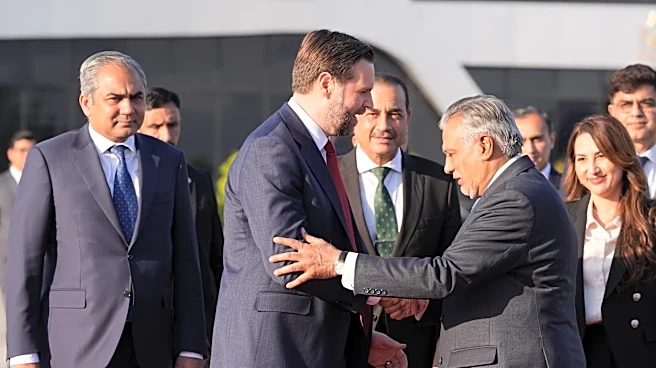
The moves came after marathon U.S.-Iran ceasefire talks in Pakistan ended without an agreement, setting the stage for a showdown.
Iranian parliament speaker, Mohammad Bagher Qalibaf, who led Iran’s side in the talks, addressed Trump in a statement on his return to Iran: “If you fight, we will fight.”
The war, which is entering its seventh week, has killed thousands of people and shaken global markets.
Here is the latest:
Iran threatened ports in the Persian Gulf and the Gulf of Oman after the U.S. announced a blockade on Iran’s ports and coastline.
“Security in the Persian Gulf and the Sea of Oman is either for everyone or for NO ONE,” according to the Islamic Republic of Iran Broadcasting, IRIB. “NO PORT in the region will be safe,” the Iranian military said.
Oil prices started climbing and Asian markets mostly declined Monday as the U.S. military prepared to blockade ships bound for or coming from Iranian ports and transiting the Strait of Hormuz.
On Monday, benchmark U.S. crude jumped $6.71 or nearly 7% to $103.28 a barrel. Brent crude, the international standard, rose $6.20, or 6.5%, to $101.40 a barrel.
Oil prices have been rising as shipping through the strait has essentially stalled since late February. Brent crude oil, the international standard, has gone from roughly $70 per barrel before the war in late February to more than $119 at times.
Japan’s benchmark Nikkei 225 lost 0.7% to finish at 56,502.77. Australia’s S&P/ASX 200 shed 0.4% to 8,926.00. South Korea’s Kospi dipped 0.9% to 5,808.62. Hong Kong’s Hang Seng slipped 1.1% to 25,613.85, while the Shanghai Composite was little changed, inching up less than 0.1% to 3,988.56.
Iraq’s oil exports plunged in March to 18.6 million barrels, down from 99.87 million in February due to the closure of the Strait of Hormuz, according to official figures released Monday.
The state-run Organization for Marketing of Oil said revenues also have fallen to just $1.95 billion, down from over $6.81 billion.
The figures showed that exports from the Kurdistan Region through Turkey’s Ceyhan port also dropped to 1.27 million barrels, down from 5.55 million barrels in February.