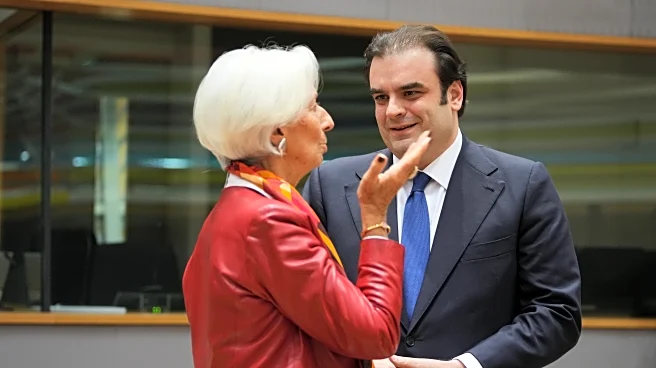




ATHENS, Greece (AP) — Greek Finance Minister Kyriakos Pierrakakis was elected Thursday as president of the Eurogroup — a move that would have been unthinkable just 10 years ago, when the country was in the throes of a deep financial crisis that almost saw it tossed out of the eurozone altogether.
The Eurogroup is the informal body of finance ministers from the 20 European Union members that use the euro as their shared currency. It gathers regularly
to discuss and coordinate economic policies in the euro area countries, and as such, wields significant power in the shaping of each country’s financial policy. The words of the Eurogroup president are closely followed.
Latvian Finance Minister Arvils Ašeradens was one of the first Eurogroup members to publicly congratulate Pierrakakis. “Wishing you every success in leading the Eurogroup forward — to evolve, adapt and meet the challenges ahead with clarity, purpose and strong collective commitment,” he posted on social platform X.
Pierrakakis, 42, is seen as a rising star in Greece’s governing center-right New Democracy party. He took the post of finance minister in March after serving for about two years as education minister. Pierrakakis was credited with introducing sweeping reforms to slash bureaucracy and get many Greek public services online during his tenure as minister of digital governance in 2019-2023.
During Greece’s financial crisis, which began in late 2009, a successive stream of Eurogroup presidents would visit Athens for meetings with the Greek foreign minister at the time, each utterance carefully scrutinized for any indication as to the country’s fate.
In one infamous encounter in January 2015, shortly after the election of a new left-wing government in Greece, the Eurogroup president at the time, Dutch Finance Minister Jeroen Dijsselbloem, clashed with his flamboyant Greek counterpart, Yanis Varoufakis.
After a tense press conference during which Varoufakis had said the new government had no intention of negotiating with the country’s bailout lenders, Dijsselbloem whispered something to Varoufakis as the two men shook hands, with Varoufakis’ face visibly dropping. Speculation swirled as to exactly what Dijsselbloem had said, but the exchange highlighted Greece’s fraught relations with its creditors and the Eurogroup.
Years of fiscal profligacy saw Greece locked out of raising funds on the international bond market by sky-high interest rates, leaving it relying on billions of euros (dollars) from three international bailouts, overseen by what became known as the troika: the International Monetary Fund, the European Central Bank and the European Commission.
The bailouts came with strings attached. Deep austerity reforms were mandated, and Greeks felt the pain. The country’s economy contracted by a quarter, sending it into a depression. Unemployment skyrocketed to 28% of the workforce in 2013, with youth unemployment reaching nearly 60%. Wages and pensions were slashed, homelessness grew and violent mass protests became the norm on the streets of Athens.
In June 2015, Greece teetered on the brink of being kicked out of the eurozone altogether. In an attempt to prevent a run on the banks, the government imposed capital controls, introducing strict limits on people’s access to their bank accounts, rationing ATM withdrawals and limiting money flows.
Days later, Greece became the first developed nation to default on its debts to the International Monetary Fund, failing to repay a $1.8 billion loan. Banking restrictions would only fully be lifted in 2019.
Fast forward a decade, and Europe’s financial outcast has turned into one of its best budget performers. All major ratings agencies have restored its bonds to investment grade, and Greece was just one of six EU member states in 2024 to have recorded a budget surplus. This year, government revenues have shot past targets through August. The economy has done well enough for the prime minister to announce a 1.6 billion euro (1.88 billion dollar) tax cuts package in September.
But it’s not all smooth sailing in Greece. The country still faces financial challenges, with many Greeks struggling under an increasing cost of living. Protesting farmers are currently blocking highways across the country, angered by high production costs and low wholesale prices for their goods, as well as delays in the payment of EU-backed subsidies following a corruption scandal.
Pierrakakis will take over from Cypriot Finance Minister Makis Keravnos, who was serving as the acting Eurogroup president following resignation of Paschal Donohoe of Ireland from the post in November to join the World Bank.
___
Lorne Cook in Brussels contributed.