


Most polls are closed in primary elections in three states, in a vote that marks the official beginning of the midterm elections. Voters cast ballots in North Carolina, Arkansas and Texas, where confusion at some polling locations prompted an extension in voting hours in three counties.
As war with Iran breaks out, Democrats and Republicans are figuring out who they want to lead their party into November’s general election, when control of Congress
and statehouses around the country will be up for grabs. The results of Tuesday’s elections could offer a hint of broader voter sentiment. The most hotly contested races of the day are in Texas, with fierce competition on both sides of the aisle for U.S. Senate nominations. It’s possible that the Republican campaign will continue into a runoff.
Here's the latest:
The head of the Senate Intelligence Committee faced two little-known challengers in the GOP primary. Democrats in Arkansas are not expected to mount a significant challenge for the seat in November.
The man was detained outside Republican Ken Paxton’s election night watch party and police say he was taken to headquarters for further investigation.
A brief police statement made no mention of Paxton’s event and it remained unclear whether the incident was linked to it.
Police said the vehicle had no license plate and officers found ammunition while searching it. The man was not identified.
Democratic polling locations in Dallas and Williamson counties stayed open late because of confusion caused by the county Republican parties refusing to hold a joint primary with Democrats. That forced voters to go to local precincts to cast ballots rather than countywide facilities they usually use.
The polls stayed open an extra two hours in Dallas. In Williamson, which includes the suburbs north of Austin, two precincts were allowed to stay open until 10 p.m. local time.
Voting also was extended for an additional hour in El Paso due to a problem with the county’s voter check-in system. — This post replaces a previous post that incorrectly stated that voting had not been extended in Williamson County.
Former Democratic Gov. Roy Cooper and ex-Republican National Committee Chairman Michael Whatley each won their party’s U.S. Senate nominations in North Carolina, setting the bout for a fall campaign that could determine control of the chamber.
Both clinched their elections in crowded fields to replace retiring Sen. Thom Tillis. He isn’t seeking a third term.
Cooper’s entry lifted Democratic hopes for regaining Senate control of the chamber. Whatley ran after receiving the endorsement of President Donald Trump.
The man was detained outside Republican Ken Paxton’s watch party in Dallas and ammunition magazines and shotgun shells were removed from a car parked outside the venue.
The man was placed in the back of a Dallas police cruiser and later taken away. It was not immediately known whether the incident was connected to the Paxton event.
Paxton, who is running for U.S. Senate, is holding his primary night watch party at a Marriott hotel. Attendees were starting to arrive when the man was detained. The Dallas Police Department and the Paxton campaign did not immediately comment.
Alex Muse, one of the attendees, said a man wearing a camouflage hat, sunglasses and mask covering his mouth and nose entered the hotel and was immediately instructed to exit the property. Muse said the man was also carrying a camouflage rucksack.
“I think it alarmed everyone that he was all in camo, had a rucksack on, face covering,” Muse said.
She says irregularities in Dallas County, her home base, could be determinative in an extremely close election.
“If one person has the right to vote and they weren’t allowed to cast their vote, we should all be standing together — Democrats, Republicans — and we should all be raising hell,” she said at a news conference shortly after a judge extended voting hours in Dallas County.
“So I am asking you, I am begging you, to make sure that you go ahead and figure out where it is that you are supposed to vote,” she added. “Stand in line, wait in line.”
A Dallas judge ordered the polls to stay open an extra two hours until 9 pm local time.
The extension follows chaos in the county and a suburban one outside Austin because the local Republican parties refused to hold joint primaries with Democrats. That meant that rather than voting at countywide vote centers as has been done for years in Texas, voters in those two counties needed to find their own precincts to cast ballots.
Hundreds were unable to vote, Dallas Democrats said. Democrats asked a judge to extend poll hours. Rep. Jasmine Crockett said the extended hours only apply to Democratic primary sites because the GOP did not make the request as well.
North Carolina law says the voting sites close at 7:30 p.m. ET and that anyone in line at the time can still cast a ballot.
But one of the roughly 2,600 sites statewide is staying open for an hour longer. The State Board of Elections gave voters extra time in a rural Halifax County precinct because workers had a problem with electronic poll books and didn’t use any backup measures to let people vote.
The state board said the delay means it won’t be releasing vote totals publicly until 8:30 p.m., when the Halifax County precinct closes. During the delay, counties can count votes and report the results internally to the state.
North Carolina voters are choosing Democratic and Republican nominations for the U.S. Senate seat being vacated by Republican Thom Tillis and for U.S. House seats. Voters also are choosing primary winners for state legislative, judicial and local races.
The Talarico campaign says it’s “deeply concerned” about reports of voting troubles in two major Texas counties.
The campaign called for voting hours to be extended but did not say whether it would file a lawsuit asking a judge to intervene.
Some voters in Dallas and Williamson counties are being turned away at polling locations and directed to different voting precincts.
The head of the association for North Carolina county elections directors says she doesn’t believe colleagues elsewhere in the state will release their countywide primary election results until the State Board of Elections starts doing so at 8:30 p.m. ET.
Results usually start getting released by the state board shortly after polls close statewide at 7:30 p.m. But the state board delayed that because members agreed earlier Tuesday to extend voting by an hour at one Halifax County precinct.
Association president Leigh Anne Price, who is also the Johnston County elections director, said her office is “going to follow what the state board has directed us to do.”
Elections boards in the state’s three largest counties — Wake, Mecklenburg and Guilford — also plan to do the same, officials said.
The Democratic congresswoman and U.S. Senate candidate from Dallas blamed
local Republicans, as well as Republicans in the Austin area, for the confusion of voters who were being turned away from polling locations in Tuesday’s primaries.
The GOP in both Dallas County and Williamson County in the Austin area opted to have voters cast ballots only in their home precincts instead of countywide. Crockett’s campaign said that forced Democrats to do it, too.
Her campaign saw Republicans’ goal as suppressing the vote and said her campaign is working with Democratic officials on possible responses, including extended voting hours.
“Texans don’t appreciate having their votes suppressed and we won’t take it lying down,” her campaign said in a statement.
Tomas Sanchez was one of the voters in Dallas County who showed up at a voting location, ready to cast his ballot in the Democratic primary, and was turned away for being at the wrong precinct.
Sanchez, a student at Dallas College, planned to vote at a location on the campus. But instead was told he had to vote at a location closer to his neighborhood.
The 22-year-old said he was under the “mistaken impression” that he could vote anywhere in the county, which has been the case since 2019. But for this primary Election Day, the Dallas County Republican Party opted not to allow countywide voting locations. The decision affects all area voters, who now much cast ballots at their assigned precinct.
Hunt made his jump into politics after serving in the Army as an Apache helicopter pilot in Iraq and Saudi Arabia. He flew combat missions in Iraq.
The lifelong Houston resident and father of three lost his first race for Congress in 2020. However redistricting created a solidly Republican district two years later, and he won the seat easily.
He’s now positioning himself as an alternative to two older career politicians in the primary, four-term incumbent Sen. John Cornyn and Texas Attorney General Ken Paxton.
Senate GOP leaders opposed Hunt’s run, believing it could prevent Cornyn from fending off Paxton’s challenge. But he argued that voters wary of Paxton needed a choice other than Cornyn.
The release of voting results in North Carolina will be delayed an hour Tuesday night because state officials agreed to keep a precinct in one county open late after workers couldn’t get some equipment working at the start of the day.
Workers at a precinct in rural Halifax County could not get the electronic poll books synchronized for 90 minutes and didn’t use any backup measures to let people vote, according to testimony at an emergency meeting Tuesday afternoon of the North Carolina State Board of Elections.
Election officials said counties can go ahead and count votes when their polls close and report the results internally to the state. But the state isn’t releasing vote totals publicly until 8:30 p.m. when the Halifax County precinct closes.
The precinct was in Littleton, a small community about 60 miles (96 kilometers) northeast of Raleigh.
They’re sticking with voting machines in one of the nation’s largest counties.
The reversal by the Dallas County Republican Party came after chairman Allen West, a former Florida congressman, spent months laying the groundwork for a massive hand-count. Voting machines have been at the center of a web of conspiracy theories pushed by some Republicans after the 2020 election, with false claims that they were manipulated to steal the presidency from Donald Trump.
A large, labor-intensive hand count is slow, expensive and prone to human error. And it would have required more polling locations and workers.
West abandoned plans for a hand count in December, saying officials were “woefully short” of the number of people needed to pull it off.
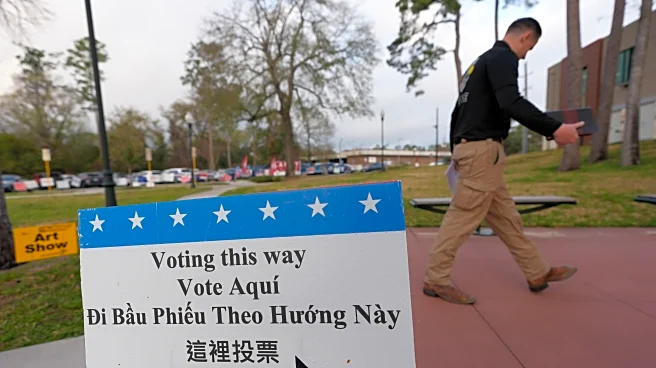
Some voters in two major Texas counties are being turned away at polling locations and directed to different voting precincts, causing confusion and frustration. The problems were hitting voters in Dallas County and Williamson County, which includes the suburbs north of Austin.
“We’re seeing a lot of people that are going to their vote centers that they usually go to ... and not realizing they can’t do that anymore. They have to go to their precinct-based location,” Nic Solorzano, a spokesperson for the Dallas County Elections Department, told the AP.
Since 2019, area voters have been allowed to cast their ballot anywhere in the county. But for this primary, the Republican parties in both counties opted not to allow countywide voting locations. Because both major parties have to agree on how to conduct the primary, the decision affects all voters. That meant that on Tuesday voters could cast ballots only at their assigned precinct. Adding to the confusion is that voting locations also might be specific to someone’s party affiliation, Solorzano said.
State Attorney General Ken Paxton not only has the endorsement of Turning Point USA, the conservative group founded by Kirk, but has played up Kirk praising him before the conservative activist was assassinated.
Paxton’s ads down the stretch of his Senate bid included one with clips of Kirk calling him “one of the best attorney generals in the country.”
Kirk also says Paxton is an “amazing, Constitution-loving Texan attorney general who is doing a great job.”
Paxton made appearances sponsored by Turning Point USA on five college campuses last fall, and last month his campaign was endorsed by the influential group, which is aimed at mobilizing young conservatives.
Kirk was assassinated in September while speaking on a college campus in Utah.
The president has stayed out of the campaign in an uncharacteristic show of restraint from someone with a tendency to want to throw his weight behind important races.
Trump has endorsed congressional candidates and a long list of state lawmakers, including those who helped deliver on his demands for redrawn U.S. House maps that boost the GOP’s chances of picking up more seats from the state in November.
But in the Republican Senate primary, the biggest race in Texas, Trump has declined to endorse Sen. John Cornyn, state Attorney General Ken Paxton or U.S. Rep. Wesley Hunt.
Trump has said he supports all three. But things could change if there’s a runoff, when it might be harder for him to stay on the sidelines once there’s a leader in a head-to-head race.
The four-term Republican senator is in the fight of his political career in his heated primary against state Attorney General Ken Paxton and U.S. Rep. Wesley Hunt. That’s new territory for Cornyn, 74, who has never before faced a significant GOP challenger.
His campaign to hang on comes barely a year after he narrowly lost a bid for Senate majority leader in 2024.
Some Texas conservatives remain angry about Cornyn’s work as the GOP’s negotiator on gun restrictions after the 2022 shooting at Robb Elementary School in Uvalde killed 19 students and two teachers. Others are not happy about Cornyn being dismissive of Trump’s debunked claims of widespread election fraud.
The three-way race raises the likelihood that neither Cornyn nor Paxton will get the 50% needed to avoid a May 26 runoff.
Whatley received Trump’s endorsement in North Carolina’s U.S. Senate race last summer, weeks after Republican Sen. Thom Tillis announced he wouldn’t seek reelection after facing criticism from the president.
The 57-year-old is his party’s highest-profile candidate in the party, and he’s repeatedly pledged to defend Trump’s agenda in the Senate if he’s elected.
Trump’s endorsement highlighted Whatley’s work as Republican National Committee chairman during his 2024 reelection campaign. Whatley also previously served as state party chair in North Carolina, whose electoral votes Trump won all three times that he ran for president.
Whatley has never run for public office until now. He’s spent a lot of time accusing Cooper of going soft on crime as governor, which Cooper denies.
The president accused the congressman of disloyalty for not leaving the Democratic Party after Trump pardoned him and his wife in a federal bribery and conspiracy case.
Cuellar doesn’t have a high-profile primary opponent in his district on the Mexico border. But he stands to face Republican Tano Tijerina — whom Trump endorsed — in the general election.
Cuellar is a moderate Democrat who kept his seat in 2024 even though Trump carried his district. Last year’s Republican redrawing of the state’s congressional map sought to make his heavily Hispanic district more winnable for the GOP.
In January a federal grand jury indicted his brother, Martin Cuellar, on charges of misusing public funds during the COVID-19 pandemic while he was sheriff in Webb County, home to Laredo. Martin Cuellar’s attorney has called the charges baseless.
In almost all cases, races can be called well before all votes have been counted. The AP’s team of election journalists and analysts will call a race as soon as a clear winner can be determined.
In competitive races, AP analysts may need to wait until additional votes are tallied or to confirm specific information about how many ballots are left to count.
Competitive races in which votes are actively being tabulated — for example, in states that count a large number of votes after election night — might be considered “too early to call.” A race may be “too close to call” if a race is so close that there’s no clear winner even once all ballots except for provisional and late-arriving absentee ballots have been counted.
The AP’s race calls are not predictions and are not based on speculation. They are declarations based on an analysis of vote results and other election data that one candidate has emerged as the winner and that no other candidate in the race will be able to overtake the winner once all the votes have been counted.
The AP’s vote count brings together information that otherwise might not be available online for days or weeks after an election or is scattered across hundreds of local websites. Without national standards or consistent expectations across states, it also ensures the data is in a standard format, uses standard terms and undergoes rigorous quality control.
The AP hires vote count reporters who work with local election officials to collect results directly from counties or precincts where votes are first counted. These reporters submit them, by phone or electronically, as soon as the results are available. If any of the results are available from state or county websites, the AP will gather the results from there, too.
In many cases, counties will update vote totals as they count ballots throughout the night. The AP is continually updating its count as these results are released. In a general election, the AP will make as many as 21,000 vote updates per hour.
The 2026 midterm season begins in earnest Tuesday with two of the nation’s most consequential Senate primaries playing out in Texas, a political behemoth Democrats have been fighting to flip for decades.
Is this the year? Republican leaders in Washington openly fret that a victory by conservative firebrand Ken Paxton over four-term incumbent Sen. John Cornyn would give Democrats a rare shot of winning the seat come November. The contest has already cost Republicans tens of millions of dollars, and there will be much more spent ahead of a May 26 runoff if no one gets 50% in the three-way primary that also includes Rep. Wesley Hunt.
Democrats, meanwhile, are picking between two rising stars with conflicting styles. There’s U.S. Rep. Jasmine Crockett, who made a name for herself through confrontation, and state Rep. James Talarico, a former middle school teacher who’s working toward a divinity degree.
▶ Read more
The United States doesn’t have a nationwide body that collects and releases election results. Elections are administered locally, by thousands of offices, following standards set by the states. In many cases, the states themselves don’t even offer up-to-date tracking of election results.
The AP fills this gap by compiling vote results and declaring winners in elections, providing critical information in the period between Election Day and the official certification of results, which typically takes weeks.