



WASHINGTON (AP) — Kilmar Abrego Garcia, a Salvadoran national who fought his mistaken deportation, left the U.S. voluntarily for Spain on Tuesday, officials and his defense attorney said, in what could bring an end to a defining saga of the Trump administration's immigration crackdown.
Abrego Garcia was arrested in Baltimore in March 2025 and deported to a Salvadoran prison in what an official later called an “administrative error.” His departure to Spain
comes after months of legal wrangling as he battled the administration's drive to deport him again.
Both his lawyers and the Trump administration sought to portray the departure as a victory.
“After a protracted fight, Abrego Garcia, on his terms, boarded a flight tonight to Spain. We will always admire his remarkable courage in staring down and defeating a vindictive prosecution instigated by the highest reaches of the Justice Department," said Sean Hecker, an attorney for Abrego Garcia.
The Department of Homeland Security said Tuesday night that he self-deported to Spain, but didn't provide any further details about the decision. Homeland Security Secretary Markwayne Mullin said in a post on X that he was “delighted” about Abrego Garcia's departure, listing off a familiar litany of allegations for why he should be deported, including that he was a gang member, an accusation Abrego Garcia has repeatedly denied.
A judge told Abrego Garcia to self-deport by Tuesday, according to a person familiar with the matter, who spoke on condition of anonymity because they were not authorized to publicly discuss the case.
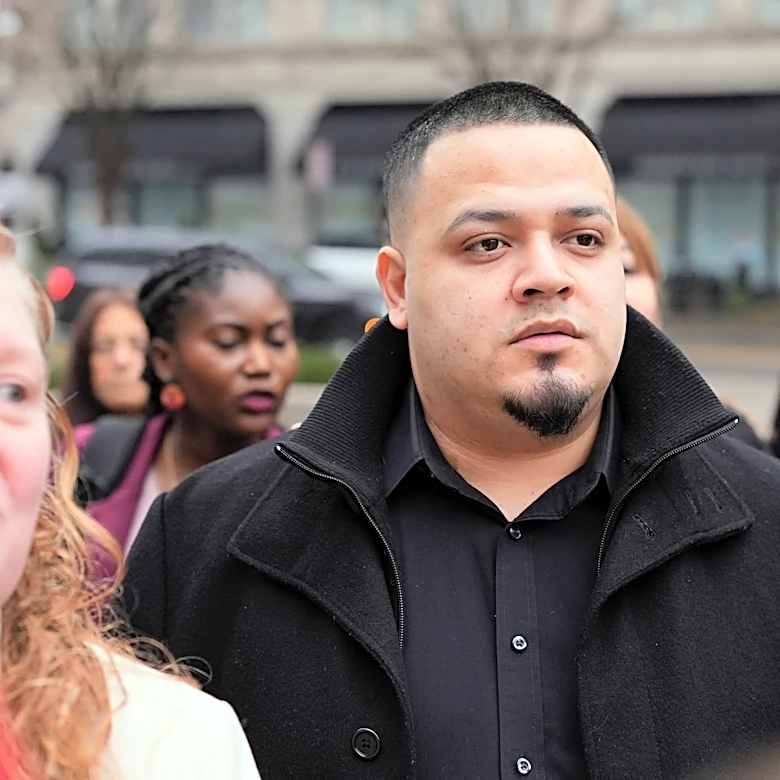
Video posted Tuesday by ABC News showed Abrego Garcia walking through Washington Dulles International Airport with his wife and others, including an official from We Are CASA, an advocacy group that has supported Abrego Garcia and his family.
Maryland Sen. Chris Van Hollen, who met with Abrego Garcia while he was pressing for his release from a Salvadoran mega-prison, described Abrego Garcia as a “free man” and said he is traveling to a country of his choice.
“I am relieved that he will be safe, in a country of his choosing, and free — including from this Administration’s constant persecution,” he said in a statement.
Abrego Garcia's deportation in early 2025 came as the Trump administration was ramping up its immigration crackdown, promising to deport 1 million people annually. Through an infusion of billions of dollars approved by Congress, the administration later supercharged its immigration enforcement capabilities, growing its cadre of immigration officers, expanding detention capabilities and pushing to deport an increasing number of people.
He was fighting against a second deportation to a series of African countries proposed by DHS officials.
The 31-year-old Abrego Garcia has an American wife and child and has lived in Maryland for years, but he immigrated to the U.S. illegally as a teenager. In 2019, an immigration judge ruled that he could not be deported to El Salvador because he faced danger there from a gang that had threatened his family. The judge allowed him to live and work in the U.S. under Immigration and Customs Enforcement supervision, but he was not given residency status.
His deportation in 2025 involved being sent to a mega-prison in El Salvador known as CECOT, which activists say is rife with abuses and where inmates are packed into cells and never allowed outside.
Facing public pressure and a court order, President Donald Trump’s administration brought him back in June 2025, but only after securing an indictment charging him with human smuggling in Tennessee.
A federal judge dismissed that case in May, finding that the Justice Department’s pursuit of criminal charges was designed to punish Abrego Garcia for challenging his deportation. The government is appealing.
The Trump administration vowed to deport him to a third country, threatening to send him to Uganda, Eswatini, Ghana, and, most recently, Liberia.
Abrego Garcia had argued that if he were going to be deported, it should be to Costa Rica, which previously agreed to take him. But Todd Lyons, the former acting director of U.S. Immigration and Customs Enforcement, said in a March 2026 memo that deporting Abrego Garcia to Costa Rica would be “prejudicial to the United States.”
Lyons wrote that Abrego Garcia should be sent to Liberia because the U.S. has spent governmental resources and political capital in negotiating for it to accept third-country nationals. The push for deportation to Liberia continued even after the U.S. signed an agreement with Costa Rica to accept deportees who cannot legally be returned to their home countries.
His case took an unusual turn on Oct. 6, 2026, when, five minutes before a hearing expected to determine whether U.S. Immigration and Customs Enforcement could detain and deport Ábrego Garcia to the West African country of Liberia, attorneys for both sides left the courtroom, along with Abrego Garcia.
When they returned 15 minutes later, it was announced the hearing was canceled. The two sides then gathered for another 90 minutes before leaving the courthouse without explanation. Abrego Garcia’s attorney said only the court case was not ready to proceed and he instructed reporters to watch the docket to learn the status of the case.
___
Associated Press reporter Rebecca Santana contributed.