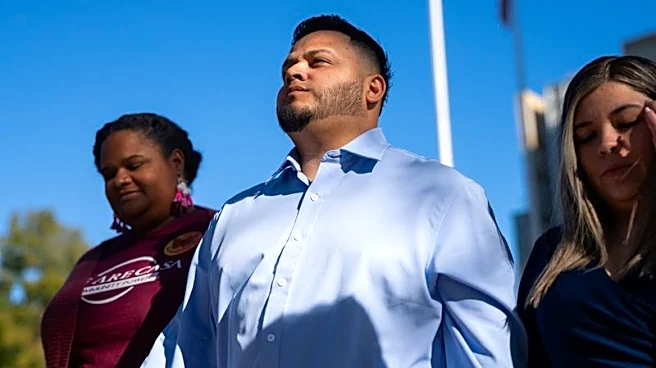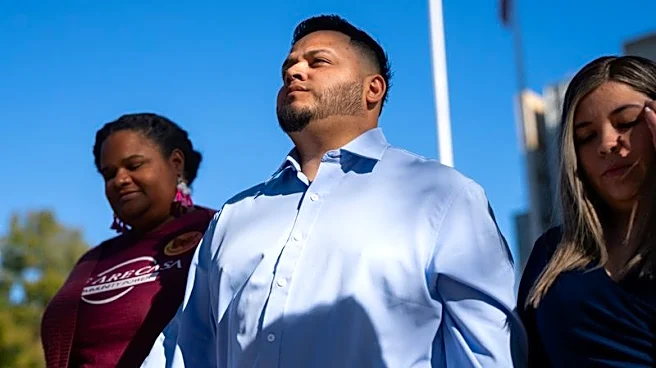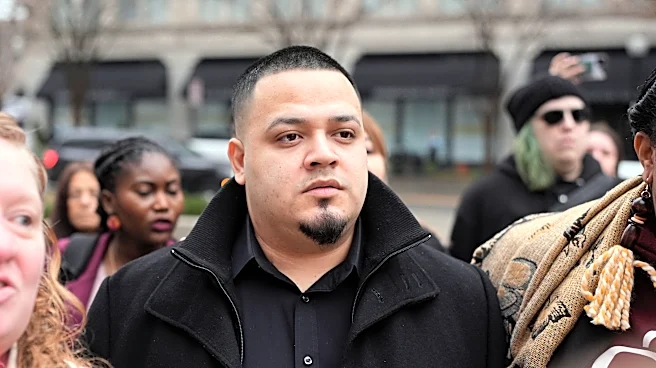






MADRID (AP) — Kilmar Ábrego García, a Salvadoran national who fought his mistaken deportation from the United States, arrived in Spain on Wednesday after voluntarily leaving the U.S., potentially ending a defining saga of President Donald Trump’s immigration crackdown.
Ábrego García, who has an American wife and child and had lived in Maryland for years, was arrested in Baltimore in March 2025 and was deported to a Salvadoran prison in what an official
later called an “administrative error.” His departure to Spain follows months of legal wrangling as he battled the Trump administration’s drive to deport him to Africa.
“The U.S. government may be the most powerful government in the world, but justice can still prevail,” Ábrego García said in a statement released Wednesday. “In this case, despite everything they tried to say, every obstacle they put in my way, and every attempt to shame me, justice prevailed under this administration in a way that many people never thought was possible.”
Ábrego García, who's in his 30s, migrated to the U.S. illegally as a teenager. In 2019, an immigration judge ruled that he could not be deported to El Salvador because he faced danger there from a gang that had threatened his family. The judge allowed him to live and work in the U.S. under Immigration and Customs Enforcement supervision, but he was not given residency status.
He didn't speak to reporters after landing at Madrid’s international airport and raised a fist as he entered a van. But at a virtual news conference later, he thanked his supporters and said, “I’m happy, and I’m celebrating my freedom.”
Simon Sandoval-Moshenberg, a Virginia-based attorney representing Ábrego García, called the move “a temporary departure.”
“Mr. Ábrego García has many options to return to the United States as the husband of a U.S. citizen spouse and the father of a U.S. citizen child. We don’t expect that to happen under this administration, which we know will never give him a fair shake, but we expect that the next administration will prioritize reunifying this family and bringing him back to Maryland,” Sandoval-Moshenberg said.
Ábrego García would decide where to settle for the next two years to wait out the remainder of the Trump administration, the attorney said. Ábrego García's immigration status in Spain wasn’t immediately clear.
U.S. District Judge Paula Xinis, who presided over Ábrego García’s long-running immigration proceedings in Maryland, ordered the case’s dismissal on Wednesday after receiving confirmation that he had left the U.S.
The court also unsealed an order that Xinis signed last Friday to spell out the terms of his “unimpeded” departure. In the order, Xinis said the government informed her that Ábrego García was free to self-deport “to any country that is willing to accept him.”
The judge, in turn, set Tuesday as the deadline for his departure and ordered the removal of his GPS ankle monitor before he boarded the flight.
The order didn’t address why the government had changed its position on him leaving the U.S. to a country of his choice.
The U.S. Department of Homeland Security said Tuesday night that he self-deported to Spain as part of a removal order and that he didn’t receive any incentives and won’t be allowed back into the U.S.
U.S. Homeland Security Secretary Markwayne Mullin said in a post on X that he was “delighted” about Ábrego García’s departure, listing a familiar litany of allegations for why he should be deported, including that he was a gang member, an accusation that Ábrego García has repeatedly denied.
Ábrego García's deportation in early 2025 came as Trump, a Republican, was ramping up his immigration crackdown, promising to deport 1 million people annually.
Through an infusion of billions of dollars approved by the U.S. Congress, the Trump administration later supercharged its immigration enforcement capabilities, growing its cadre of immigration officers, expanding detention capabilities and pushing to deport an increasing number of people.
Ábrego García was fighting against a second deportation to a series of African countries proposed by Department of Homeland Security officials.
___
Kunzelman reported from Washington.