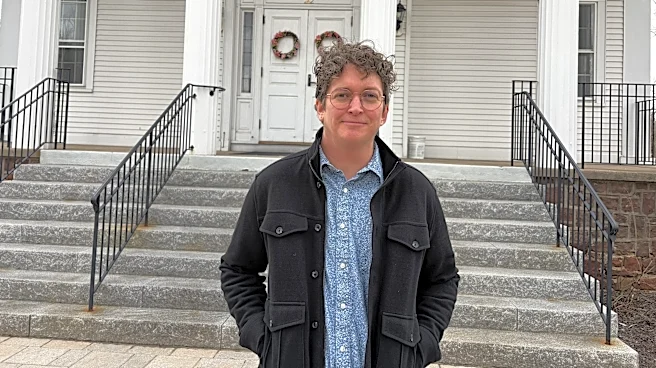

The Rev. Ellis Miller pointed toward six acres of flat fields covered in dry grass, shrubbery and brush — land, in the backyard of Granby Congregational Church on Salmon Brook Street, where Miller envisions
their ministry could provide new affordable housing for anyone in the community who needs it.
Only 5% of the housing stock in Granby is considered affordable. There are two senior affordable housing complexes in town, but both have extensive wait lists. Miller thinks building on the church’s property, a block away from the center of town — with a grocery store, restaurants and a commuter bus line — would help Granby meet the 10% threshold set out in 8-30g, one of the state’s affordable housing laws.
“We have the land, we have the heart, we need a simple process,” Miller said in testimony to lawmakers on March 4.
Miller is one of many religious leaders across the state advocating for House Bill 5396, which would speed up the approval process for affordable housing development on land belonging to a religious organization. The idea is referred to as “YIGBY,” an acronym for “Yes in God’s backyard” and a play on the term affordable housing advocates often assign to people opposed to housing development — “NIMBY” or “Not in my backyard.”
As the church explores the beginning stages of potentially developing the property, Miller does not have a vision of the quantity or style of housing that is possible in the space yet. They said they won’t know until the church works with an architect or hires a developer.
The bill was raised and passed by the legislature’s Planning and Development Committee this year, and it awaits consideration in the full House and Senate.
This proposal comes as Connecticut has been grappling with a growing housing shortage, especially in affordable units, which has fueled concerns about affordability and contributed to a rise in homelessness across the state.
The state has worked to address the shortage through other legislation, including a comprehensive housing bill that passed last year in a special legislative session. Towns are now required to create housing growth plans. The bill also changed minimum off-street parking requirements, expanded fair rent commissions and created incentives to move towns toward allowing more housing, among other measures.
Some religious leaders like Miller believe that while that bill was a positive step, more needs to be done to address the affordability crisis — and they are willing to offer their land to make it happen.
“If H.B. 5396 became law, it would help us take the bold steps forward to transform our field of dreams into affordable housing,” Miller said.
The “YIGBY” concept began to gain national interest after the city of San Diego amended local land development codes in 2019 to allow religious organizations to build affordable housing on their property. California’s passage of the Affordable Housing on Faith and Higher Education Lands Act in October 2023 was the first time the concept was enshrined in state law.
Affordable housing on religious land has already broken ground in California. YIGBY, the nonprofit based in San Diego, partnered with Bethel AME church in the city to support a 26-unit project for low income seniors and homeless veterans. The project began construction in 2024 and was completed in late 2025.
The movement has expanded beyond affordable housing to include parks, schools and other community developments. YIGBY is an offshoot of what’s known as the YIMBY movement, which stands for “Yes in my backyard” and supports community development, land use reform, housing and infrastructure projects.
Supporters in Connecticut and across the country are looking to address a national shortage of affordable homes. And some religious institutions, which have seen attendance decline, have found themselves with excess capacity on their property — and the will to put it to good use. After California passed its 2023 bill, states including Florida,Washington and Virginia passed their own versions of the legislation.
Other states including New York, Colorado and Texas have raised similar proposals that failed to pass due to zoning and safety concerns. Opponents generally argued the legislation would wrest control of local development from local governments.
The Connecticut YIGBY bill, if passed, would not bypass town governance, rather it would allow for what’s known as “summary review” of proposed affordable housing developments on church properties. This would speed up the approval process by allowing any project that complies with local zoning regulations to be approved without being subject to a public hearing and other local procedural requirements. The bill sets a 90-day deadline for municipalities to make a decision on any application. At least 30% of the units in any proposed YIGBY development would need to be affordable for it to qualify for summary review.
Miller said they were cautious when the church first brought a proposal to town officials expressing interest in building affordable housing. Granby town leaders responded positively, but Miller said that’s not the case for every church and town government across the state.
“It shouldn’t be dependent on the relationship of every nonprofit or church and their individual relationships with their town to solve it,” Miller said. “The state should take action on that and really work to encourage both towns and churches to work together to address that problem.”
Zoning rules vary from town to town, but they can make development complicated, and Miller said it would help to have some sort of “safety net” from the state to simplify things.
“There’s any number of reasons why the project might not move forward, but if that element could be removed, that’s one less barrier,” Miller said.
A lack of housing — particularly housing that’s affordable to people with low incomes — has long plagued the state.
A report from the Partnership for Strong Communities, a housing research and advocacy organization, says that although Connecticut is building more housing — particularly multifamily housing — than in past years, it would still take decades to meet demand if construction continued at the current rate.
Even though the growth rate of the state’s housing supply accelerated from 2023 to 2025, Connecticut’s rate of homes for sale in 2025 was lowest in the country, and its rental vacancy rate was second to last in 2024, according to analysis by DataHaven.
Low-income residents in the state face a shortfall of about 120,000 housing units, according to the 2025 Connecticut Fair Share Housing Study. At the current pace of new supply, it could take 50 years to close that gap, the study found.
Nick Kantor, program director at Pro Homes Connecticut, which supports affordable housing development, said while no one piece of legislation could solve the housing shortage, the YIGBY bill is a step in the right direction.
“We need more housing, more homes. So all the tools that can be applied to adding more homes we want to be supportive of,” Kantor said.
Several Connecticut religious leaders said they support the YIGBY bill and they want to be able to help alleviate the state’s housing shortage and improve affordability for residents.
Westminster Presbyterian Church in West Hartford has explored developing affordable housing on an acre of land behind their church. Minister Rev. Julie Emery said her congregation has seen a decline in membership, which has led to budget shortfalls — a common challenge for many churches in recent years.
Emery and her staff assessed the property and came to the conclusion that building rental units could alleviate the church’s financial woes while helping the town add housing. They received a grant from the Housing Ministries of New England to hire a consultant and architect to start the process earlier this year.
But they soon found out the development process could take six to eight years. Emery said church leaders haven’t made any final decisions yet on what to do with the property, but they’re hopeful the YIGBY legislation, if it passes, could fast-track the process if they decide to build affordable housing.
“I think that we are hopeful that this will make it possible for us to have a choice in what we do with our property,” Emery said.
She said that the church does not envision a high rise with lots of units but rather sees the space with smaller single-family home-style units.
“We are really in the beginning stages of imagining what that might look like,” Emery said.
Miller and Emery’s churches are a part of Greater Hartford Interfaith Action Alliance, one of the groups that approached state legislators in the Planning and Development Committee about raising the YIGBY bill. GHIAA, which is organized through the Center for Leadership and Justice in Hartford, held a series of public listening sessions with residents where concerns about housing affordability came up repeatedly, Cori Mackey, the center’s executive director, said.
“Our faith also calls us to change the systems that create the need for these ministries in the first place,” Mackey said. “One critical way to do that is by changing unnecessary barriers to creating affordable housing on land owned by congregations themselves.”
Another coalition of religions organizations based in New Haven and Fairfield Counties, Congregations Organized for a New Connecticut (CONECT), also offered its support for the legislation. The Rev. Caitlin O’Brien, a senior organizer with CONECT, said church leaders don’t tend to have the experience or capacity to take on a complex zoning approval process, which she said can be “unpredictable and protracted.”
But both Mackey and O’Brien said religious institutions are deeply committed to serving their communities, and if they’re going to build and manage housing, they want to get it right.
“It’s not like a swoop in and develop and leave,” O’Brien said. “We’re going to be intentional about our neighbors and we’re going to make sure to be in the right relationships.”
The Planning and Development Committee advanced the bill last month on a vote of 13-8. It now must pass both legislative chambers to reach the governor’s desk.
The Connecticut legislature has a history of long debates in the House and Senate over state-proposed zoning changes, and the debate in committee pointed to questions that could come up if it’s raised in either chamber.
Ranking member of the committee Sen. Jeff Gordon, R-Woodstock, sought to address arguments advocates made about uncertainty with local zoning approvals. A former member of his town’s Planning and Zoning Commission, Gordon said decision deadlines are clearly laid out and towns are serious about sticking to them.
“It is not uncertain at all, it is not endless,” Gordon said during a public hearing on the bill.
Gordon said he wasn’t opposed to the idea of churches building affordable housing, but he expressed concerns that fast-tracking approvals through summary review could lead to safety issues. He voted “no” on the bill.
Rep. Renee LaMark Muir, D-Deep River, asked for clarification on whether there would be any rules for how religious organizations could use whatever profit they make from housing developments.
YIGBY legislation in other states has called for those profits to be reinvested into the church’s social missions, operations and property maintenance. The current version of Connecticut’s bill doesn’t address this question.
Churches would be subject to property taxes on any housing developments, unless it qualified for an exemption under existing law.
Some lawmakers raised questions about the bill’s constitutionality, pointing specifically to the “establishment clause” of the First Amendment, which states that “Congress shall make no law respecting an establishment of religion.”
“I’m not saying that they shouldn’t exercise their faith, and trying to find realistic ways for housing opportunities is not bad. But I think it is a legitimate concern when you’re having one group getting preferential treatment — in this case, religious groups,” Gordon said during a committee meeting.
Co-chair of the committee, Rep. Eleni Kavros DeGraw, D-Avon, said she is open to expanding the bill to include more organizations, not just religious institutions.
Rep. Andre Baker, D-Bridgeport, said he works with religious groups in Bridgeport that offer emergency shelter to the rising number of unhoused people in the state. He said the bill could allow these groups to do even more to prevent homelessness, like build new housing.
“Let’s not allow (these issues) to stop us from providing housing for people and allowing these faith-based organizations to jump in and do what their missions have called for,” Baker said.
Still, advocacy groups representing local governments expressed concerns that the bill could take important decision-making away from community leaders, who they say know their towns best.
Brian O’Connor, director of public policy at the Connecticut Conference of Municipalities, said his group opposes the bill because it appears to be an attempt to circumvent the local zoning process. He said local municipalities need to be able to consider public health or safety concerns, like water and sewer infrastructure.
Betsy Gara, executive director at the Connecticut Council of Small Towns, said that towns are already spending a considerable amount of time figuring out how to comply with the comprehensive housing bill passed last year.
“There’s a lot happening right now with respect to planning, zoning, land use regulations, and I think we have to be careful about giving certain developments priority status in the communities when others are subject to other rules and regulations,” Gara said.
Gara said housing needs are different across communities and a summary review wouldn’t allow for the full consideration many municipalities would prefer to conduct — such as traffic flow patterns and wastewater capacity, which she said could pose public health risks if they’re not thought through.
For many clergy and religious groups, offering shelter to the unhoused is a core part of their mission. Some say the YIGBY legislation offers a way to extend that part of their service.
In Connecticut, the need for those services has been growing. The population of people living outside, in their cars or in other places not meant for human habitation rose by 45% from 2024 to 2025.
At the bill’s public hearing, Katie Jennings, campaign director for the CT Coalition to End Homelessness, said the legislation could help prevent homelessness.
“The majority of people experiencing homelessness in Connecticut are extremely low-income households priced out of the rental market, and increasing the supply of stable and affordable housing is one of the most evidence-based ways to reduce inflow into homelessness over time,” Jennings said.
Mark Colville founded the Amistad House and Rosette Neighborhood Village, a community of small shelters, in his backyard in New Haven. The project is part of the Catholic Worker Movement, a network of communities that serve those in need through hospitality.
But Rosette Village was established without building permits, and it didn’t go through the local zoning board. City officials have said the development violates state building codes, and over the last few years its electricity has been shut off several times.
But Colville is emphatic that homelessness is traumatic and people need a community in order to heal from that trauma.
“We need communal housing models. The zoning laws in this state have always excluded that possibility,” he said.
Colville said he supports the YIGBY bill. “Let churches do what they do,” he said.
Liza Arulampalam, senior pastor at Center Church in Hartford (and spouse of Mayor Arunan Arulampalam), told lawmakers during the public hearing that her church is one of only two cold weather shelters in the city. She said the shelter can hold just over 50 people, and this year, they’ve seen increased demand.
“By the time our guests arrive at our doors, they are living testimonies to how our state has failed to invest upstream in housing stability,” Arulampalam said. “If we are serious about being a just society, we must move above emergency response and address the root causes that place people in our building night after night instead of in permanent homes.”
___
This story was originally published by The Connecticut Mirror and distributed through a partnership with The Associated Press.