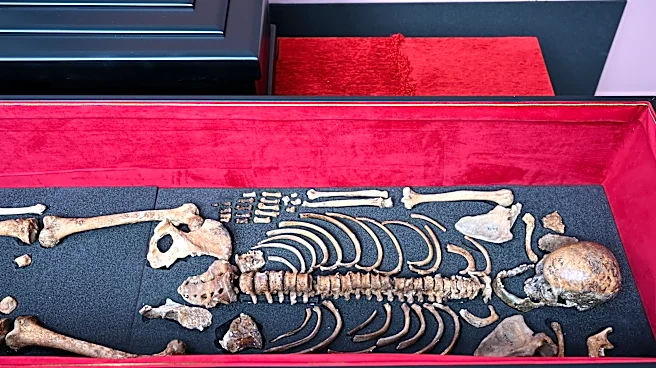



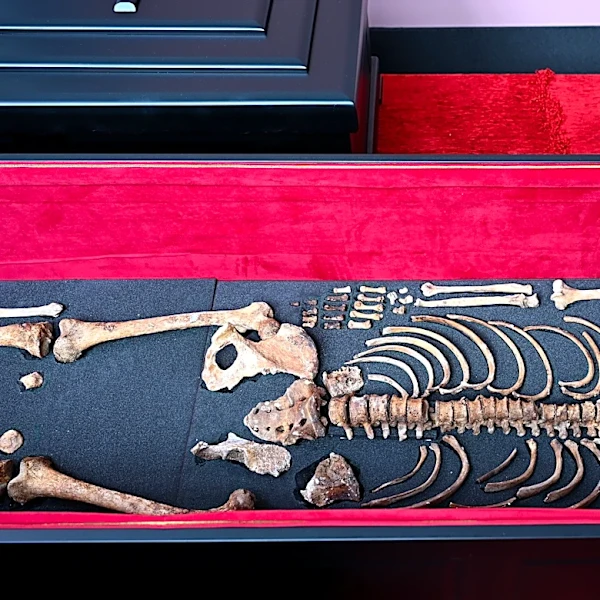


SOFIA, Bulgaria (AP) — The remains of medieval ruler Czar Samuel arrived in Bulgaria on Saturday, after decades of negotiations with neighboring Greece.
Samuel, or Samuil in Bulgarian, was a warrior emperor who battled the Byzantine Empire to expand his kingdom but was ultimately defeated and died shortly afterward in 1014. He is considered a symbol of Bulgaria’s national identity.
The remains, discovered at a Greek border area 60 years ago, were flown
to the Bulgarian capital, Sofia, aboard a military aircraft that was escorted by Bulgarian air force fighter jets from the country’s border with Greece.
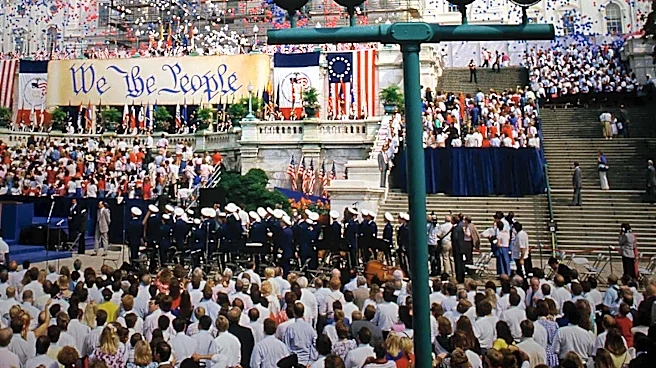
The coffin with the remains arrived at a central square in Sofia, where it was welcomed by thousands of Bulgarians. In a rare show of unity, politicians from all ends of the fragmented political spectrum also paid tribute to the medieval ruler, listening to the national anthem and a 21-gun salute.
“Today we Europeans are learning to read history with a desire to belong not only to our homeland, but also to the culture that unites us across the entire European continent," Bulgarian Prime Minister Rumen Radev said at the ceremony.
“That is why Europe must not reopen old wounds but must work for peace as the supreme good,” Radev added, referring to the centuries-long history of bitter rivalry between the two neighboring states.
A procession accompanied the remains of Czar Samuel to the nearby Church of Saint Sophia, a sixth-century basilica that gave its name to the Bulgarian capital. According to church officials, Samuel was baptized in this church.
“More than a millennium after his life and historic feat, Czar Samuel returns to his people to remain forever in Bulgaria,” said Patriarch Daniil, the head of Bulgaria's Orthodox Church, in a prayer at the white marble sarcophagus where the remains were laid to rest.
Saturday’s handover in Thessaloniki follows an agreement earlier this week between the two countries’ culture ministers, under which Bulgaria will return religious relics taken from Greek monasteries during World War I.
Several prominent Greek academics and religious leaders have criticized the arrangement as inadequate on the Bulgarian side.
Greek Prime Minister Kyriakos Mitsotakis and his Bulgarian counterpart Rumen Radev attended a ceremony at Thessaloniki’s Museum of Byzantine Civilization, where the remains were kept, before the handover.
“These are items that belong to both our peoples; they constitute our memory and our bond, and our compatriots and future generations deserve and must have the opportunity to pay tribute to their ancestors,” Radev said.
“If in the past Czar Samuel divided us, I can say that today he unites us. He strengthens our strategic cooperation and makes the historical relations between our states and peoples even stronger,” he said.
Mitsotakis said he hoped Saturday’s ceremony would bolster Greece’s international campaign to return the Parthenon Marbles, a collection of 2,500-year-old marble sculptures taken from the Acropolis in Athens and later displayed in the British Museum.
“The global community is essentially re-evaluating its long-standing stance on protecting cultural heritage,” Mitsotakis said.
“This shift is embodied by today’s initiative, which rests on the obvious principle that monuments and historical heirlooms cannot be treated as spoils of war, nor as the result of circumstances subsequent to their creation," he added.
—————
Kantouris reported from Thessaloniki, Greece.
Associated Press writer Derek Gatopoulos in Athens contributed to this report.