





BARCELONA, Spain (AP) — Millions of Spanish workers shut down businesses and snarled transport in a massive protest Wednesday over housing costs that the government hopes to leverage ahead of a national election later this month.
The walkout — under the slogan “Salaries. Housing. Prices.” — was the first general strike in Spain in 14 years.
In Barcelona, the country’s second-largest city, most storefronts on a main shopping boulevard were boarded up
in anticipation of violence during protests later in the day. Some retail chains were open to business while public transport was at a standstill or facing long delays.
The subway opened only for the rush hour.
Carlos Ferrer, a 45-year-old customer service worker who was trying to get back home to Alicante by train from Barcelona, said sometimes only “radical measures, such as a general strike” can force a change of course.
“Authorities need to feel pressure from the citizens so they can do something," he said.
Rain pelted the capital, Madrid, as strikers marched down main streets and blocked off Gran Vía, the city’s main thoroughfare, where big brand stores remained open although some were also boarded up. Unions have called for workers to march through the city center later Wednesday, and protests are also planned in more than 50 cities and towns.
Manuel Gómez, a 19-year-old student in Madrid, welcomed the protests, which he said marked a change for the country.
“In Spain, we have a serious problem, which is that when we don’t like something, we never go out to protest,” he said.
About 5% of flights for Wednesday were canceled at airports across the country, according to the country’s airport operator, AENA.
“The strike has exceeded the labor unions’ expectations,” said Unai Sordo, secretary general of CCOO, one of the two unions calling the strike. “It has been a success in terms of turnout.”
Earlier, the two unions — CCOO and UGT — reported significant work stoppages in strategic sectors. They said the stoppages amounted to 90% in the automotive and port sectors, 85% in the meat industry, 82% in waste collection, and 75% in the energy sector.
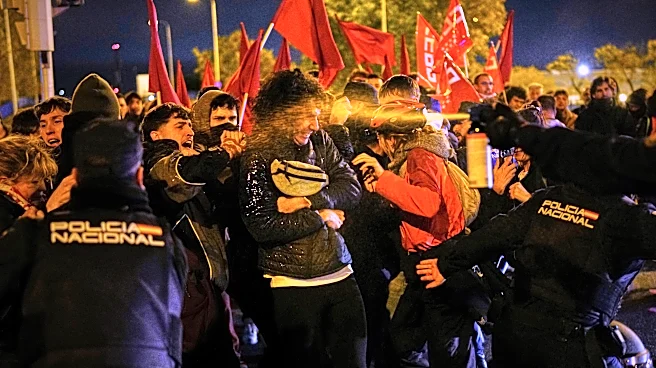
Minor incidents were reported in the first hours of the strike. Tires were set on fire at roadblocks in Barcelona, and scuffles with police were reported near the main wholesale market on Madrid’s outskirts. Police also used pepper spray against the strikers in some places.
Many schools and universities reportedly closed or are working at minimal capacity. In Madrid, this added to an ongoing strike started by teachers nearly a month ago demanding better working conditions. In southwestern Spain, classes were suspended due to bad weather.
“It’s extremely important to remind people that we, the workers — who are also renters or who also pay mortgages — are the ones with the power to halt production and bring the economy to a standstill,” Sandra Mora, spokesperson for the Tenants Union, told national radio, RNE.
The strike brought workers, activists, politicians and ordinary Spaniards around the same interests — accessible housing. The average rent in Spain has almost doubled in the last 10 years, eating into household budgets and angering voters.
The anger reached a boiling point following the nationally televised eviction of an 87-year-old woman from her home in Madrid last month. The subsequent death of Maricarmen, as the woman became known, caused even more indignation and solidified her as a symbol of Spaniards who feel they pay too much in rent and can’t even dream of homeownership.
Housing activists leveraged the uproar over Maricarmen's eviction to call for the general strike, and soon won the backing of the UGT and CCOO unions.
The housing activists are seeking the elimination of pricey tourist apartments, a crackdown on real estate speculation and the automatic renewals of leases as a way to protect renters. Unions demand more government intervention in the housing market and a new minimum wage agreement through talks with the business owners' association.
The nationwide protests over Maricarmen's eviction propelled Spain’s government to push through emergency measures to limit evictions and help tenants, but right-wing parties in the Parliament refused to ratify them, claiming they would provoke a flight of properties from the rental market.
Spanish Prime Minister Pedro Sánchez then doubled down and called an early election, hoping to earn four more years in power for his left-wing coalition. The vote is set for Nov. 29.
Then, in late October came a brutal high-speed train collision — Spain's second deadly rail disaster of the year — that killed 69 people. The aftermath of the tragedy has dominated Spanish news and created a drag on Sánchez's campaign just when he had hoped to build momentum.
The strike now offers a much-needed opportunity for Sánchez’s Socialists and other parties on the Left seeking to stay in power, analyst Oriol Bartomeus said.
“The Socialists need for the strike to be a success and for there not to be any violence so that the election campaign can swing back to being about housing,” Bartomeus, a professor of political science at the Autonomous University of Barcelona, told The Associated Press.
On Thursday, Sánchez's government will again try to have a reduced interim Parliament ratify the two housing decrees that the full lower chamber rejected last month.
Sánchez posted a long video on social media this week, lauding past social policies like the 40-hour work week and national health insurance, which were the fruit of the workers' movement and the right to strike.
“It wasn’t easy, but they changed Spain,” Sánchez said, warning that right-wing parties would bring austerity and underfunded social services if they took over.
The traditional conservative Popular Party and the far-right Vox oppose any government intervention in the housing market, other than incentivizing construction of new homes.
The two also argue that the unions are trying to help Sánchez stay in office, with months of polling showing voters leaning toward the right.
If the strike descends into violence or has a low turnout, right-wing parties, which already have joined forces to govern in some Spanish regions, could benefit, Bartomeus said.
“The Popular Party and Vox both want the strike to be a flop and to end in scenes of burning dumpsters and shattered shop windows,” Bartomeus added, so that the next morning, "they can say, ‘This is chaos and we are coming to establish order.’”
___
Associated Press journalists Hernán Muñoz in Barcelona, Spain, and Iain Sullivan in Madrid contributed to this report.