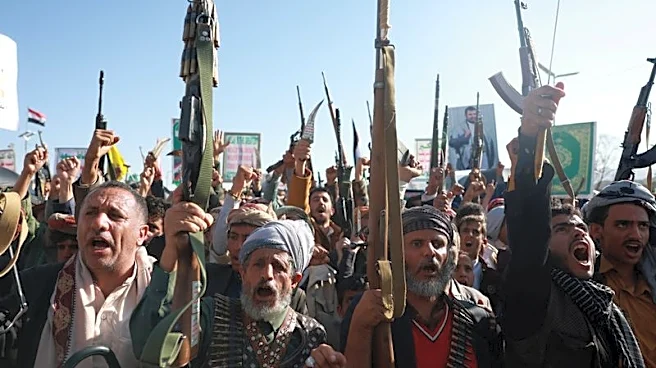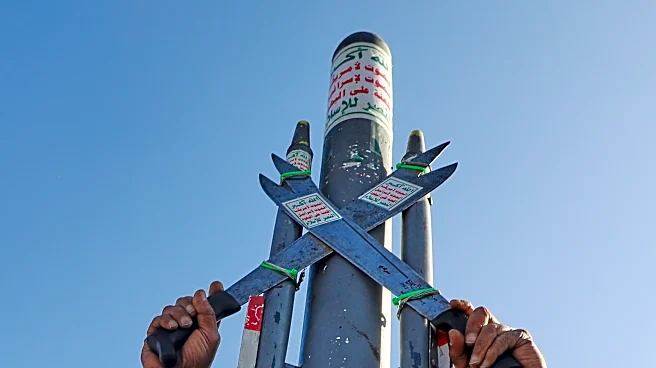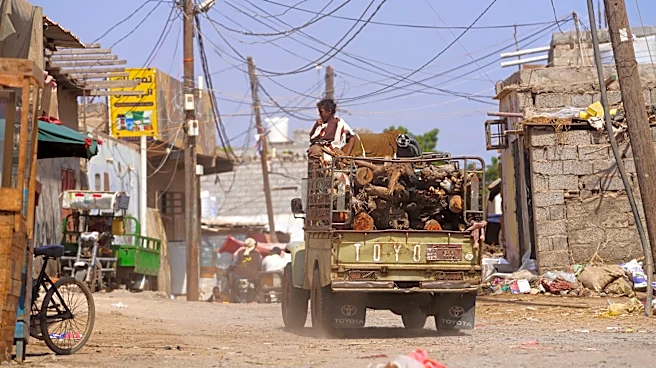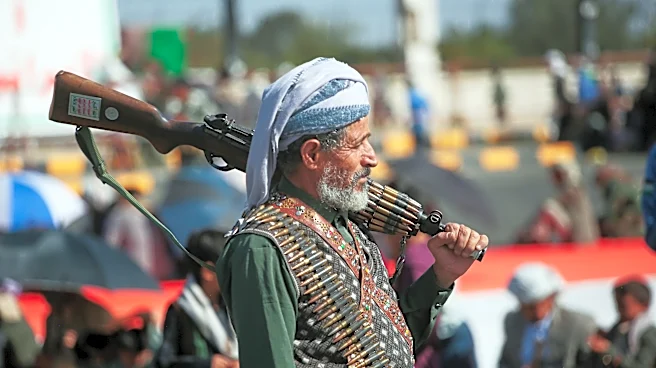






CAIRO (AP) — Iran’s government is encouraging the latest escalation in attacks by the Tehran-backed Houthi rebels and doesn’t seem ready to make the needed concessions in the wider war with the United States, one of Saudi Arabia’s top diplomats said Thursday.
Rayed Krimly, deputy minister for public diplomacy at the foreign ministry, spoke to journalists in a rare briefing following more than a week of Houthi attacks targeting the Riyadh international
airport, the headquarters of Saudi oil giant Aramco and other aviation, oil and military facilities across the kingdom.
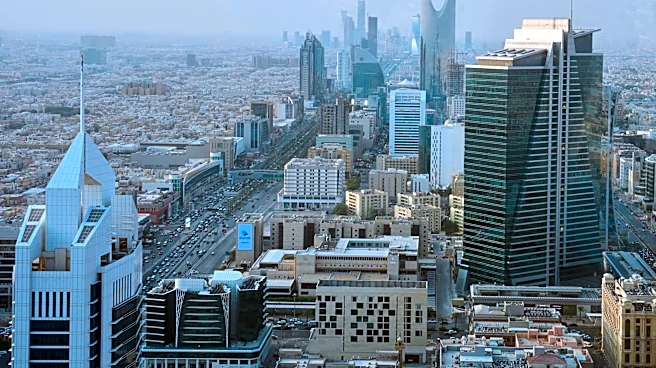
At least 19 people, including foreigners, have been killed in what Krimly called war crimes. King Khalid International Airport in the Saudi capital alone has been targeted 20 times by the Houthis this month, a spokesperson for the Saudi-led coalition fighting the rebels said Thursday.
The escalation between the Saudis and the rebels in neighboring Yemen has exposed the kingdom’s challenges in intercepting the attacks in the latest front in the Iran war, while further rattling global markets. It also has reinforced Saudi appeals to allies including the United States for more military help.
Krimly said the Saudis had reached out and called for a meeting in Oman with the Houthis weeks ago “to resolve outstanding differences and bring an end to this escalation,” but he said the rebels refused to participate.
Days later, the Houthis made one of their most significant territorial grabs yet, racing down Yemen’s Red Sea coast to seize land on the Bab el-Mandeb Strait, a crucial shipping alternative to the Strait of Hormuz. Earlier this month, the Saudi-led coalition launched a major military offensive in Yemen to retake those areas.
That caused new friction between Mideast rivals Saudi Arabia and Iran.
“We think the escalation by the Houthis at this later stage of the conflict is encouraged by Iran,” Krimly said, adding that Iran “continues to arm, train and support the Houthi militia in violation of relevant U.N. Security Council resolutions and in violation of its commitments in the Beijing agreement.” That deal saw Saudi Arabia and Iran restore diplomatic ties after a seven-year rift.
While Iran’s government has said it is open to dialogue on helping to find an end to the fighting, Krimly said Saudi Arabia has not requested any Iranian mediation.
“We maintain direct channels of communication with the Houthis, and Oman serves as a facilitator of these talks and not as a mediator,” he said.
Saudi Arabia still has direct communications with Iran, he added. In the middle of the series of attacks on the Riyadh airport, the Saudi and Iranian foreign ministers spoke at least once by phone.
At the same time, Iranian Foreign Minister Abbas Araghchi as recently as Thursday called the Saudi blockade on the Houthis unjust and illegal.
On the wider Iran war, Krimly said the kingdom continues to support the mediation efforts of Qatar and Pakistan in trying to maintain talks between Washington and Tehran.
Mediators are trying to work out two issues, he said. One is a solution that would ensure safe passage for ships through the Strait of Hormuz in return for ending the U.S. blockade of Iranian ports, which is aimed at bottling up Iran's oil exports and applying economic pain.
The other issue is a “clearer commitment” on how negotiations over Iran’s nuclear program will take place and what they will include.
“In both fronts, the Iranians take a long, long time to come back to the mediators with any new proposal, and what they come with is insufficient,” Krimly said. “And then they begin to talk about a temporary arrangement in (the Strait of) Hormuz, and a temporary arrangement to this and that, and then we spend sometimes weeks and months discussing this, back and forth.
“They don’t seem to be able to reach consensus on the needed solutions that will pave the way for a peaceful solution of the conflict,” he said.
Iranian officials did not immediately respond to requests for comment.
Krimly also said the kingdom believes that China and Russia are involved in supporting both Iran and the Houthis, but he gave few details.
“Of course, some of the capabilities of Iran, and of the Houthis, do come -- or the intelligence -- do come from at least elements in Russia or China, even commercial elements sometimes, but we do discuss these matters regularly with China and Russia, and we will continue to do so,” he said.
A new report this week said the Houthis are attempting to build a new advanced medium-range ballistic missile system with the help of Chinese parts.
Krimly said Saudi Arabia continues to have direct communications with members of the Gulf Coordination Council including the United Arab Emirates, which had been a key member of the Saudi-led coalition fighting the Houthis until friction led the UAE to withdraw its support months ago.
As for the mutual defense agreement the kingdom recently signed with Pakistan and Turkey, Krimly offered no new details on what assistance the two partners might offer as the Houthis keep attacking.