




WASHINGTON (AP) — The Department of Defense is introducing a course centered on Western civilization and Christianity this fall in the schools it operates for military families, part of an effort by Defense Secretary Pete Hegseth to redirect the education system toward patriotic values and classical learning.
The Department of Defense Education Activity operates about 160 schools across 11 countries and educates roughly 70,000 students who are children
of active-duty military or civilian service members. Conservatives have eyed the schools — which, unlike most public schools, are run by the federal government — as a testing ground for reshaping education.
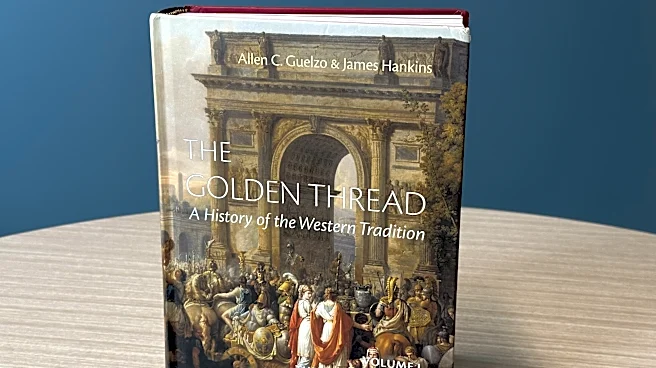
The Western civilization course planned for this fall will use a textbook published by Encounter Books, a conservative publishing house. Titled "The Golden Thread: A History of the Western Tradition, Volume I: The Ancient World and Christendom," it includes suggested lesson plans created in partnership with Hillsdale College, a conservative Christian school in Michigan that has also developed influential materials for K-12 schools.
Historians and educators who reviewed excerpts of the text told The Associated Press it depicts points throughout history in misleading ways, representing Western civilization and Christianity as one and the same and casting Islam as a threat to both.
“You’ve got to wonder a bit whether Western civilization is a Trojan horse for classical Christian education,” said Phil Gorski, a historical sociology professor at Yale University.
The course is part of a wider reshaping of the Defense Department's schools. They have begun hiring classical learning teachers, and the department has brought in new academic chiefs with ties to classical learning charter schools and to Republican-led efforts to promote more patriotic education.
The Pentagon, which was sent a series of questions about the textbook and the broader push for classical learning, did not respond in time for publication.
Classical education broadly refers to a teaching style built on the liberal arts, with an emphasis on critical thinking and citizenship. Students are taught to imitate the rhetoric and style of great thinkers and writers. While some classical educators have pushed to incorporate diverse scholars, critics have argued the movement focuses too heavily on foundational texts from Greek, Roman and other Western writers and gives short shrift to achievements in Asia, Africa and the Middle East.
Conservative politicians have embraced classical learning, especially as the Trump administration and Republican-led states have pushed schools to emphasize patriotism and put boundaries around how they teach unflattering parts of American history.
In his writing and public remarks since before becoming defense secretary, Hegseth has advocated for parents to embrace classical Christian education.
In his 2022 book “Battle for the American Mind,” Hegseth, a former Fox News host, describes a history of progressives working to remove God and religion from public and private schools. For parents, he writes, not sending their children to classical Christian schools would be to admit defeat.
“It is certainly not sustainable, merely passing the same losing hand to the next generation,” Hegseth writes. “With this approach, we lose. We lose America — and Western Civilization.”
Many classical Christian schools focus on reclaiming Western civilization from external threats. But across the broader field of classical education — including secular private schools — the field is increasingly split on this point, said Susan Wise Bauer, the author of a popular classical homeschooling program. She said there is a range of approaches on which texts are worth studying.
“Whenever you have a system of education where that is the impulse, ... 'This is us, and they are them over there,'” she said, “then the idea of a shared literary heritage becomes a weapon.”
In the Pentagon's system, high school students can take the new course, Western Civilization to 1500, to fulfill a world history graduation requirement, according to a news release. The course is offered through the department's virtual school.
In the textbook’s introduction, the authors write: “The dangers presented by the neglect of Western history are not trivial.”
“When citizens of Western countries are utterly ignorant of history, as most now are, they are left unarmed against the general hostility to their own tradition that has become so destructive a force in contemporary culture,” they write.
The idea that external forces will displace the dominant culture is a common right-wing political narrative, said Curtis Dozier, a professor of Greek and Roman studies at Vassar College.
"It’s this right-wing idea that when immigrants come to a country, they care more about their own traditions and history and seek to replace the tradition of the place,” he said.
The textbook's authors credit early Christianity with promoting the idea that all people must be treated humanely. It argues that “Christian faith also supported a humane cosmopolitanism."
The book describes Islam as inherently more violent than Christianity. In a chapter on the Middle Ages, the text describes Arabs as resentful or bitter toward Christians and Jews.
In a section titled “Holy War and Martyrdom in Battle,” the book describes wars fought by Christians, such as the Crusades, as intended to defend and protect other Christians. Islam, in contrast, glorifies violence and war, the book says, invoking the Oct. 7 Hamas attacks and 9/11.
“In recent decades, Islam as a religion has, understandably, aroused acute hostility from a great many non-Muslims around the world thanks to the behavior of radical Muslim terrorists. Sometimes referred to as Islamists, their atrocities have been applauded by depressingly large numbers of ordinary Muslims,” the book says.
Matthew Gabriele, a history and religion professor at Virginia Tech, said the book's description of the Crusades and the conflicts with the Islamic world strips out important details and context to depict Islam as an aggressive religious tradition and downplays the religious motivations and violence of the Christian church.
“It’s trying to make a contemporary political point by continuously referencing things that happened in the 21st century,” Gabriele said. “The fact that (the book) does this very selectively and only when it suits a particular political project suggests to me that this is not a scholarly history in any kind of real sense.”
The book's publisher, Roger Kimball, said it was peer-reviewed by 15 experts. “As the proud publisher of this incomparable work, I stand behind it in every detail,” he said.
One of the book's co-authors, Harvard emeritus professor James Hankins, said the text does not attempt to characterize Christianity and Western civilization as one. Segments of the book acknowledge the West’s cultural debts to the Islamic world, said Hankins, who now teaches at the University of Florida's Hamilton School for Classical and Civic Education, a conservative-backed project to teach Western civilization.
An emphasis on the study of Western civilization was standard until the 1970s, Hankins said. He criticized the move away from teaching it, noting that other countries such as China study their own civilization.
“Abandoning it has been foolish in my view, and is one cause of the growing cultural disorientation of the last couple of generations,” he said in an email. “People no longer know where they come from or where they belong in the story of our civilization.”
In speeches and interviews, Hegseth has drawn a line from the country's founding to Western civilization and early Christianity, a religion he describes as under attack by outside forces. He often argues the U.S. was founded as a Christian nation and troops should embrace God.
At an event last September recognizing a civics education initiative, Hegseth emphasized the need to teach these values to children early on.
“That type of brilliance didn’t come out of thin air," he said of the Founding Fathers. “It was first inspired by God (and) inspired by an understanding of human history, an understanding of biblical history (and) an understanding of Western civilization philosophy and theology and civics poured into a generation of men and poured into an American experiment — it wasn’t an accident.”
President Donald Trump's administration also has moved to align the military's education apparatus with its broader vision for American schools. Admissions offices at U.S. military academies now accept the Classical Learning Test, a college entrance exam that positions itself as a classical alternative to the SAT. And last year, the ACLU sued the defense school system over its decision to ban hundreds of books that covered topics like race, gender and democracy.
In March, the department abruptly changed the leadership of Department of Defense Education Activity schools, replacing Beth Schiavino-Narvaez with Paul Craft as director. In a news release at the time, Hegseth described Craft as the right leader to reorient the school system "toward patriotic values and classical learning.”
The Pentagon also replaced the education activity's chief academic officer, hiring Tiffany Hoben, who previously worked in the Florida Department of Education under Republican Gov. Ron DeSantis. In Florida, she oversaw the rollout of a civics curriculum that was criticized for claiming America's founders did not intend for a full separation of church and state.
This summer, the department announced the hiring of Matthew Kirby as the system's Americas regional director. Kirby is the CEO of Liberty Classical Schools, an Atlanta-based network of charter schools.
In an all-hands meeting after his appointment, Craft described classical learning as a priority that came directly from Hegseth.
“He has tasked us with taking the best that we can from the lessons learned from classical learning in a private school setting to say, ‘How do we expose our kids to that in a public school setting like us?’” Craft said.
____
The Associated Press’ education coverage receives financial support from multiple private foundations. AP is solely responsible for all content. Find AP’s standards for working with philanthropies, a list of supporters and funded coverage areas at AP.org.