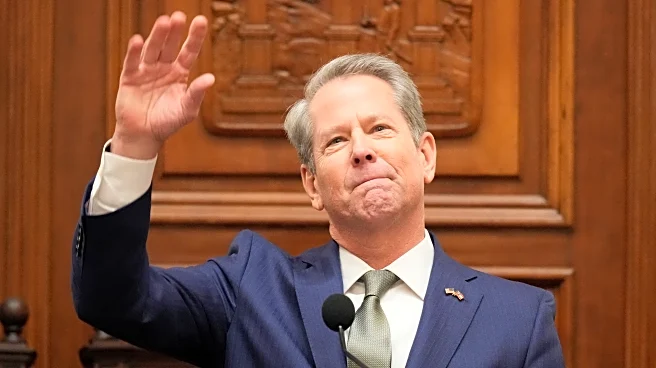

ATLANTA (AP) — Georgia Gov. Brian Kemp delivered his final State of the State speech on Thursday — but it may not have been a farewell.
As the rare Republican who has defied President Donald Trump and thrived,
Kemp is still trying to mold politics in the battleground state in ways that could linger after he leaves office.
He wants to help his friend Derek Dooley, a former University of Tennessee football coach, oust Democrat Jon Ossoff from his U.S. Senate seat. He's supporting candidates for legislature and statewide office that adhere to his small government agenda. And he’s pushing to keep Georgia’s taxes low, arguing that doing so fuels the state’s economic growth.
Operating outside the national spotlight, Kemp offers a potential model for Republicans for a post-Trump future, one that's more low-drama conservatism and less Make America Great Again populism.
“Brian Kemp has been a force in Georgia politics the likes of which we may not see again for some time,” said Stephen Lawson, a Republican strategist.
Kemp’s success is uncertain, and Democrats hope they can gain ground this year without him at the helm. They're trying to win the governor's office for the first time since 1998, get Ossoff elected to a second term and inch their way toward legislative majorities.
But Kemp's political resilience has been noteworthy at a time of national turmoil. He rebuffed Trump's efforts to overturn Democratic President Joe Biden's victory in 2020, then defeated a Trump-endorsed primary opponent in 2022. Kemp later reconciled with Trump without endorsing his election denial, and he's managed to remain an influential voice in national politics.
“Historically, you’re either the back bench, bomb-throwing conservative candidate, or you’re the more moderate business candidate,” said Ralph Reed, a longtime activist who chairs the Faith and Freedom Coalition. “But he’s been able to do both.”
In his speech Thursday, Kemp said he wants to spend $1.17 billion from Georgia’s surplus to give income tax rebates of $500 per family or $250 per person, the fourth time he’s issued such rebates. He surprised no one by calling to speed up Georgia’s planned income tax cuts to get the state’s flat tax rate down to 4.99%.
“We must continue doing everything in our power to allow the hardworking men and women of our state to keep more of their hard-earned money in their pocket in the years to come," Kemp said.
It’s the same version of an affordability agenda that Kemp has pushed for years, with a few new bells and whistles. He's calling for $2,000 one-time bonuses for teachers and university and state employees. That's a throwback to the signature promise from his first term that he delivered — $5,000 raises for every teacher. And he wants to increase retirement payments to law enforcement and endow $325 million for Georgia's first comprehensive need-based college aid program
“Refusing to grow government, budgeting conservatively and paying off debt aren't flashy," Kemp said.
It’s possible that Kemp could run for another office down the line. He’s been floated as a possible candidate for U.S. Senate or even president. But the die-hard University of Georgia graduate may just choose to go home to Athens.
“I think the Republican Party has changed forever,” said longtime Democratic state Rep. Al Williams of Midway. “His brand of Republicanism, I don’t know what kind of future it has in the MAGA world. He’s conservative but not crazy."
Democrats, hoping to move toward the majority in the swing state, argue Kemp has kept tilting Georgia toward the rich. They remain dismayed that he refused to expand Medicaid to all adults, while arguing Kemp's backing of abortion restrictions and other social conservative causes belie his moderate image.
“I think that Brian Kemp as governor has not been honestly all that different than 22 years of Republican rule that has made the American dream less attainable for most Georgians,” said Charlie Bailey, chair of the Democratic Party of Georgia.
Kemp first upset Trump by naming Kelly Loeffler to a vacant U.S. Senate seat in 2019. Trump had wanted then-U.S. Rep. Doug Collins instead.
Trump reacted negatively again in April 2020 when Kemp allowed Georgia businesses to mostly reopen during the pandemic
After the 2020 election, Kemp stared down weeks of pressure from Trump, refusing to call a special legislative session to overturn the results.
“He’s one of the few southern governors that showed some kind of guts when it came to Donald Trump," Williams said.
With Trump partisans seizing control of the Georgia Republican Party, Kemp's reelection initially looked dicey. But with support from key suburban swing voters who liked Kemp more than Trump, he clobbered Trump’s chosen candidate, former U.S. Sen. David Perdue, in a Republican primary, then cruised to a lopsided victory in a rematch with Democrat Stacey Abrams, unlike Kemp's narrow 2018 win.
“After 2020 he stood on principle and did what he thought was right — and he was rewarded for that in a major way in 2022," Lawson said.
After that triumph, a Kemp-for-president boomlet stirred. Kemp never publicly embraced it, and he was backing away from the idea by 2023. But he became chair of the Republican Governors Association, raising his visibility with donors nationwide. By August 2024, when Trump came to Atlanta and publicly trashed Kemp and his wife for 10 minutes during a rally, alarmed national Republicans brokered a truce, convincing Trump he needed Kemp to win Georgia.
Trump won his comeback months later, carrying Georgia.
Kemp declined to run for Senate this year despite pressure from Trump. Some still believe he might have a future in national politics — maybe as a vice president or a Cabinet secretary in a future Republican administration.
Regardless of future ambitions, Kemp is still trying to shape Georgia politics. His biggest bet is on Dooley in the U.S. Senate primary in May. Two Republican congressmen — Mike Collins and Buddy Carter, are also vying for the right to take on Ossoff. Dooley has been positioning himself in some ways like Kemp, an outsider betting he can keep the race focused on attacks on the Democratic incumbent.
Thus far, Kemp has stayed out of the race for governor, although one of the top Republicans jockeying to succeed him — Attorney General Chris Carr — calls himself a “Brian Kemp Republican.”
Kemp is also trying to stamp his imprint further down the ballot. For example, he appointed John King as insurance commissioner and Barbara Rivera Holmes as labor commissioner. They are Georgia’s first two Hispanic officials in statewide elected offices, part of a Kemp push to expand the party beyond white voters as Georgia grows more diverse.
——
Associated Press writer Charlotte Kramon contributed.