



The color drained from Scott Fisher’s face when a member of the Maui Invasive Species Committee told him a little red fire ant had been found at Waihe‘e Coastal Dunes and Wetlands Refuge on the island’s north shore.
“That’s scary,” he said, standing near the stream bank where the field crew had collected the insect.
Fire ants have been present on nearby land since at least 2024 but until last week the highly invasive species had never been spotted inside
the refuge, which is owned and managed by the nonprofit Hawaiʻi Land Trust. As a leader of ecological restoration work there, Fisher did not want to think about the potential consequences of a stinging ant infestation spreading across land that draws thousands of children for education programs every year.
“I don’t know how to describe the emotion, but it was visceral,” he said. “My kids grew up swimming in this river, and to consider the fact that they would no longer be able to enjoy it the way that I want them to — and that their kids can’t enjoy it — that’s devastating.”
With county and state support, the invasive species committee has managed to slow the ants’ spread across Maui, even as populations exploded on the Big Island and Oʻahu. But lately detections have surged, signaling that the problem may be reaching a tipping point, according to committee outreach and education specialist Lissa Strohecker.
Experts had identified fire ants at an average of two new locations a year after their discovery on Maui in 2009, Strohecker said, until 2024 when they were found at eight new sites.
“We’re on the brink of winning or losing,” she said. “We don’t want this to fail.”
A team of seven committee employees has been using state-of-the-art technology and an ant detection dog to combat the spread, even dropping ant birth control from helicopters and drones. Failing to stop the stinging ants from spiraling out of control could have devastating consequences for agriculture, tourism, biodiversity and quality of life on the Maui.
About 40% of the fire ants are found on private property and three out of four infestations were reported by community members. Infestations have been identified all over the island, including in Kīhei, Kapalua, Nāhiku, Haʻikū and Hāna.
Unfortunately, Strohecker said, by the time a report comes in, the ant population often already has spread across 2 or 3 acres.
Little fire ants are considered one of the worst invasive species in the world, known for their painful sting and ability to form supercolonies of millions of ants that overwhelm other species of insects, said Brooke Mahnken, data manager and former fire ant coordinator for the Maui Invasive Species Committee.
“Once they establish and their population starts growing, they will infest every square inch in the three-dimensional space,” he said. “When that happens, it’s an incredible loss of biodiversity. Almost everything else is killed or eaten or driven out.”
Fire ants typically sting if they are disturbed in vegetation or fall from trees onto people or animals. Pets, livestock, birds and other animals can go blind after repeated stings.
Fortunately, using treatments developed by the Big Island-based Hawai‘i Ant Lab, the invasive species committee has eradicated ants from nine sites.
The committee has historically received about $2 million in annual funding — mostly from state and local grants — and only a portion of that goes toward fire ant detection and eradication. The work is expensive and Strohecker said the group is pursuing additional sources of support, including from the state’s new environmental green fee assessed by taxing tourists.
“It is meticulous, arduous, iterative, long-term work to do eradication,” Mahnken said. “Once you map out the full infested area — and that might take months if it’s a large area — then that’s when you start treatment.”
The committee spends the first year tackling an infestation by treating the area every six weeks with ant bait mixed with the growth inhibitor s-methoprene, which prevents the insects from reproducing.
“It’s very low impact,” Mahnken said. “But if you stop feeding it to them, they can come back and start to reproduce again.”
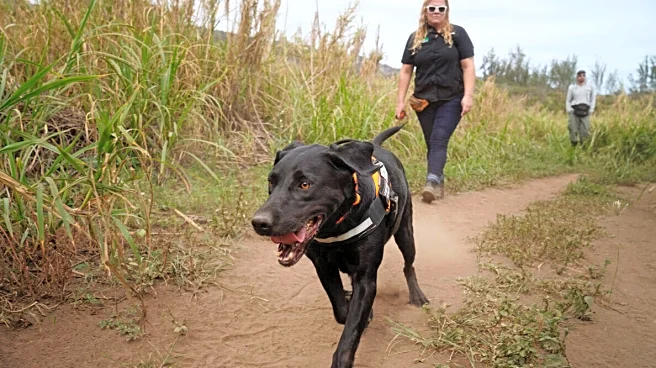
After the first year, a field crew returns to the site of an infestation and examines it for any sign of ants, which is a little bit like looking for a needle in a haystack. That’s where the ant detection dog Freddie comes in handy. The committee bought the dog in 2024 with $45,000 from three foundations and the Hawai‘i Invasive Species Council.
The 4-year-old black Labrador was trained in Brisbane, Australia alongside his handler and full-time caretaker Trisha Dillenburg. He can help guide field crews to ant hotspots, confirm the results of surveys and determine the edges of infested areas.
The team continues treatment anywhere ants are still detected before surveying the entire area again. The process is repeated over and over until no ants are detected, Mahnken said. Then, the area is monitored for five more years before the population is considered eradicated.
As of September, little fire ants had been identified 28 times on Maui, according to the committee’s data. Twelve of those sites were in the active treatment stage, seven were still being monitored and nine were considered eradicated.
Strohecker urged community members to educate themselves on the risks of fire ants and to report suspected sightings to the committee. Community members also are encouraged to check high-risk items that are more likely to harbor the ants — such as potted plants, soil, mulch and landscaping materials — before bringing them into their homes and yards, and to periodically survey their properties using ant collection kits that are available online and at some local garden supply stores.
“You want to find them before they find you,” she said.
Collection kits are mailed to the committee, where technician Monte Tudor-Long examines the collected ants under a microscope to determine whether they are little fire ants.
“It’s definitely distressing when somebody comes in and says they’ve surveyed a new site and there were some lookalikes, and then I put them on here and they are LFA,” he said, resting his hand on his microscope. “Then I have to be the one to tell someone, ‘Hey, it looks like we have a new infestation.’”
The crew was sent out to Waihe‘e Coastal Dunes and Wetlands Refuge last week to determine whether any ants had made their way over from a nearby infestation.
Members placed a few plastic tubes around the stream that divides the refuge from the infested property and smeared them with peanut butter. After about half an hour, only one suspected little fire ant had taken the bait, which crew leader Kayani Singh said suggested that there was not a full-fledged infestation.
Holding up the little tube where a crew member had trapped the nearly invisible ant, Singh explained that to the naked eye, tropical fire ants and other less harmful ant species look nearly identical to fire ants. Still, he was fairly confident that he had accurately identified the tiny red ant based on its appearance and behavior.
“LFA are very aggressive, despite being so tiny and slow,” he said. “So you underestimate them.”
By the end of the week, Tudor-Long had confirmed that it was indeed a little fire ant.
The consequences of a widespread infestation at Waihe‘e Coastal Dunes and Wetlands Refuge would be profound, according to Fisher, with the Hawaiʻi Land Trust. Restoration projects would be delayed, education programs would be moved indoors and camping would cease to prevent people from being stung while allowing the treatment to proceed.
“I want this to be a place where you can come and learn about Hawaiian cultural history, where you can learn about Hawaiian natural history, where you can turn your hands into the soil and it fulfills you,” he said. “All of these programs would come to a screeching halt.”
___
This story was originally published by Honolulu Civil Beat and distributed through a partnership with The Associated Press.