
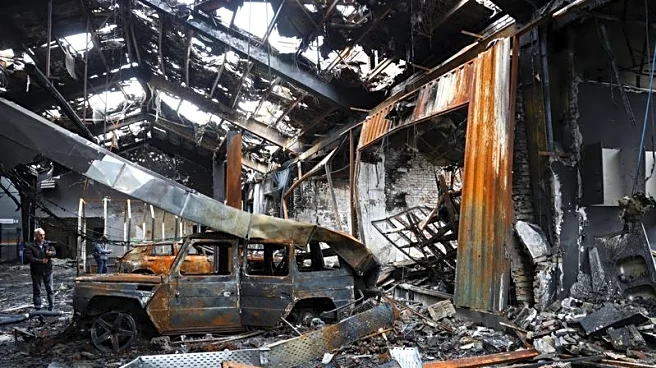
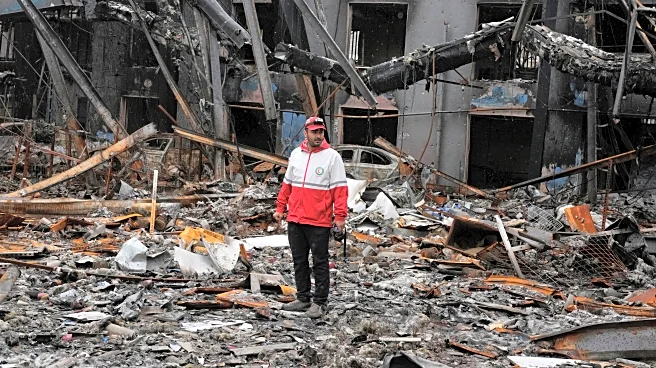
U.S. President Donald Trump on Monday threatened widespread destruction of Iran’s energy resources and other vital infrastructure, including desalination plants, if a deal to end the war with Tehran is not reached “shortly.”
Trump said the U.S. is negotiating with Iran’s parliamentary speaker, Mohammad Bagher Qalibaf, in an interview with the New York Post published Monday. The former Revolutionary Guard commander was previously floated as Washington’s
negotiating partner, but has denied Iran is talking to the U.S. and said Pakistan-facilitated discussions were merely a cover for American troop deployments.
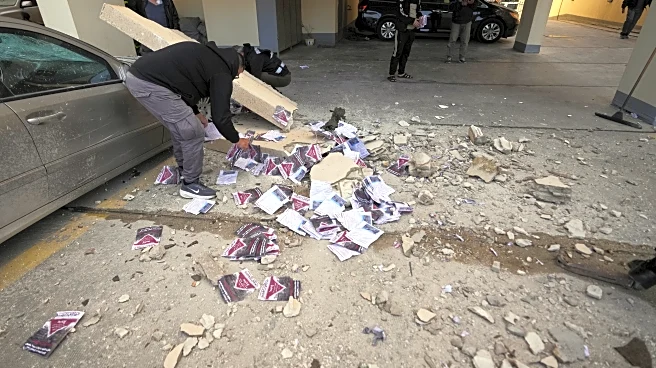
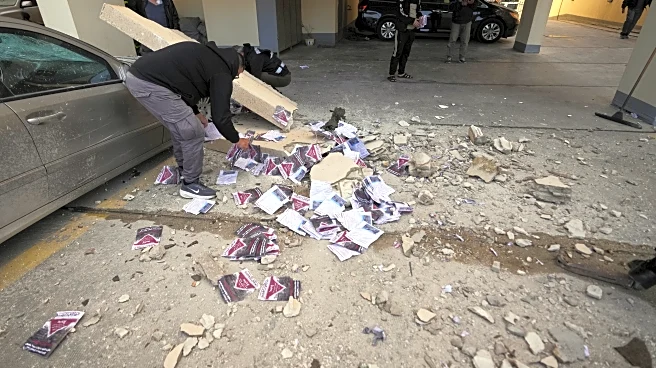
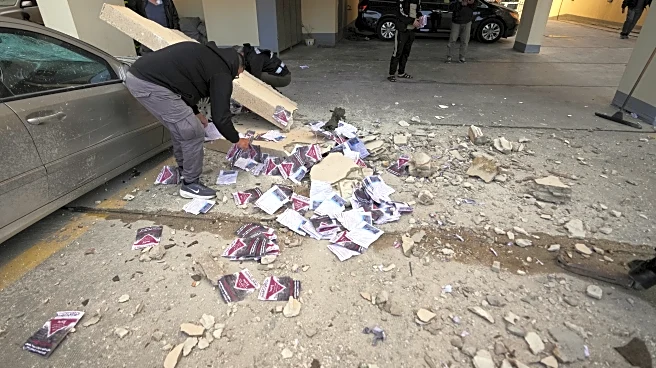
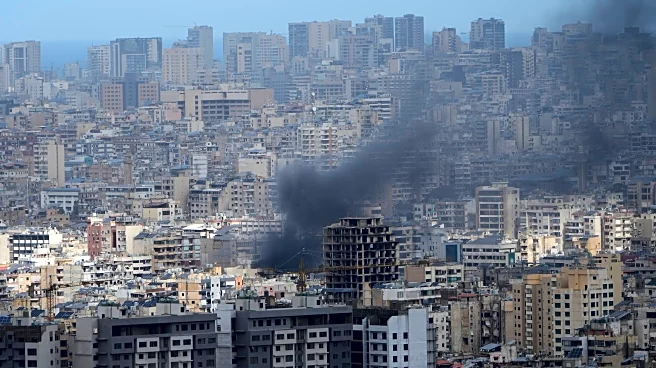
Meanwhile, Israel has invaded southern Lebanon to push out Iran-backed Hezbollah militants, who have fired rockets and drones across the border, in a campaign that Israeli officials suggest could become a prolonged occupation. Three U.N. peacekeepers were killed in southern Lebanon in less than 24 hours, but it's unclear who was responsible.
U.S. stocks edged higher in shaky trading Monday as oil prices keep climbing because of uncertainty about when the war could end.
Here is the latest:
The leaders of wealthy Gulf states Saudi Arabia and Qatar as well as key U.S. ally Jordan held an in-person meeting on Monday to discuss regional tensions and ways to avoid further escalation.
After the summit in Saudi coastal city of Jeddah, the three leaders put out statements warning that continued Iranian attacks, including strikes on civilian and critical infrastructure, mark a dangerous escalation.
The talks focused on coordinating a regional response, backing diplomatic efforts to ease tensions and managing the economic fallout of a conflict that has disrupted energy markets and trade routes across the region.
Secretary of State Marco Rubio has accused America’s NATO allies of abandoning the United States in an hour of need, adopting Trump’s hostile rhetoric toward the alliance.
Rubio complained bitterly that NATO ally Spain had barred U.S. planes involved in the war against Iran from overflying its airspace. Rubio has generally been supportive of NATO even as Trump has lashed out against alliance members for not stepping up during the war.
But on Monday he let loose, alleging in an interview with Al Jazeera that Spain’s leftist leaders are “bragging” about cutting off its airspace even as the U.S. has pledged to defend their country.
He said the alliance is useful for the U.S. because it allows America to station troops and equipment in Europe, “but if NATO is just about us defending Europe if they’re attacked but then denying us basing rights when we need them, that’s not a very good arrangement.”
Monday’s back-and-forth between U.S. and Iranian officials mirrored previous exchanges over whether there are actually negotiations to end the war.
Trump told The New York Post he was negotiating with Iran’s parliamentary speaker, Mohammad Bagher Qalibaf, who then rebutted the claim in a post on X. So did a spokesperson for Iran’s Foreign Ministry.
Qalibaf said the U.S. was promoting “desires as news while threatening our nation at the same time.”
Spokesperson Esmaeil Baqaei said no negotiations had taken place, while confirming that intermediaries had delivered a set of proposals to Iran. He said Iran would “not forget the betrayal that was inflicted upon diplomacy in two instances within less than a year,” referencing the June 2025 and February 2026 indirect talks that preceded attacks by Israel and the U.S.
Trump last week floated the prospect of negotiations, temporarily easing some spikes in oil prices. Iranian officials later denied talks were taking place. At the time, they accused the U.S. of negotiating with itself, while state media reported on alternative Iranian proposals.
A man who crashed his pickup truck into a Detroit-area synagogue earlier in March was carrying out an attack inspired by Hezbollah, the Iran-backed Lebanese militant group, the FBI said Monday.
Ayman Ghazali made a video before the attack at Temple Israel in West Bloomfield Township, saying he wanted to “kill as many of them as I possibly can,” said Jennifer Runyan, head of the FBI in Detroit.
A week before the attack, Ghazali learned that four of his family members were killed in an Israeli airstrike in his native country of Lebanon, according to an official there. Ghazali was a U.S. citizen.
Israel’s military said a brother, Ibrahim Ghazali, who was killed in the airstrike, was a Hezbollah commander in Lebanon. U.S. National intelligence director Tulsi Gabbard told a Senate committee that Ayman Ghazali had family ties “to a Hezbollah leader.”
▶ Read more
Jeanine Hennis-Plasschaer, the U.N. special coordinator for Lebanon, issued a scathing statement Monday, saying that the humanitarian impact in southern Lebanon as Israel trades fire with Hezbollah has reached devastating levels.
The envoy detailed the three U.N. peacekeepers and nine Lebanese paramedics killed in just the last few days as a snapshot of the death toll that now stands at more than 1,240.
“One thing is clear: the longer this goes on, the harder it will be to come back from,” Hennis-Plasschaer said. “As maximalist rhetoric abounds, the prospect of a negotiated settlement is a daunting one. But we must start somewhere.”
She added that while “tactical military gains may produce short-term wins, on and off the battlefield,” they do risk “long-term damage to the stability and prosperity both Lebanese and Israelis deserve.”
This was only the fourth written public statement from Ayatollah Mojtaba Khamenei, who has not been seen in public, since he became supreme leader following the killing of his father Ayatollah Ali Khamenei.
The head of the Iranian Revolutionary Guard’s navy was killed last week in an Israeli airstrike, according to the United States and Israel, and Iran confirmed his death on Monday.
In remarks carried by state media, Khamenei described him as courageous and central to Iran’s role in the Persian Gulf.
Commodore Alireza Tangsiri died for his country, Khamenei said, so that its military “may continue on the path of Iran’s maritime authority and resistance stronger and more firmly than in the past.”
Even with nearly all of its navy destroyed, Iran can control the strategic Strait of Hormuz through an arsenal of missiles and drones built up over decades.
The United Nations’ most powerful body will convene an emergency session Tuesday after officials announced that three peacekeepers in southern Lebanon had been killed in the last 24 hours. The meeting was scheduled after a request from France.
It was unclear who was behind the projectile and explosion that killed the three peacekeepers, as the U.N. says the incidents remain under investigation.
Jean-Pierre Lacroix, under-secretary-general for peace operations, said Monday that all three peacekeepers who were killed were from the Indonesian army. That makes 97 fatalities of UNIFIL peacekeepers due to malicious acts since the mission began in March 1978 and a total of more than 330 fatalities -- the most of any U.N. peacekeeping operation.
Millions of people have jobs that require using personal vehicles for work, like delivery drivers and ride-share providers, as well as self-employed electricians, nannies, home health care aides and real estate agents.
The Iran war has pushed up the average U.S. price for a gallon of regular gas by $1.
Some companies compensate employees for using their own vehicles, including the cost of gas. Ride-hailing and food delivery platforms like Uber and Instacart don’t reimburse drivers for gas, but some are offering temporary incentives in response to rising gas prices.
Leslie Sherman-Shafer, an Uber driver in the San Francisco Bay Area, said she’s putting in extra hours to cover the difference.
“With everything going up, it’s impossible to save a dime,” said Sherman-Shafer, a retired dental office assistant.
▶ Read more
Asked about Pope Leo XIV’s comment that God “does not listen to the prayers of those who wage war,” White House press secretary Karoline Leavitt said there’s nothing wrong with praying for U.S. troops.
“Our nation was a nation founded 250 years ago almost, on Judeo Christian values, and we’ve seen presidents, we’ve seen the leaders of the Department of War, and we’ve seen our troops go to prayer during the most turbulent times in our nation’s history,” Leavitt said Monday at a White House briefing.
“I don’t think there’s anything wrong with our military leaders or with our president calling on the American people to pray for our service members and those who are serving our country overseas.”
U.S. officials have invoked their Christian faith in support of the war, especially Defense Secretary Pete Hegseth, who recently prayed to have “every round find its mark.”
At his Palm Sunday homily, Leo said God “rejects war, whom no one can use to justify war.”
When asked about reports that American-made landmines have been spotted on the ground in Iran and whether Trump signed off on using landmines in Iran, Leavitt said: “I don’t have any comment on that report today.”
When asked whether landmines are being used at all, Leavitt again declined to answer, saying: “I don’t have any comment on that.”
Federal Reserve Chair Jerome Powell said Monday that it is important to closely monitor inflation amid a spike in energy prices from the Iran war.
Powell spoke before nearly 400 students at Harvard University as gas prices inched toward an average of $4 per gallon in the U.S. He said there wasn’t a lot Fed policymakers could do since energy shocks “tend to come and go pretty quickly” and monetary maneuvers work over the longer-term. But a series of energy shocks, nevertheless, could be concerning.
“You have to carefully monitor inflation expectations because you could have a series of big supply shocks and that can lead, you know, the public generally, businesses, price setters, households ... to start expecting higher inflation over time. Why wouldn’t it?” Powell said.
▶ Read more about Powell’s address here
The International Federation of Red Cross and Red Crescent Societies says a 44-year-old doctor had been killed in an airstrike.
The group said in a statement that a Friday airstrike killed Somayeh Mir Abo Eshagh while she was volunteering with the Red Crescent. It said Abo Eshagh had volunteered intermittently for 22 years.
“The killing of Soumaya, and any attack on humanitarians, is unacceptable and must be condemned. We continue to call for the protection of humanitarian teams who risk everything to save lives — this is a moral and legal obligation,” the group said in a statement.
It said Abo Eshagh was the second medical worker to be killed in Iran and that 17 had been injured since Israel and the U.S. launched the war on Feb. 28.
The S&P 500 fell 0.1% in Monday afternoon trading, coming off its worst week since the war with Iran began. The Dow Jones Industrial Average was up 136 points, or 0.3%, as of 1:41 p.m. Eastern time, and the Nasdaq composite was 0.5% lower.
That followed gains for stock markets in much of Europe, but caution was still prevalent throughout financial markets. After jumping to an initial gain of 0.9%, the S&P 500 quickly erased virtually all of it before drifting between small gains and losses. Stocks in some Asian markets fell sharply, while the price for a barrel of Brent crude delivered in June rose 2.3% to $107.72.
All the back and forth has some investors saying they’re giving Trump’s pronouncements less weight than before. But stock prices are nevertheless cheaper than they were before the war, which has some investors waiting for an opportune time to buy.
▶ Read more
White House press secretary Karoline Leavitt said Monday that it’s an “ongoing process” for the U.S. to ensure that the officials they’re negotiating with in Iran are actually in power and able to implement any deal. Leavitt did not detail who the U.S. is speaking with.
“Anything that they say to us privately will be tested and we will ensure that they are being held accountable to their word,” Leavitt said.
Three days after saying U.S. ground troops would not be needed to achieve U.S. goals in Iran, Secretary of State Marco Rubio said President Donald Trump has “options available” to deal with Iran’s threats to control the Strait of Hormuz.
Rubio told ABC’s “Good Morning America” on Monday that diplomacy is Trump’s top preference but after being asked twice about any plans for U.S. ground troops, didn’t repeat the assertion he made Friday that the step wouldn’t be necessary to achieve the administration’s objectives.
Trump threatened Monday to blow up Iranian civilian infrastructure if the strait isn’t opened.
“Now, they are making threats about controlling the Hormuz Strait in perpetuity, creating a tolling system and the like,” Rubio said. “That’s not going to be allowed to happen. And the president has a number of options available to him, if he so chooses, to prevent that from happening.”
Jean-Pierre Lacroix, the United Nations’ peacekeeping chief, told reporters Monday that the world body condemns the “unacceptable incidents” that killed three Indonesian peacekeepers in southern Lebanon, where Israel is battling the Iran-backed Hezbollah.
The peacekeeping mission known as UNIFIL did not say who was responsible for the deaths overnight and into Monday.
“Peacekeepers must never be targeted,” Lacroix said. “UNIFIL is investigating these incidents to determine the circumstances.”
Additionally, Lacroix was asked if he would describe Israel’s ongoing operations in southern Lebanon as an “invasion,” he said that given Israeli military statements and actions, “it certainly looks like we might end up with, I would call it, an expanded buffer zone in southern Lebanon.”
He added, “Now what width, what breadth, what size, what all of this, of course, is very difficult to assess.”
The president confirmed the talks with Speaker Mohammad Bagher Qalibaf in an interview with the New York Post published on Monday, as Trump pressures Iran’s government to reach a deal to end the monthlong war.
He told the publication that he’ll “let you know that in about a week” when asked whether the speaker was someone that the U.S. could work with.
Qalibaf, a 64-year-old pilot and former Revolutionary Guard commander, has denied there have been discussions with the U.S. amid reports that he was floated as Washington’s negotiating partner.
Two more United Nations peacekeepers in southern Lebanon were killed Monday, the UN peacekeeping mission in Lebanon known as UNIFIL said.
An explosion of “unknown origin” destroyed their vehicle near the village of Bani Hayyan and also wounded two peacekeepers, one severely.
All three peacekeepers who were killed were from the Indonesian army, said Jean-Pierre Lacroix, under-secretary-general for peace operations. The first was killed when a base was hit by a projectile, UNIFIL said.
Spokesperson Kandice Ardiel earlier said two of the wounded peacekeepers could not be immediately accessed due to “lack of security guarantees” following the explosion. It took coordination between Lebanese and Israeli authorities for them to securely reach them and take them for treatment, she added in a post on X, formerly Twitter.
U.S. Secretary of State Marco Rubio says Iran’s leadership is fracturing under the monthlong U.S.-Israeli war and that negotiations are possible with a new generation of Iranian leaders. But, he said the U.S. military buildup around Iran in the Middle East will continue as a backstop.
In an interview with ABC’s “Good Morning America” on Monday, Rubio said the Trump administration is aware of competing voices within Iran’s government pitting hard-liners against those who might be willing to negotiate a resolution to end the war. He declined to say who the dissenting voices, saying it would be dangerous for them to be publicly identified.
“There’s some fractures going on there internally,” Rubio said. “If there are new people now in charge who have a more reasonable vision of the future, that would be good news for us, for them, for the entire world. But we also have to be prepared for the possibility, maybe even the probability, that that is not the case. So we’re going to test it.”
The summons was to protest attacks by militant groups operating from Iraqi territory, Kuwait’s Foreign Ministry said on X, demanding Baghdad take steps to stop them.
Kuwait’s said it has the right to respond to threats against its security and sovereignty.
Iraq has struggled to rein in Iran-backed Iraqi militias that have launched attacks throughout the war. In a letter last week, Kuwait and other Arab states urged Baghdad to prevent such groups from operating in Iraqi territory.
Iraq’s Foreign Ministry has said it is addressing “security challenges” and rejects allowing its territory to be used to attack others, without directly addressing the allegations.
British Prime Minster Keir Starmer’s comments came after meeting Monday with the leaders of energy, shipping and banking firms, and as Trump has threatened to seize Iran’s Kharg Island, a crucial facility for oil exports.
“This is going to have to be a joint effort,’’ Starmer said at the start of the meeting. “The government can’t do it on its own.’′
The talks involved representatives from U.K.-based energy giants Shell and BP, global shipping provider Maersk, maritime insurance specialist Lloyd’s of London and international banks HSBC and Goldman Sachs
A 22-year-old resident of Karaj, a city just west of Iran’s capital, said his area lost power for several hours overnight following nearby strikes.
“I was really scared. I thought that they’d hit the power plants and that we are not going to have power anymore,” he said, speaking on condition of anonymity out of security fears.
He said he’d already packed a go-bag with documents, chargers, a laptop and wads of cash in case “bank servers go down.” Power returned around 1 a.m. Monday.
He and his friends have scant information about the war, he said, amid Iran’s blanket internet shutdown. “I am really confused. I don’t know what to feel or what to think.”
He added that security checkpoints are common in his area. “They search the car, they check the trunk, they ask for your ID, and they send you on your way.”
— By Amir-Hussein Radjy in Cairo.
The measure will take effect Wednesday. The oil will be provided on loan, with refiners required to return it.
The move is due to limited supplies the country receives through the Italian TAL pipeline, which continues as the IKL pipeline through Germany and serves the Czech Republic.
The amount represents about 10% of reserves intended to cover 90 days of consumption.
Lebanon’s Health Ministry says 3,680 others have been wounded.
Eighty-seven of those killed were women, 124 children and 52 were medical workers.
More than one million people have been displaced.
A resident of northern Tehran, in his 50s, has described both widening damage from U.S.-Israeli strikes, as well as facing threats from security forces.
“There have been a lot of explosions,” he said, referring to his neighborhood. He said the local police station had been destroyed and a relative had to leave her apartment elsewhere in the capital after a nearby strike blew out its doors and windows.
He said that on the night of the Persian New Year in late March, he and his neighbors shouted anti-government chants from their windows and balconies, and that nearby security forces responded by firing warning shots in the air.
Security forces have issued multiple warnings they will shoot anyone who attempts anti-government demonstrations.
The resident was reached by The Associated Press after he crossed the border out of Iran into Turkey. He spoke on condition of anonymity for his and his family’s safety, saying he planned to return after a few months.
— By Amir-Hussein Radjy in Cairo.
NATO air defenses have intercepted a fourth ballistic missile fired from Iran, Turkey’s defense ministry said.
A ministry statement said the missile entered Turkish airspace Monday and was “neutralized” by NATO air and missile defense units deployed in the eastern Mediterranean.
“All necessary measures are being taken decisively and without hesitation against any threat directed at our country’s territory and airspace,” the ministry said.
Earlier this month, NATO deployed two Patriot missile defense systems to Turkey to bolster its air defenses.