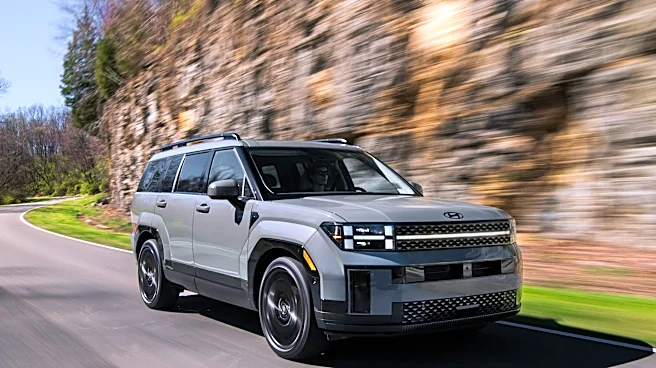





With prices ballooning everywhere, finding a large family vehicle that fits your budget has become harder than ever. That’s why the Hyundai Santa Fe and Nissan Pathfinder are appealing. These two three-row SUVs are priced to undercut most competitors by thousands of dollars, at both the top and bottom ends of their lineups. The Santa Fe and Pathfinder are considerably different, however, and those differences result in advantages for both. The auto
experts at Edmunds tested them to find out which one is the better buy.
The Hyundai Santa Fe is smaller than most other three-row crossover SUVs, including the Pathfinder. Its boxy shape makes up for this size disadvantage in some ways — third-row headroom and cargo space behind the third row are better than expected, for example — but there’s simply less space than in the Pathfinder. On the upside, the Santa Fe’s smaller size makes it easier to park, and its cabin space may be all that your family realistically needs.
You’ll like the Pathfinder if a roomy cabin is a top priority. Bigger kids or even adults will be more comfortable in its third row, and its extra 1.5 inches of middle-row shoulder room makes it easier to comfortably fit three people across or install bulky child safety seats. The Pathfinder can also hold more stuff in the back. It has 45 cubic feet of cargo space behind its second-row seating, compared to the Santa Fe’s 40.5 cubes. That’s not a huge difference but enough perhaps to fit an extra suitcase or two.
Advantage: Nissan Pathfinder
The Pathfinder is powered by a V6 engine that produces 284 horsepower. At the Edmunds test track, it accelerated from zero to 60 mph in 7.6 seconds, which is an average result for a midsize three-row SUV. In routine driving, the Pathfinder has pleasing power, but the transmission can be hesitant to downshift when you’re going uphill. According to the EPA, you can expect to get up to 23 mpg in combined city/highway driving.
The Santa Fe comes standard with a turbocharged four-cylinder engine producing 271 horsepower, and in Edmunds’ testing, it reached 60 mph in 7.2 seconds. Its transmission also responds more quickly when you need a prompt downshift. Fuel economy is nearly the same, with up to an EPA-estimated 24 mpg combined.
This category could be a draw, but the Santa Fe has one notable advantage: It’s also available with a hybrid powertrain. The hybrid Santa Fe makes 231 horsepower, so it’s not quite as quick, but it gets an EPA-estimated 36 mpg combined. Over time, the savings at the pump can really add up. Nissan does not currently offer a hybrid powertrain for the Pathfinder.
Advantage: Hyundai Santa Fe
The Pathfinder starts at just over $41,500, with the destination charge. The Santa Fe starts at just under $37,000, or just over $38,000 for the hybrid. The base feature content is quite strong for both, though the Nissan has a few extra items like three-zone climate control and heated power front seats. However, if you add those and other items to the Hyundai by way of the midgrade SEL trim, the price is still well south of the Pathfinder. This price discrepancy continues as you go up the trim level ladder, including for the Santa Fe XRT and the Pathfinder Rock Creek off-road-oriented trims. Hyundai also has a longer warranty, giving you a five-year bumper-to-bumper warranty compared to Nissan’s three-year coverage.
Advantage: Hyundai Santa Fe
This is a big win for the Santa Fe. Never mind comparisons to the Pathfinder; it’s a technology leader, period, when it comes to device integration features and ease of use. Whether you’re a techie or tech-hesitant, Hyundai’s system should please you. The various driver assistance technologies are also abundant in number and worked well in Edmunds’ testing.
The Pathfinder comes up a little short. Its infotainment tech scores well, and Edmunds’ editors like the available cooled wireless charging pad that helps keep your phone from overheating. But the driver assistance tech isn’t as good. In Edmunds’ testing, they found that the lane keeping system can sometimes struggle to keep the vehicle steady in its lane, and the adaptive cruise control system doesn’t operate as smoothly as the Santa Fe’s.
Advantage: Hyundai Santa Fe
If you need to routinely use the third row, the Nissan Pathfinder is the better call, and it’s still a strong value option when compared to other three-row crossover SUVs. Otherwise, Edmunds recommends getting the Santa Fe. It’s less expensive, has more useful technology features, and offers an available hybrid powertrain.
_____
This story was provided to The Associated Press by the automotive website Edmunds.
James Riswick is a contributor at Edmunds.