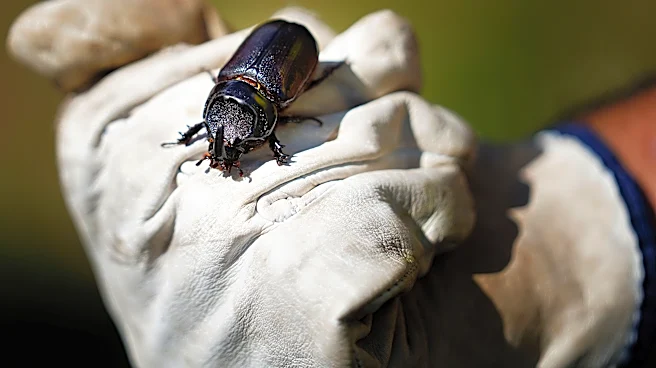





State officials are surveying parts of Maui and Molokaʻi for evidence of coconut rhinoceros beetles, and residents near detection sites are being asked to check palm trees for signs of damage after the highly invasive pest was discovered on both islands.
The suspected detection Tuesday of a male beetle near Kaunakakai Harbor would mark the first time one has been found on Molokaʻi. Based on photographs of the specimen, the Department of Agriculture
and Biosecurity says it is likely a coconut rhinoceros beetle, and it is being sent to its Plant Pest Control Branch on Oʻahu for official confirmation.
Residents on Molokaʻi petitioned the state Department of Agriculture and Biosecurity more than six months ago for better protections from the beetle, which led to the state’s strictest regulations for importing certain products such as mulch.
The appearance of a beetle near Kahului Airport on April 1 marks the first official sighting since November 2023 on Maui.
The Department of Agriculture and Biosecurity’s Dean Matsukawa said in a statement Wednesday that a single dead adult coconut rhinoceros beetle was collected by the Maui Invasive Species Committee from a detection trap at Kahului Airport.
He blamed the recent departure of a public information officer, whose final day was April 1, for the delay in notifying the public. He said they were awaiting sign-off from other partners and were organizing their response, “so we weren’t tripping each other like Keystone cops.”
The early April detection of a male beetle near Kaunakakai Harbor on Molokaʻi spells the worst-case scenario for many Molokaʻi residents who had been trying to keep the beetle off the island.
The beetle has become emblematic of the state’s decades-long struggle to contain and mitigate the impacts of invasive species throughout the islands. The insect spread from Oʻahu in 2023, after almost a decade of containment, helping spur record funding for biosecurity. But even after the funding infusions, there remains widespread dissatisfaction with the agency’s progress in hastening and strengthening the state’s response to the pests, which have also been established on Kauaʻi and Hawaiʻi island.
The beetle is notorious for its feeding and breeding habits. It prefers to consume the sap of palm species, especially coconuts, by boring into their hearts and killing them. They breed and multiply in compost and green waste and they are known to fly up to 2 miles daily. It has also been found to attack kalo, or taro, and banana, among other culturally important crops.
A rapid response is crucial to eradicating pests like the beetles. If it is not contained on Molokaʻi, the voracious scarab beetle could decimate coconut palms, a culturally important plant and food source for residents. The same goes for Maui.
The state should be swift in its response, Wayne Tanaka of Hawaiʻi Sierra Club said.
“It’s one thing to try and eradicate five or 10 CRB that have slipped through the cracks but if they are in the hundreds,” he said, “all hope to quash those colonies goes out the window.”
The detection on Molokaʻi and Maui is “incredibly alarming” for the entire state, Tanaka added.
Six months ago, the mere likelihood of the beetle’s arrival on Molokaʻi constituted an emergency, according to residents Kunani and Ipo Nihipali, who successfully petitioned the state biosecurity agency last year for special protections for the island. The board’s interim rule banned the transport of certain agricultural products that could harbor the pest, such as compost.
Molokaʻi Rep. Mahina Poepoe introduced House Bill 1929 this year to establish an advisory board for the island, made up of residents, to develop a dedicated biosecurity plan alongside state biosecurity staffers. The bill calls for the creation of a quarantine facility on the island, with dedicated staff, for secondary inspections of incoming goods. Poepoe did not respond to requests for an interview.
The bill is still alive this session, having cleared the Senate Ways and Means Committee on Wednesday.
On Maui, a single female beetle was discovered in one of the state’s lantern-shaped pheromone traps next to the airport, on Old Haleakalā Road. It is an unlikely location for the beetle to be found, in an area filled with invasive trees and grasses and without many palm species.
No other CRB were detected in the other traps checked, according to the Department of Agriculture and Biosecurity release. Personnel from the Maui Invasive Species Committee and the agriculture department are conducting surveys, the release said, and deploying additional detection traps. Residents, businesses and landowners within a 2-mile radius of Kahului Airport were asked to check coconut palms and other large palms for possible signs of CRB feeding damage, the release said.
A similar response is playing out on Molokaʻi. Residents, businesses and landowners in a 2-mile radius from Kaunakakai Harbor were asked to check coconut palms or other large palm species for possible signs of CRB feeding damage and to identify and report piles of green waste that could harbor CRB, a state release said. Residents are also encouraged to remain vigilant when purchasing or moving mulch, compost and soil products, as well as avoid purchasing bags with damaged packaging or holes.
Matsukawa told Civil Beat that the department is sending staff to Molokaʻi to assist since there are no biosecurity staff based on the island.
Department staff levels have presented a problem in recent years, with agricultural leadership saying they’re unable to attract talent. That is in spite of more than $20 million in extra funding for the department, appropriated in 2024, which lawmakers have threatened to pull if the agency doesn’t address staff vacancies and other grievances.
“It’s really hard while we’re doing budgets to help them … I have really no faith in where we’re going with biosecurity,” Molokaʻi Sen. Lynn DeCoite said. “We can’t help them if they’re not communicating.”
Among other concerns, legislators said the agency is overly friendly with the agricultural groups it regulates, such as the nursery industry, known for being a key spreader of pests.
___
“ Hawai‘i Grown ” is funded in part by grants from the Stupski Foundation, Ulupono Fund at the Hawai‘i Community Foundation and the Frost Family Foundation.
___
This story was originally published by Honolulu Civil Beat and distributed through a partnership with The Associated Press.