


LONDON (AP) — U.K. Prime Minister Keir Starmer on Tuesday averted a parliamentary inquiry over his choice of Peter Mandelson as British ambassador to Washington, but failed to quell questions about whether he bent the rules to make the controversial appointment.
In a boost for the prime minister, the House of Commons rejected a move by opposition politicians to trigger a parliamentary standards investigation into Starmer. But a former senior official
said he could not confirm that “due process” was followed when Mandelson, a friend of Jeffrey Epstein, was given the key diplomatic job despite failing security checks.
Reverberations from the ill-fated appointment have left Starmer fighting for his job, and at odds with his civil service. The prime minister is angry he wasn’t told that Mandelson had failed security vetting, while senior officials say they felt pressure from Starmer’s office to confirm the appointment quickly at the start of President Donald Trump ’s second term.
“I was presented with a decision and told to get on with it,” said Philip Barton, who was top civil servant in the Foreign Office when the choice of Mandelson was announced in December 2024. “The prime minister had been made aware of the risks and had accepted the risks.”
Starmer’s former chief of staff, Morgan McSweeney, acknowledged Tuesday he’d made a “serious mistake” by recommending Mandelson, but denied pressuring officials to ignore security concerns.
McSweeney told lawmakers on the House of Commons Foreign Affairs Committee that “the prime minister relied on my advice, and I got it wrong.” He apologized to Epstein’s victims, saying “I am sorry for any part this controversy has played in causing further hurt or distress.”
But he insisted that he didn’t “ask officials to ignore procedures, request that steps should be skipped, or communicate explicitly or implicitly that checks should be cleared at all costs.”
Starmer fired Mandelson in September after new details emerged about the ambassador’s friendship with Epstein, a convicted sex offender who died in prison in 2019.
Police opened an investigation into Mandelson in February over allegations that he passed sensitive government information to Epstein when he was a member of the U.K. government in 2009. He denies wrongdoing and hasn’t been charged.
McSweeney, who called Mandelson an adviser and confidant, resigned in February, saying he took responsibility for the ambassadorial appointment.
McSweeney said that he felt Mandelson’s experience as a former European Union trade commissioner would serve the U.K. well in striking a trade deal with the Trump administration.
“I don’t think the prime minister would have chosen Mandelson if Kamala Harris had been elected president,” he said.
But McSweeney denied allegations that Starmer’s staff pressured officials to rush through the confirmation.
He said that at the time of the appointment, he had the impression that Mandelson’s relationship with Epstein was “a passing acquaintance.” When emails were published showing the friendship was close, “it was a knife through my soul,” McSweeney said.
Starmer fired top Foreign Office official Olly Robbins earlier this month after the revelation that Mandelson was approved for the job against the recommendation of the government’s security vetting agency. Starmer has called it “staggering” that Robbins failed to tell him about the security concerns.
Robbins says he was bound by confidentiality rules. He has said the concerns didn’t relate to Epstein, though he hasn’t disclosed what they were about.
It’s rare but not unknown for U.K. ambassadors to be political appointees rather than career diplomats. Barton, who was Robbins’ predecessor at the Foreign Office until January 2025, told the Foreign Affairs Committee that he was concerned Mandelson’s known links to “toxic, hot potato” Epstein “could become a problem.”
“There was pressure to get everything done as quickly as possible,” said Barton – though he denied there was pressure for a specific outcome.
Starmer has denied that anyone in his office put pressure on the civil service.
Critics say Starmer’s decision to appoint Mandelson is evidence of bad judgment by a prime minister who has made repeated missteps since he led the center-left Labour Party to a landslide election victory in July 2024.
Starmer already defused one potential crisis in February, when some Labour lawmakers urged him to quit over the Mandelson appointment. He could face a new challenge if, as expected, Labour takes a hammering in May 7 local and regional elections, which give voters a chance to pass a midterm verdict on the government.
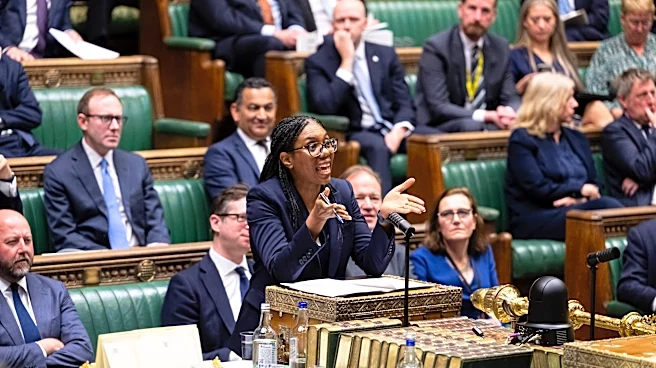
He managed to win a vote Tuesday in the House of Commons, where lawmakers rejected by 335 votes to 223 a demand by the opposition Conservative Party for Parliament’s Privileges Committee to investigate Starmer’s claim that “due process” was followed in Mandelson’s appointment.
The committee has the power to suspend lawmakers, including the prime minister, for breaches of the rules, and a finding of deliberately misleading Parliament is usually a resigning offense.
“It’s clear that full due process was not followed,” Conservative leader Kemi Badenoch said, adding that “appointing a known national security risk to be ambassador to the United States is a profound failure of government.”
Badenoch urged Labour lawmakers not to be complicit in a “cover-up.”
Starmer urged Labour legislators to “stick together” and vote against the motion, calling it a “stunt” timed to damage the party before the May elections.
Many heeded the call, but several criticized Starmer during debate in the House of Commons. Labour lawmaker Emma Lewell said that “like the public, I feel let down, disappointed and I am angry.
“Peter Mandelson should never have been appointed,” she said. “This was a fundamental failure of judgment.”
___
Associated Press writer Sylvia Hui contributed to this story.