







ABUJA, Nigeria (AP) — Nigeria's military has again killed a large number of civilians with an airstrike it says was targeting militants instead, a mistake that has occurred a number of times in recent years and raises questions about the capabilities of a U.S. security partner.
The latest such strike occurred on Sunday, when Amnesty International’s Nigeria office says at least 100 civilians — some of them children — were killed at a market in Tumfa
town in northwestern Zamfara state. A Red Cross official in the state confirmed the airstrike to The Associated Press and said “multiple civilians” were killed.
Nigeria ’s military, however, denied killing civilians. Maj. Gen. Michael Onoja confirmed an airstrike at the market but said there was “no verifiable evidence of civilian casualties," and said military operations continued in the area.
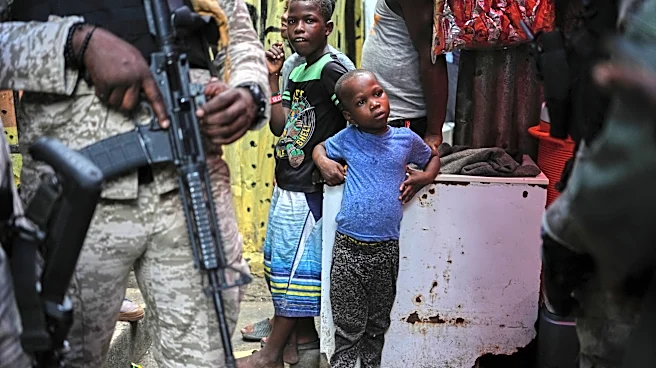
Such strikes are common in Nigeria's conflict-battered north, where the military relies heavily on aerial bombardments to target hideouts of dozens of armed groups. Fighters tend to move in large numbers on motorcycles through remote forests and villages that are often out of the reach of ground troops.
Since 2017, the military has killed over 500 civilians with airstrikes, according to SBM Intelligence, a Lagos-based research firm that gathered reports and data from affected villages.
The Trump administration recently sent troops and drones for intelligence and logistics support to Nigeria's military. It is not clear if U.S.-provided intelligence was used in the latest strike.
Nigerian authorities have admitted killing civilians with airstrikes on a few occasions in the past, framing them as accidental. But locals and analysts say they’ve become more frequent.
Nigeria’s Minister of Defense Christopher Musa has said the military has been improving its human rights record and is holding its personnel to account.
Dozens of armed groups are operating in Nigeria besides the most well-known one, the Boko Haram extremist group that launched an insurgency in 2009 to establish its radical interpretation of Islamic law in the northeast.
Fighters are mostly former herdsmen caught up in conflict with farming communities over access to land and water. Once armed with sticks, groups now carry out attacks with guns that have been smuggled into the country, resulting in thousands of deaths per year.
Some armed groups carry out mass killings and kidnappings for ransom in the northwest and central regions. They also extort “taxes” from communities to support their operations in addition to money from ransom payments, analysts said.
Attacks sometimes last for days in villages with inadequate security presence. Fighters rarely remain in one location for long, frequently relocating and blending in with local communities to evade detection.
Nigerian authorities say it can be challenging to avoid civilian casualties in airstrikes because armed groups often use civilians as human shields.
“Bandits and terrorists, unlike professional soldiers, don’t respect the rules of engagement. They don’t care about killing their hostages if they come under attack,” Nigeria’s former President Muhammadu Buhari once said.
The frequent military mistakes resulting in civilian deaths, however, also can be attributed to loopholes in intelligence gathering as well as insufficient coordination among ground troops, air assets and stakeholders, said Senator Iroegbu, an Abuja-based security analyst.
The Nigerian government and military often promise to investigate airstrikes to prevent mistakes from happening again. Analysts, however, say such investigations often don’t lead to improvements.
In 2024, the military took a rare measure to prosecute two of its personnel over an airstrike that killed over 80 civilians in Kaduna state. It also promised to release the report of its investigation into the incident but has not done so.
Nigeria also needs improved investment in pilot training and development as well as upgrades in aircraft and targeting systems, said Oluwole Ojewale with the Africa-focused Institute for Security Studies.
The military also needs to build trust and secure the support of local communities, whose intelligence on armed group movements is crucial to accurately target and defeat them, he said.