





Federal environmental regulators and water quality advocates want the Wyoming Department of Environmental Quality to rectify a policy restricting who can submit water samples used to decide whether waters are too polluted and below Clean Water Act standards.
Currently, Wyoming only accepts water samples collected by the state and federal government and their subdivisions when it’s directly making “impaired” water determinations — that’s been the case
since 2020, according to state officials who in March proposed to continue that policy.
The revision is part of a DEQ document titled: “Methods for Determining Attainment of Surface Water Quality Standards: Basis and Overall Approach.”
That wordy proposal triggered a number of concerned parties to speak up.
Among them, the U.S. Environmental Protection Agency. In an April 24 letter to the DEQ, acquired by WyoFile through a Wyoming Public Records Act request, the federal agency’s regional office in Denver quoted language from its regulations implementing the cornerstone water-protection law.
When developing a Clean Water Act-required list of impaired and polluted waters, “each State shall assemble and evaluate all existing and readily available water quality-related data and information,” EPA Region 8 Water Division Acting Director Sarah Bahrman wrote to DEQ.
Wyoming’s policy, meanwhile, states that: “Data used to make use support determinations must be collected by a person employed by, or under contract with, a governmental entity.”
Bahrman urged DEQ to address the discrepancy. Wyoming’s method should consider federal regulations requiring states to use “existing and readily available data and information,” she wrote.
If DEQ chooses to exclude data, EPA’s guidance was also to provide a summary explaining why, including a “technical, science-based rationale.”
A handful of conservation groups echoed the concern included in the EPA’s comment letter.
Wyoming Outdoor Council staffer Lindsey Washkoviak wrote to the DEQ that its methods “unnecessarily restrict” credible data sources and contradict the Clean Water Act, agency rules and state statutes. She called the policy “fiscally irresponsible” and recommended that the agency strike the restrictive language.
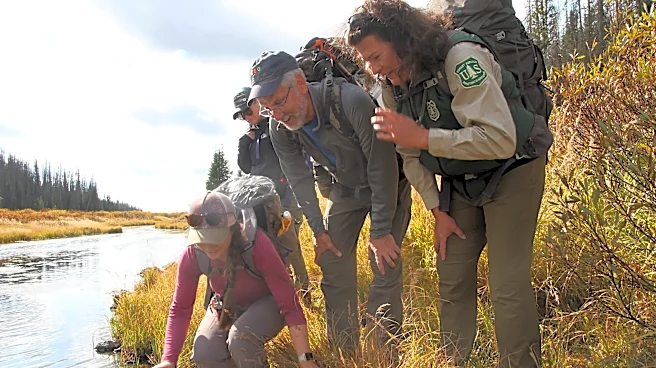
Washkoviak also pointed out that parties that meet DEQ’s “rigorous quality assurance requirements” routinely collect water samples, including parties “that may have more rigorous training and qualifications than governmental entities.”
“These include the University of Wyoming researchers and their students, non-governmental organizations, private consultants, and trained citizen scientists,” she wrote.
Kurt Colhoff, with the Greater Yellowstone Coalition, told the DEQ in a comment letter that the “restrictive, source-based language” about eligible data providers “has no place in this document and should be removed.”
“The state of Wyoming, with its small population base and large land area, should be seeking out ways in which to increase DEQ’s ability to monitor and assess water quality rather than limiting it,” Colhoff wrote. “A cursory review of Wyoming’s (impaired water list) illustrates this point.”
Wyoming has one of the smallest lists of impaired water bodies in the nation, he wrote, and “enormous swaths” of streams that have not been assessed.
In a joint comment letter, American Rivers, Protect Our Water Jackson Hole and the Powder River Basin Resource Council seized on the same issue.
The groups wrote that Wyoming’s former requirements were “source-neutral” and “quality-based” and that the state accepted data from tribes, universities and watershed groups for its impairment decisions. Starting in 2020, the nongovernmental data was relegated to a “secondary role.”
“Nothing in Wyoming statute requires this shift,” American Rivers staffer Justin Hayes wrote, adding that it “excludes otherwise scientifically valid data solely because of who collected it and thereby narrows the scope of usable data beyond what Wyoming law authorizes.”
Changes to the eligibility requirements for submitting water samples for “impairment” decisions follow a decade-old dustup between state regulators and the grazing-focused Western Watersheds Project. Data submitted by the group’s former employee, Jonathan Ratner, were deemed “non credible,” and E. coli-related impairments for three small western Wyoming streams were nullified.
In 2025, Wyoming DEQ proposed to again delist one of those streams, Lander Creek, after state regulators found that E. coli was still a problem — they argued that it was too small for swimming, and thus didn’t require a human health-related impairment.
The alleged unreliability of the Western Watersheds Protect samples factored into why the state now restricts which parties’ data go into impairment decisions, DEQ Watershed Protect Manager David Waterstreet told WyoFile.
“We are ensuring that we are making the right conclusions every time,” Waterstreet said.
Ron Steg, DEQ’s Lander Office Manager, said that the data restrictions have not curtailed the waters that appear in Wyoming’s impaired waters report.
“I’ve been with the program since 2017,” Steg said. “I don’t recall seeing any data that would bump up against this requirement.”
DEQ officials declined to weigh in on the contention that their data restrictions are at odds with EPA’s regulations implementing the Clean Water Act. The state agency will have to evaluate and respond to the comments making that claim, Waterstreet said.
“I’ve got to run those (responses) up the management chain for their review,” he said.
State officials stood behind DEQ’s broader proposal. The 30-page document outlines elaborate procedures for determining whether Wyoming waterbodies, rivers and streams attain surface water quality standards. It covers a lot more ground than delineating which parties are eligible to submit the data that goes into impairment decisions.
“We want to make sure that our assessment procedure is transparent,” Steg said. “When someone asks, ‘What data do we need, and how do we need to collect it to determine if this use is supported or not?’ we want to have something we can literally hand to somebody.”
Steg called DEQ’s overall update to its methods a “huge positive step forward.”
Even groups critical of DEQ’s data source requirements agreed with that assessment.
“Overall, we see these updated methods as a positive step forward for the DEQ,” Washkoviak at the Wyoming Outdoor Council wrote. “(W)e commend the agency for moving them forward in order to fulfill its statutory responsibilities under the Wyoming Environmental Quality Act and Clean Water Act.”
___
This story was originally published by WyoFile and distributed through a partnership with The Associated Press.