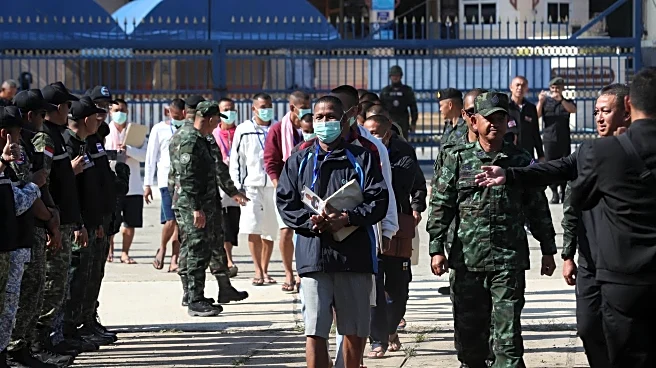

BANGKOK (AP) — Thailand on Wednesday released 18 Cambodian prisoners of war held for five months, fulfilling the terms of a ceasefire agreement the two countries signed to end bitter fighting along their
border.
The release was stipulated in the ceasefire agreement signed Saturday by the defense ministers of the two countries at the same border checkpoint between Thailand’s Chanthaburi province and Cambodia’s Pailin province where the soldiers were released.
“The repatriation of the 18 Cambodian soldiers was undertaken as a demonstration of goodwill and confidence-building, as well as in adherence to international humanitarian principles,” Thailand’s Foreign Ministry said in a statement.
Cambodia’s Defense Ministry said the release “creates an environment conducive to peace, stability, and the full normalization of relations for the benefit of both nations and their people in the near future.”
The soldiers’ release removes a major impediment toward that goal after two rounds of destructive combat over competing territorial claims.
Thailand had insisted it was allowed to hold the men under provisions of the Geneva Conventions governing the rules of war, which said they could be detained until the end of hostilities. The prisoners were allowed visits by the International Committee of the Red Cross and other rights covered under international humanitarian law, Thai authorities said.
Their continued detention was used effectively by Cambodia’s government to rally nationalist sentiment in the conflict against Thailand.
Wednesday’s statement from Cambodia’s defense ministry said the government “has remained steadfast in the promise made to the families of the 18 soldiers and the Cambodian people: that no soldier would be left behind.”
The ceasefire agreement said the soldiers would be freed if the end of combat was sustained for 72 hours after it came into effect at noon on Saturday. The 72 hours passed on Tuesday, but Thai authorities said they needed to evaluate the situation, claiming that 250 Cambodian drones had been active along the border.
The two countries had given differing accounts of the circumstances of the men’s capture, which took place on the same day the initial ceasefire came into effect at the end of July.
Cambodian officials say their soldiers approached the Thai position with friendly intentions to offer post-fighting greetings, while Thai officials said the Cambodians appeared to have hostile intent and entered what Thailand considers its territory and subsequently were taken prisoner.
There were originally 20 Cambodia soldiers taken captive, but two were repatriated within days for what were said to be medical reasons.
The original July ceasefire was brokered by Malaysia and pushed through by pressure from U.S. President Donald Trump, who threatened to withhold trade privileges unless Thailand and Cambodia agreed. It was formalized in more detail in October at a regional meeting in Malaysia that Trump attended.
Despite those deals, the countries carried on a bitter propaganda war and minor cross-border violence continued, escalating in early December to widespread heavy fighting.
Thailand lost 26 soldiers and one civilian as a direct result of the combat since Dec. 7, according to officials. Thailand also reported 44 civilian deaths.
___
Sopheng Cheang reported from Phnom Penh, Cambodia.