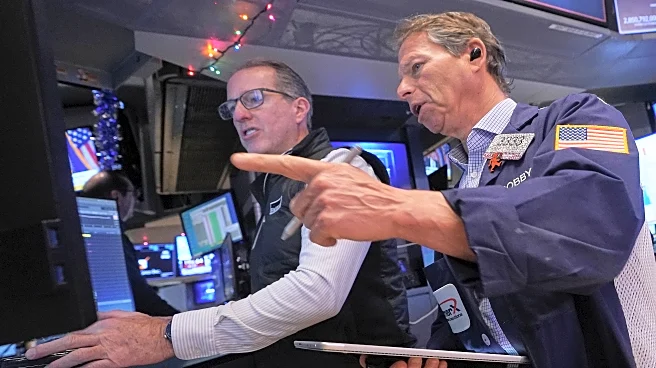




Wall Street drifting lower before the opening bell, heading for the fourth day of losses, on the final day of trading for 2025, a banner year for markets that was driven by both optimism and uncertainty.
Futures for the S&P 500 and the Dow Jones Industrial Average each ticked down 0.1% early Wednesday. Nasdaq futures were off 0.2%.
Institutional investors are largely closed out of their positions for the year, so trading is expected to be extremely
light. U.S. markets will be closed on Thursday for New Year's Day.
The S&P 500 is up more than 17% this year as investors embraced artificial intelligence technology, both in the sector and its potential across almost all other sectors.
The AI frenzy that drove markets in 2025 did not come without concerns. Chief among them is the worry that artificial intelligence technology may not produce enough profits and productivity to make all the investment worth it. That could keep the pressure on AI stocks like Nvidia and Broadcom, which were responsible for much of the market’s gains this year.
And it’s not just AI stocks that critics say are too pricey. Stocks across the market still look expensive after their prices climbed faster than profits.
On top of concerns that stocks are overvalued, the ongoing impact of a wide-ranging U.S.-led trade war threatens to add more fuel to inflation in the U.S. While the Federal Reserve has cut its benchmark lending rate three times to close out the year, inflation remains solidly above the central bank’s 2% target.
Fed officials have cited concerns over a weakening labor market as their motivation for cutting rates. Arriving later Wednesday is the Labor Department’s most recent data on weekly jobless claim applications, which are viewed as a proxy for layoffs.
The Fed has signaled more caution moving forward. Minutes from its December meeting reflect the divisions within the central bank as it deals with uncertainty about the threats facing the economy.
Wall Street is betting that the Fed will hold interest rates steady at its next meeting in January.
Sung Won Sohn, professor of finance and economics at Loyola Marymount University, believes uncertainty is brewing for global markets because of inflation, labor shortages and questions about where interest rates might be headed.
“Central banks must tread carefully, and financial markets will likely experience continued volatility as expectations shift,” he said.
“For businesses, investors, and policymakers alike, flexibility, risk management, and close attention to economic signals will be essential in navigating the challenges ahead.”
Trading in precious metals continued to be volatile as the year winds down. Silver swung back to a big loss, giving back more than 8% early Wednesday after Tuesday's gain of more than 10%. Following Friday's 7.7% jump, silver lost nearly 9% on Monday. It's still up more than 140% this year.
Gold fell 1.5% Wednesday morning but is still up 66% in 2025.
Elsewhere, global stock markets including Germany, Japan and South Korea were closed Wednesday for the New Year's holidays, while trading was mixed in those that remained open.
France's CAC 40 lost 0.5% by midday, while Britain's FTSE 100 shed 0.2%.
Earlier in Asia, the Hang Seng index dipped 0.9% to 25,630.54, while the Shanghai Composite rose 0.1% to 3,968.84. The Taiex in Taiwan jumped 0.9% to 28,963.60. In Australia, Sydney's S&P/ASX 200 dipped less than 0.1% to 8,714.30.
Tokyo trading was set to be closed for the New Year's holidays on Thursday and Friday and scheduled to reopen on Monday. In South Korea, trading was scheduled to be closed on Thursday.
U.S. crude picked up 31 cents to $58.26 per barrel. Brent crude, the international standard, added 28 cents to $61.61 per barrel. Yet crude, unlike some other commodities this year, has been falling in prices. A barrel of crude costs 19% less today than it did at the start of the year, and gas prices are down 6% to 7% nationally, or about 20 cents per gallon.