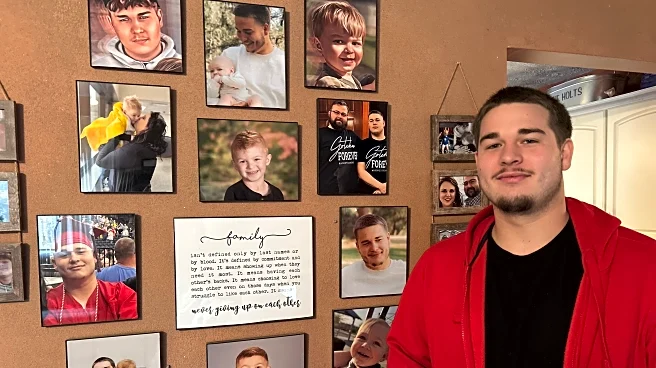

When Jaiden Holt was growing up, there wasn’t a whole lot in his life that made him feel good.
His biological mother lost custody of him when he was young, and he entered the child welfare system, often
living with his aunt and grandmother in St. Albans. Then, when he was seven, his mother regained custody and took off for Florida with Jaiden in tow.
For the next seven years, they lived in tents and U-Haul trailers, occasionally squatting in abandoned buildings. Jaiden rarely went to school. Once, his mother left him, and he ended up living with her drug dealer for two years.
“It wasn’t fun, but you just kind of learn to adapt to it,” he said.
But Jaiden remembers how his first real barbershop haircut made him feel. It was modeled after a style pop star Justin Bieber was wearing at the time. Despite everything else going on in his life, that haircut made Jaiden feel untouchable.
“He had that big ol’ swoosh on his hair, and I wanted that swoosh and I got that swoosh,” he said, grinning. He pulled out his phone, displaying a photo of his younger self with his new haircut, brow furrowed, pouting at the camera.
A couple of years after that haircut, Jaiden was a teenager, back in West Virginia and in the foster care system. For a while, everything was temporary as he lived in child shelters, a group home and with a foster family that wasn’t a good fit. By the time he was 17, things were looking up: Jaiden had found a home with people who loved him. They adopted him shortly before his 18th birthday, and he graduated from high school later that year.
But in the two years since then, he’s been stuck. He wants to be a barber, cutting hair to make other people feel the way that “big ol’ swoosh” had once made him feel, but he can’t afford barber school. He has two young sons he needs to support, but has had no luck applying for minimum wage jobs. It’s hard for Jaiden to see a very rosy future.
“Honestly, I’ve never been the type to have hopes and dreams about stuff,” he said. “Because, even growing up, I never saw a future. I didn’t expect to make it past 16, if I’m being honest.”
What Jaiden didn’t know is that he could have gone to barber school at any time. The federal government gives West Virginia money to help former foster kids like him afford college and trade school or pay for rent, tutoring, budgeting classes and a range of other services.
And he’s not alone. For years, West Virginia’s child welfare agency has been failing to connect foster kids to these services. In doing so, a Mountain State Spotlight investigation has found, state officials have been squandering a powerful opportunity to help the state’s most vulnerable kids move from foster care to adulthood.
Since 2010, the state has returned nearly $7 million for these programs to the federal government, Mountain State Spotlight’s investigation found.
In all, West Virginia has returned more than a fifth of the money it received from the grant program from 2010 to 2023. The state’s foster care agency has sent money back under the administrations of three previous governors, both Democratic and Republican.
Agency spokeswoman Angel Hightower acknowledged the unspent funds, but insisted that wouldn’t happen under current Gov. Patrick Morrisey’s administration.
“Since the new administration took office in 2025, the Department of Human Services has proactively worked to identify underutilized funds earlier in the grant process, so they can be reallocated to other programs aimed at helping foster care children as they enter adulthood, ensuring they are used effectively,” she wrote in an email.
Hightower was not able to say whether the state spent all available funds for the latest grant cycle, which ended in September. She said the state’s grant report was not yet due, and had not been filed.
For a generation of foster kids, the administration’s commitment comes too late.
“It’s ridiculous,” said attorney Cathy Wallace of the wasted money. She has frequently represented foster kids as their guardian ad litem. “It’s one of the most embarrassing things West Virginia can say that they do.”
On a January day a few weeks into the 2023 legislative session, state senators gathered to review the budget for the Department of Health and Human Resources.
Interim DHHR Secretary Dr. Jeff Coben reminded lawmakers he’d only been in the position for seven weeks. His tenure with the department would last another five months, before he returned to his duties at West Virginia University’s School of Public Health.
As Coben ran through a slide presentation of the budget highlights, a slide caught the eye of Sen. Ben Queen, R-Harrison. It laid out billions of dollars the agency had received in extra COVID-era federal funding. And for several of the grants, money hadn’t been spent.
“Are we sending federal funds back that we’re not using?” Queen asked Coben.
“We do some, yes,” Coben replied.
A month later, West Virginia sent back nearly $5 million for two grants through the John H. Chafee Foster Care Independence Program, earmarked to help foster kids.
The idea behind the program, named after the late U.S. senator from Rhode Island who sponsored the legislation that created it, is to give states money to help prepare kids for adult life after foster care. One pot of money can be spent in a variety of ways to help kids learn the necessary skills to live independently. The other helps pay for post-secondary college or vocational training. The federal government covers 80% of the cost, while the state has to kick in the rest.
But frequently, West Virginia hasn’t spent the money. It wasn’t just that extra COVID money: The state failed to spend all of the money from Chafee grants more than half of the time between 2010 and 2023 .
This isn’t just a problem in West Virginia. Earlier this year, a report by the U.S. Government Accountability Office found that 29 states returned extra pandemic funds for independent living. Twenty-five returned at least part of the extra grant for education and training. And even among the regular annual grants, the agency found that states sent back millions of dollars every year from 2018-2022.
For Jennifer Pokempner of the Youth Law Center, this unspent money doesn’t indicate a lack of need; rather, that states aren’t doing a good job telling kids what’s available.
“It seems very clear that there’s a real high need for services,” she said. “And I think states would benefit from really being a lot clearer about the programs, doing more outreach.”
Nowhere is that more true than in West Virginia, which for years has led the nation in the highest percentage of kids in foster care. The system has been chronically overwhelmed with shortages of social workers and foster homes, leaving kids languishing in institutions and living in hotel rooms.
Chafee is meant for kids like Jaiden Holt who need extra help to close the gaps created by years spent in the foster care system. When this money is spent wisely, it can help former foster kids build a steadier foundation for their adult lives.
Take Maria Bass. When she turned 18 after years of living in shelters, juvenile detention centers and treatment facilities, she faced long odds. But she had a trusting relationship with her state social worker, and when the worker explained Maria would be able to access additional benefits if she voluntarily extended her time in the state’s custody, she agreed.
“She wants what’s best for me,” she said of her caseworker.
By doing so, Maria has been able to pay for her college courses toward earning a medical assistant degree at West Virginia Junior College. She has a one-bedroom apartment overlooking the Kanawha River in Charleston — money from this program covers the entire rent. And this assistance has given her the breathing room to prepare for and dream about the better life she wants to give her unborn son. He’s due in February, and his crib, bouncer and playmat already fill Maria’s apartment in anticipation.
“My son is not going to have the experience I had as a kid,” she said fiercely. “I’m going to do way better.”
But an analysis of the data West Virginia submits to the federal government shows that more often than not, kids like Maria don’t get any services through the program. Between 2018 and 2023, only 13% of the kids who aged out of West Virginia’s foster care system got any of these federally-funded services — far below the U.S. average of 81%. Of the West Virginia kids who did get support through this program, they got fewer individual services than U.S. kids on average.
In a statement, a spokesperson for West Virginia’s child welfare agency blamed the low participation rates on a broader lack of social services in some parts of the state. But two of the major benefits this federal money can provide are rent and education subsidies that theoretically should be available throughout the state.
Since 2023, DoHS officials say they have expanded independent living options for former foster kids.
“Increasing awareness and developing partnerships remain a priority to ensure youth understand which services are available to them,” Angel Hightower wrote.
When West Virginia doesn’t connect kids with these services, the state misses opportunities and the money goes unspent. And lawyers, current and former CPS workers and former foster kids say often, it all comes down to the caseworkers: whether they have enough time to spend helping older teens plan for their adult lives, and whether they’ve developed a close enough relationship to ensure the teenage foster kid takes their advice.
For Wyatt Pitcock, an absent Child Protective Services worker almost caused him to miss his chance to tap into the opportunities that West Virginia promises to former foster kids.
“The CPS workers honestly didn’t tell me much about what would happen after I aged out,” Wyatt, now 19, said. He spent several years in foster care in Braxton County. “I wanted to go to college, but I didn’t think there was any way I’d be able to afford it.”
Even though Wyatt was on track to graduate high school with decent grades, his CPS worker had never mentioned MODIFY: the program run by West Virginia University to help connect qualified former foster kids with money from Chafee. Referring foster kids to that program is explicitly part of the social workers’ duties when managing the cases of older teenagers.
The only reason Wyatt found out about the program was through a chance encounter: his foster sister applied for help with college, and a representative came to their apartment to talk to her and their foster mom.
“Can Wyatt get this stuff too?” Wyatt remembers his foster mom asking. The answer was yes, and the worker helped him fill out the forms.
Now, Wyatt is a sophomore at WVU. He’s majoring in social work and hopes someday he can help kids like him.
“My CPS worker was very absent whenever I was in the system,” he said. “I want to get into the system and try to make it a little better. I know I’m only one person, but I’m hoping that one person can make a difference.”
But over the past few years, even the most diligent and well-meaning social workers have found it difficult to spend adequate time with all of the foster children assigned to them.
Many workers have said their average caseload was in the 30s, and some have reported having as many as 50 cases at a time. And because of the way the state calculates cases, each case often has multiple children. That high caseload has been attributed to high vacancy rates among CPS workers combined with large numbers of children in the system.
In the past two years, the state has added more positions and reported progress in filling vacancies: as of October, 7.5% of the allotted CPS positions were vacant, down from more than 27% in 2023.
But as recently as 2024, agency officials noted that simply filling the vacancies wouldn’t be enough to achieve the target caseload of 10 cases per worker. If the remaining vacancies were filled today, West Virginia would still need dozens more workers to reach that goal. A state spokesperson didn’t answer a question about what the current average caseload is for social workers.
Earlier this year, Mountain State Spotlight revealed that state officials fall far short of giving foster kids the mental health care they need, and that the state is increasingly putting the burden of children’s needs onto grandparents without providing adequate help for those families. We also reported that, despite years of talk about the problem, the state still struggles to hire and retain child welfare workers.
Last month, a federal audit found severe deficiencies in the way CPS workers investigate child abuse, problems the state agency attributed to the longstanding crisis of overly-burdened workers with high caseloads.
After kids enter West Virginia’s custody, these same out-of-control caseloads often mean CPS workers have no time to spend on seemingly less urgent tasks, like creating a plan with all kids older than 14 to help them work toward independence.
“Transition planning is a vital part of the youth’s case plan,” West Virginia’s Foster Care Policy reads. “The plan must be specific for the youth and contain information that will assist the youth in their successful transition to adulthood.”
Part of that is working with the foster kid to identify the skills they need to learn, and crucially, whether any of these services can be paid for using Chafee funds from the federal government.
Until recently, Amie Andersen was a CPS worker in McDowell County. She said more than half of the kids she worked with were teenagers.
She thought back to one of her most memorable cases: “I’ve never met a more intelligent teenage boy,” she said. He entered foster care as a teenager, and they put him in a temporary shelter. As Andersen tried to find him a more permanent placement, he told her his plan for adulthood was to live out of his car.
“Had I known there were more resources there for him that I could have plugged into for him early on, I think he wouldn’t have had to struggle so hard,” she said.
Amanda Barnett was able to benefit from Chafee funds at a young age: when she was 16, after a variety of failed placements, the state moved her into her own apartment in Putnam County.
“This child isn’t working in group homes, she’s not working in foster care, she’s not working here, she’s not working there, she can’t go home to her family, what else do we have left?” Amanda said of what she believed were her social worker’s thoughts at the time.
This wasn’t a semi-independent option, like many run by nonprofits around the state to help older foster kids ease into their independence. It was her own apartment, where she lived by herself. She didn’t have a driver’s license or a car. And with no other support, problems emerged. Amanda said she had a tendency to spend too much of her stipend at the local Dollar General, which was one of the only places she could walk to. Eventually, her CPS worker found alcohol in her apartment.
“They didn’t like the way that I was handling things,” she said. “But I mean, I’m a 16-year-old. You give a 16-year-old their own apartment, there’s going to be a lot of problems — especially a 16-year-old that’s been in the state’s custody for the last five years.”
The whole experience left her with the sense that she didn’t have any control over her life, and no one cared. Now 23, she looks back on that time and marvels at how unprepared she was.
“They taught me nothing,” she said of her CPS workers. “I figured that out all by myself, in the sense of what to do, how to live, how to exist.”
Many former foster kids talk about the lack of control they felt while in the system. So, maybe it shouldn’t be surprising that for many, their first act as an adult is to take that control back.
When kids in foster care turn 18, they have an option to voluntarily extend their state custody. While foster kids are eligible for Chafee services starting at age 14, some of the most significant benefits, including subsidized rent and money for college, are for older kids. By choosing to stay involved in the system, a young adult can unlock those benefits.
But advocates in every corner of West Virginia said it’s rare they can convince a kid to sign up.
For 28 years, L. Scott Briscoe has represented thousands of kids in Boone County in court as their guardian ad litem. And as each kid gets closer to their 18th birthday, he’s tried to get them to consider opting in to more support.
He said of those thousands of kids, only two have agreed.
“I’ve made the pitch in every possible way to every 17-year-old that I know. I try to dangle that carrot of money in front of them,” Briscoe said. “I have tried in so many ways to explain the opportunities for education, housing, vocational training, money in their pockets. But time after time after time, every single kid says to me, ‘I don’t want it. There are strings attached.’”
These agreements are sometimes referred to as “extended foster care” or even “signing yourself back into the system.” But in reality, it’s not the same as foster care for children. Instead, this program is a safety net for young adults. In return for agreeing to stay out of trouble with the law, and to hold down a part-time job or pursue a degree or vocational certificate, former foster kids can get several years of benefits. And in theory, West Virginia gets several more years of checking in with these kids and trying to set them on a path for future success.
“The problem is, it takes a huge paradigm shift on the part of the child to recognize what they’re being offered. Because their experience has been in the system where everything has been taken away from them,” said Layne Diehl, an attorney in Martinsburg. “I think they just truly do not believe what you’re telling them. They just don’t buy it. They think you’re lying to them.”
Advocates around the state and country say that with clearer explanations of the benefits — as well as the ways the extended foster care program differs from traditional foster care — more kids might be willing to remain involved with the system as young adults and take advantage of the federal funding.
This support could have really helped Orion Flynn, who lives in Huntington. He aged out of the system in 2023 after more than a decade bouncing among treatment centers, group homes, temporary shelters and short-term foster families.
Looking back on his experience two years later, he has a laundry list of the skills he wished he had been able to learn before he aged out of care: cooking, laundry, doing taxes, applying for jobs.
“Various life skills that are small, but whenever you stack them all together, it just makes life a little harder not knowing them,” he said.
He said he was interested in learning more about what his options were for independent living support once he turned 18. But when he asked his CPS worker about it, he said she explained that he would probably have to start out in more of a group home setting, before moving into his own apartment.
But Orion had been to group homes before.
“You were treated like a number on a sheet a lot of times. I didn’t want to experience that again,” he said. “Seeing how that was presented as my only option for getting any help after foster care, I kind of stopped pursuing it.”
When these youth aren’t properly supported, the effects can be seen in towns and cities across West Virginia.
In Charleston, Traci Strickland runs the Kanawha Valley Collective, a nonprofit that helps people experiencing or at risk of homelessness.
“This year we have seen more people directly aging out of foster care,” Strickland said. “Within the past month, I’ve had three calls directly related to people who have just aged out of foster care.”
It doesn’t have to be like this. But experts say convincing more former foster kids to accept help and support after age 18 will likely involve a reimagining of the program, as well as its requirements.
Other states have tried various approaches. In Illinois, for example, youth generally remain in the state’s custody until they’re 21. In Washington State, lawmakers increased participation rates for kids over 18 when they removed a requirement, which still exists in West Virginia, for youth to work or be in school to keep getting help.
Outside of the child welfare system, nonprofits have seen success in reaching former foster kids who want nothing else to do with the state. Many programs have placed an emphasis on mentorship, helping foster kids and former foster kids develop trusting relationships with adults, who can then offer advice and support.
At the FPC Hope Center in Charleston, director Kyla Nichols said their services aren’t so different from what the state provides with federal funding. But most of the kids she works with chose not to extend their custody.
“I think they’re more willing to seek services through programs like Hope Center because they’re voluntary,” she said. “They know they have a say, they can access as many or as little services as they choose.”
Whether kids get support through federal funding while they’re in West Virginia’s child welfare system or through places like Hope Center afterwards, advocates agree there’s a sweet spot. It’s easier to help a kid before they’ve experienced homelessness, struggled with substance abuse or been incarcerated, rather than after.
“I’m old enough now where I’m seeing a lot of my old clients are now parents and are back in the system too,” attorney Cathy Wallace said. “This is one of the tools that we have that can help break that cycle: giving them an education and giving them opportunities when they didn’t have it before and giving them a support system to allow them to do that. And if we’re not going to be able to provide that, then I think it hurts our ultimate mission of breaking the cycle and raising children who could be productive citizens.”
In St. Albans, Jaiden Holt has a new mission: to try to figure out how to unlock the funding for barber school that he should be entitled to as a former foster kid.
“I still want to go, it’s just about figuring that stuff out,” he said.
He’s heard from a worker who can help him apply for the program, and his mom is going to help him navigate the process. And he’s allowing himself to dream — just a little — about what the future might hold. Like that someday he’ll own his own business with a barbershop in the front and a lounge in the back.
“Then you gotta call it ‘Chop It Up,’” he joked. “Get it? Cause, like in the back you’re chopping it up.”
He hopes it’s not too late.
___
This story was originally published by Mountain State Spotlight and distributed through a partnership with The Associated Press.