



Iran offered to end its chokehold on the Strait of Hormuz without addressing its nuclear program, officials with knowledge of the proposal said Monday.
Iran also wants the United States to end its blockade of the country as part of its proposal, according to the two regional officials, who spoke on condition of anonymity to discuss the closed-door negotiations.
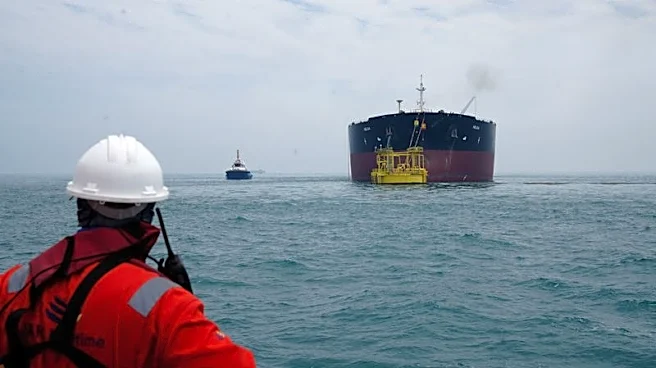
Oil prices were up Monday as a standoff between the U.S. and Iran in the Strait of Hormuz
remained despite a ceasefire, while Pakistan leaders were seeking to revive stalled talks between the two countries.
Iran’s Foreign Minister Abbas Araghchi was in Russia Monday for a meeting with President Vladimir Putin as part of a trip that included two stops in Pakistan and a visit to Oman, which shares the strait with the Islamic Republic.
Pakistan-led mediators are working to bridge significant gaps between the U.S. and Iran, according to a regional official involved in the mediation efforts who spoke on the condition of anonymity because they were not authorized to discuss the matter.
U.S. President Donald Trump canceled plans for his top envoys to travel to Islamabad this weekend for negotiations after Iran insisted the U.S. should end its blockade of Iranian ports before new talks can take place.
Early Monday, the U.S. military’s Central Command said it has so far turned around 38 ships during the blockade.
Here is the latest:
Military spending in the Middle East plateaued in 2025, even as it climbed in other parts of the world, according to a report released Monday by the Stockholm International Peace Research Institute. The think tank, which goes by the acronym SPRI, said regionwide spending increased 0.1% but actually fell in both Israel and Iran.
Israel’s military spending fell 4.9% to $48.3 billion, reflecting a less intense year of fighting than in 2024 after it entered ceasefires in Lebanon in November 2024 and in Gaza in October 2025. Even as large-scale combat subsided, Israel continued carrying out lethal strikes and maintained a ground presence in both. Spending remains sharply elevated — up 97% compared with 2022 — and the war has strained public finances, with Israel reporting wider deficits and increased borrowing since it began.
Iran’s spending fell 5.6% to $7.4 billion. SIPRI attributed that to inflation and broader economic strain, though researchers warned that government reports are likely understated.
“Iran also uses off-budget oil revenues to finance its military, including the production of missiles and drones,” SIPRI researcher Zubaida Karim said.
Lebanon President Joseph Aoun blasted militant group Hezbollah on Monday over its rejection of direct talks with Israel.
Lebanon’s decision to hold negotiations with Israel is not “treason,” Aoun said in a statement, adding that treason is when “someone takes the country to war to achieve foreign interests.”
Harshly criticizing Hezbollah without naming it, Aoun asked whether there was a “national accord” when the Iran-backed group took Lebanon to war last month.
Hezbollah fired rockets into Israel on March 2, two days after the U.S. and Israel attacked Iran. The fighting has killed over 2,500 people, wounded more than 7,000 and displaced over 1 million people.
Aoun asked how long people in south Lebanon will pay for the wars of other nations or groups, “the latest of which was the war for backing up Gaza and the war for backing up Iran.”
“I totally reject this war” when the goal is to benefit others, he said.
Aoun said he wants to end the state of war with Israel in the manner of the 1949 Armistice Agreements that brought calm along the border for years without normalizing relations.
“Was the armistice agreement humiliation? I will not accept reaching a humiliating deal,” Aoun said.
Transavia France said late Sunday it is canceling some flights in May and June because of rising fuel costs.
The low-cost airline, part of the Air France-KLM group, said in a statement “the current geopolitical context in the Middle East and its repercussions on the price of aviation fuel” forced the cancellations.
French media reported the cancellations represented less than 2% of the company’s May and June flight program.
Transavia said affected passengers would be able to choose between a voucher, full refund or free rebooking, which will be offered within 24 hours for the majority of canceled flights.
China said Monday it opposed a decision by the United States to sanction one of its refineries for purchasing Iranian crude oil shipments.
The U.S. announced Friday it would sanction Hengli Petrochemicals in China’s northeastern port city of Dalian.
The measure blocks the company and others that transport Iranian oil from accessing the U.S. financial system.
Hengli Petrochemicals is among dozens of Chinese buyers of Iran’s oil. China is Iran’s largest overall oil customer.
“China always opposes illegal unilateral sanctions that lack a basis in international law and urges the U.S. to stop its wrong practices of abusing sanctions and exercising long-arm jurisdiction,” Ministry of Foreign Affairs spokesperson Lin Jian said.
“We will firmly safeguard the legitimate rights and interests of Chinese companies,” Lin said.
Karex, the world’s largest manufacturer of condoms, said it has raised prices by up to 30% to cope with escalating costs due to the closure of the Strait of Hormuz, which is a vital channel for petrochemical supplies.
CEO Goh Miah Kiat said the company has little choice but to pass higher costs to customers for condoms, personal lubricants, probe covers and catheters as raw materials, logistics and production expenses surge.
Karex produces 5 billion condoms annually, or about a fifth of global market share, with its biggest market in the United States, according to company data.
The Malaysian firm believes demand will rise at least 30% this year as “people use more condoms during periods of economic uncertainty,” Goh said.
Karex faces rising costs for nitrile latex, silicone oil and lubricant materials, natural rubber latex and aluminum foil packaging, Goh said, adding that freight costs and supplier delays have forced Karex to hold larger inventories of key materials.
Iran is offering to end its chokehold on the Strait of Hormuz without addressing its nuclear program, two regional officials with knowledge of the proposal said Monday.
Iran also wants the United States to ends its blockade of the country as part of its proposal, according to the two officials, who spoke on condition of anonymity to discuss the closed-door negotiations.
The new proposal, passed onto the U.S. by Pakistan, is not likely to receive the backing of U.S. President Donald Trump, who wants to end Iran’s atomic program as part of an overall deal including the Strait of Hormuz to make the ceasefire permanent.
“We have all the cards. If they want to talk, they can come to us, or they can call us,” Trump told Fox News Channel on Sunday.
Axios first reported Iran’s proposal.
— By Samy Magdy
Iranian Foreign Minister Abbas Araghchi said Monday that his trip to Russia offered an opportunity to coordinate with Moscow after the war with Israel and the United States.
Araghchi made the comments in a pretaped interview posted by the state-run IRNA news agency.
“It is a good opportunity for us to consult with our Russian friends about the developments that have occurred in relation to the war during this period and what is happening now,” he said.
Araghchi said it was America’s approach that “caused the negotiations to be delayed” that had been planned in Islamabad.
“The previous one, despite the progress that had been made, could not achieve its goals,” he said, blaming what he called Washington’s “excessive demands.”
Trump has questioned who is in charge in Iran at the moment and said confusion within its theocracy made it difficult to reach a deal.
Iran’s top diplomat arrived Monday in Russia ahead of a meeting with Russian President Vladimir Putin.
The state-run IRNA news agency said Abbas Araghchi landed in St. Petersburg for his meeting with Putin.
Araghchi has visited Islamabad twice and Muscat, Oman, on the foreign trip as negotiations with the U.S. appear stalled over the Iran war.