


Public opposition to the military’s plan to build up to seven telescopes in a state conservation district atop Haleakalā has been mounting in recent weeks, after the release of a draft environmental impact statement late last month.
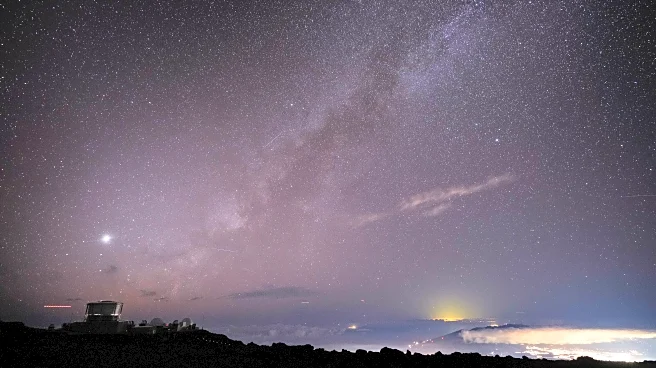
Six academic and four space surveillance telescopes already sit on the volcano’s summit, which, at 10,000 feet, is the Valley Isle’s highest peak. However, the government’s position is that new telescopes are needed to
enhance the United States’ ability to track and identify potential threats among satellites and other objects in space over the Pacific.
Haleakalā is home to numerous endangered or threatened species like the Hawaiian hoary bat, Hawaiian shearwater, the Hawaiian goose or nēnē and a species of silversword that grows only on the mountain, but the project’s environmental impact is expected to be minimal, according to the draft environmental survey. There would, however, likely be significant adverse effects on cultural resources because the mountain top is considered by many Native Hawaiians and others to be a sacred and deeply spiritual place, the EIS says.
Opponents of the telescopes say the environmental report does not have sufficient strategies for mitigating negative impacts on cultural and environmental resources, and federal officials have not done enough to incorporate feedback from locals.
Some of that frustration came through on Tuesday, when more than 100 people packed into the Kīhei Community Center for the first of two public hearings where the public can share feedback and ask questions about the draft report. The meetings are being conducted by the Air Force and the hearing panel includes Air Force officials and advisers.
Dozens of people voiced concerns at the meeting about the approximately $5.9 million project’s potential to degrade cultural resources, negatively affect biodiversity and make Maui a military target. Many residents said the U.S. government has a long history of harming Hawaiian land for military operations, and they noted federal officials are still cleaning up a 720-gallon diesel fuel spill caused by a lightning strike at the Maui Space Surveillance Complex on the mountain in January 2023.
“You have no answers other than sorry, we are going to do better,” Mona Kea told the panel. “Nobody believes you at this point, so I don’t really understand why you are still here. It’s such a clear and resounding no from the community.”
The Air Force says the cleanup of the spill shows the military is committed to protecting cultural resources.
“Restoring the land in a way that is culturally informed has been and continues to be our top priority to ensure we do this right,” U.S. Space Force Lt. Col. Douglas Thornton, 15th Space Surveillance Squadron commander, said in a written statement last week. “We are cognizant of the cultural significance of our operational location to provide essential space domain awareness and continue to build trust with the community in which we live and work.”
Construction of the telescopes is currently planned to begin by 2027, and it is expected to take about two years. The domed telescopes — as well as infrastructure improvements like a new paved access road, parking facilities and surface water runoff management measures — would be built on less than 1 acre of land near the existing space surveillance complex on Haleakalā.
The completed complex would be known as Air Force Maui Optical and Supercomputing Site Small Telescope Advanced Research Facility, or AMOS STAR.
In recent decades, several new telescopes have been built near Haleakalā’s summit, where the near-absence of light pollution, high altitude air and clear skies render the space viewing conditions among the best in the world. The Air Force has been providing space intelligence to the U.S. Department of Defense from facilities on Haleakalā and in Kīhei for nearly 70 years.
Haleakalā features prominently in the story of Maui as the place where the demigod wrangled the sun, and fights over the telescopes on the mountain top date back years. In 2015 and 2017, demonstrators were arrested after they lay in the road to stop construction vehicles transporting parts for the controversial $344 million Daniel K. Inouye Solar Telescope.
Federal officials first unveiled plans to build up to seven new telescopes in 2024, and that spring, hundreds of locals attended public hearings to express vehement opposition to the project. The Air Force also received written comments from more than 600 people, the majority of whom were against the planned space surveillance facility, according to the draft environmental impact statement.
In June of that year, the Maui County Council unanimously voted to oppose the project, and Mayor Richard Bissen sent a letter to the Air Force expressing the community’s disapproval.
Despite the outcry, federal officials have maintained that the need to build the new telescopes and expand their ability to identify satellites and other objects will only become more critical in the coming years as space debris continues to accumulate in Earth’s orbit.
The new facility would be managed and operated by the Air Force Research Laboratory, which is responsible for tracking the approximately 48,900 space objects orbiting above the Pacific. Haleakalā is perhaps the only site where the telescopes could be built, in part because its geographic location and optimal viewing conditions would allow officials to monitor critical areas of space that can’t be seen from other locations, the document states.
A hui of local organizations has come together under the banner “Protect Haleakalā” to oppose the project, said Kiope Raymond, the president of the group Kilakila O Haleakalā, a Native Hawaiian group that has fought against military and research telescopes on Haleakalā. Even though locals have publicly resisted telescopes on the volcano’s summit for years, there is still a lack of sufficient consultation with Native Hawaiian organizations.
“The pain has become intergenerational,” Raymond said. “And the pain is traumatic, coming from the broken process itself.”
The draft environmental report says that workers will “respect, honor, and not interfere with traditional cultural practices,” and employees and contractors will be required to receive “cultural awareness” training.
But that is not enough, said Raymond, who founded one of Maui’s first Hawaiian language immersion preschools. The project should not be allowed to proceed at all, he said.
Maui County Council member Tamara Paltin, who represents West Maui, said many locals are also wary of any perceived military expansion in Hawaiʻi and are afraid that increasing the nation’s intelligence operations on Maui could make the island a target.
“People are rightfully, I think, scared,” she said. “The reason that Pearl Harbor was attacked back in the ‘40s was because it was a strategic military installation of the American empire, and with the state of things in the United States of America right now and other nations’ feelings towards the United States of America right now, it’s pretty horrifying.”
Hawaiʻi has had a complicated relationship with the U.S. military since Marines aided the overthrow of the monarchy in 1893. Those tensions have surfaced repeatedly throughout history, and they are coming to a head once again as military leases on state lands on Kauaʻi, Oʻahu and an artillery range on Big Island are set to expire soon. Native Hawaiian groups, including those advising Gov. Josh Green, have also criticized the negotiation process for seeming to exclude Hawaiian voices.
The fight over telescopes on Haleakalā parallels a similar movement on Mauna Kea. However, the Big Island saw very different results.
After nearly a decade of legal battles and protests, construction of the Daniel K. Inouye Solar Telescope on Haleakalā was completed in 2021, but similar demonstrations successfully stalled the building of the Thirty Meter Telescope on Mauna Kea and led to the creation of a new entity to manage the mountain.
Raymond said there needs to be more collaboration on Haleakalā. Unlike Mauna Kea, Haleakalā has no comprehensive management plan among the various agencies that use it including the National Park Service, several branches of the military and the University of Hawaiʻi.
Without a cohesive plan, Raymond worries that each of the agencies will operate in a silo.
“It’s just not fair how we do it,” Raymond said.
Federal officials for the U.S. Air Force and U.S. Space Force will host a second public hearing on Wednesday from 6 p.m. to 9 p.m. at the Mayor Hannibal Tavares Community Center in Makawao, and will accept written feedback on the 516-page document through March 16.
___
Civil Beat’s coverage of climate change and the environment is supported by The Healy Foundation, the Marisla Fund of the Hawai‘i Community Foundation and the Frost Family Foundation.
___
This story was originally published by Honolulu Civil Beat and distributed through a partnership with The Associated Press.