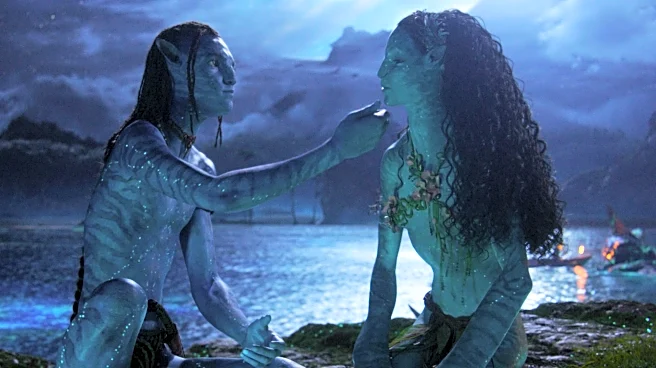

When I came down with a cold the day after I saw the third and latest “Avatar” film, “Fire and Ash,” I half-wondered if I had picked it up on Pandora.
The promise of Cameron’s 3D trilogy has always been
immersion: immersion in a science-fiction world, in technological wonder, in a maybe future of movies. “Avatar” is almost more a place to go than a movie to see.
Still, it’s now been two decades since Cameron set off on this blue-tinted quest. The sheen of newness is off, or at least less pronounced, with new technological advances to contend with. “Fire and Ash” is running with a behind-the-scenes video about how performance capture was used during the film’s making. The implicit message is: No, this isn’t AI.
The “Avatar” films, with their visual-effects wizardry and clunky revisionist Western storytelling, have always felt, most of all, like an immersion in a dream of James Cameron’s. The idea of these movies, after all, first came to Cameron, he has said, in a bioluminescent vision decades ago. At their best, the “Avatar” movies have felt like an otherworldly stage for Cameron to juggle so many of the things — hulking weaponry, ecological wonder, foolhardy human arrogance — that have marked his movies.
“Fire and Ash,” at well more than three hours, is our longest stay yet on Pandora and the one most likely to make you ponder why you came here, in the first place. These remain epics of craft and conviction. You can feel Cameron’s deep devotion to the dynamics of his central characters, even when his interest outstrips our own.
That’s especially true in “Fire and Ash,” which, following the deep-sea, family-focused part two, “The Way of Water,” pivots to a new chapter of culture clash. It introduces a violent rival Na’vi clan whose rageful leader, Varang (Oona Chaplin), partners with Stephen Lang’s booming Col. Miles Quaritch and the human colonizers.
For those who have closely followed the “Avatar” saga, I suspect “Fire and Ash” will be a rewarding experience. Quaritch, Pandora’s answer to Robert Duvall’s Bill Kilgore in “Apocalypse Now,” remains a ferociously captivating character. And the introduction of Chaplin’s Varang gives this installment an electricity that the previous two were missing.
But for those whose trips to Pandora have made less of an impact, “Fire and Ash” is a bit like returning to a half-remembered vacation spot, only one where the local ponytail style is a little strange and everyone seems to have the waist of a supermodel.
Time has only reinforced the sense that these films are hermetically sealed movie terrariums. They're like a $1 billion beta test that, for all their box-office success, have ultimately proven that all the design capabilities in the world can’t conjure a story of meaningful impact. The often-remarked light cultural footprint left by the first two blockbusters only hints at why these movie seem to evaporate by the ending credits. It’s the lack of inner life to any of the characters and the bland, screen-saver aesthetics. At this point in a trilogy, nine hours in, that hollowness makes “Fire and Ash” feel like almost theoretical drama: more avatar than genuine article.
These movies have had to work extremely hard, moment to moment, just to pass as believable. But almost every gesture, every movement and every bit of dialogue has had something unnatural about it. (The high frame rate is partially to blame.) That’s made these uncanny movies a combination, in equal measure, of things you’ve never seen before, and things you can’t unsee.
“Fire and Ash,” scripted by Cameron, Rick Jaffa and Amanda Silver, picks up with the aftermath of the climatic battle of “The Way of Water.” The Na’vi and their seafaring allies, the Metkayina clan, are nursing their wounds and recovering the human weapons that sunk to the sea floor.
When a rival clan called the Mangkwan or Ash People come to challenge the Na’vi, those weapons represent an ethical quandary. Should they use such firepower in their own local battles? This is a more difficult question partially because the fire-mad Mangkwan are especially bloodthirsty, led by their slinky sorceress, Vanang (played with seductive sadism by Chaplin, granddaughter of Charlie).
But their fight is only a piece of the larger war of “Fire and Ash.” The focus of this third chapter (films four and five are said to be written but not greenlit) is interspecies coexistence. As human and Na’vi lines continue to blur, the question becomes whether the human invaders will transform Pandora or if Pandora will transform them.
That puts the focus on the three characters in various in-between states. First, there’s Spider (Jack Champion), the human son of Quaritch who lives happily with the Na’vi while breathing through a machine to survive the Pandora atmosphere. (Champion has the double misfortune of wearing a mask and looking downright puny next to the tall and slender natives.) But in “Fire and Ash,” he discovers he can breathe unfiltered, a development that prompts intense military interest in a potentially hugely profitable breakthrough in Pandora assimilation.
There’s also Jake Sully (Sam Worthington), the former human who has made a Na’vi family with Neytiri (Zoe Saldaña). For Neytiri, the growing menace of human warfare causes her to doubt her bond with Jake. The prejudices of “Fire and Ash” seep even into the home.
Most interesting of the three, though, remains Quaritch. He may be violently trying to subjugate Pandora but he also obviously delights in his Na’vi body and in his life on this distant moon. You can see him flinch when his commander, General Ardmore (Edie Falco), refers to their Mangkwan allies as “savages.” Meanwhile, Quaritch and Vanang hit it off like gangbusters.
“You’ve got new eyes, colonel,” one character tells Quaritch. “All you’ve got to do is open them.”
The “Avatar” films have done plenty to open eyes over the past 16 years. To new cinematic horizons, to the boundlessness of Cameron's visions, to the Papyrus font. But the most endearing quality of “Avatar” is that Cameron believes so ardently in it. I might be caught up less in the goings on Pandora, but I'm kind of glad that he is. There are worse things than dreaming up a better world, with still a fighting chance.
“Avatar: Fire and Ash,” a 20th Century Studios release, opens in theaters Dec. 19. It's rated PG-13 by the Motion Picture Association for intense sequences of violence and action, bloody images, some strong language, thematic elements and suggestive material. Running time: 195 minutes. Two and a half stars out of four.