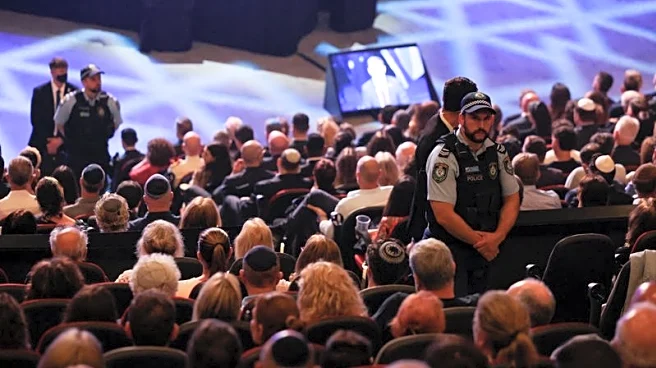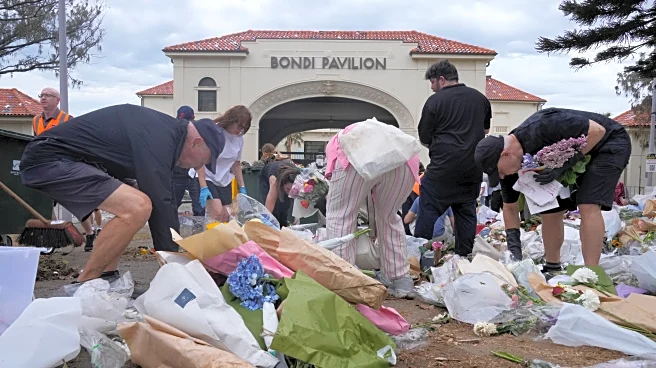




MELBOURNE, Australia (AP) — Australia’s Parliament on Tuesday passed anti-hate speech and gun laws proposed after two shooters killed 15 people at a Jewish festival in Sydney last month in an attack that authorities say was inspired by the Islamic State group.
The gun laws create new restrictions on gun ownership and create a government-funded buyback program to compensate people forced to hand in their firearms.
Anti-hate speech laws enable groups
that don’t fit Australia’s definition of a terrorist organization, such as the Islamist group Hizb ut-Tahrir, to be outlawed. Hizb ut-Tahrir is already outlawed by some countries.
The government had initially planned a single bill, but separated the issues into two bills introduced to the House of Representatives on Tuesday.
Both bills initially passed the House, where the center-left Labor Party government holds a majority of seats. The firearms bill was the first to be passed by the Senate, where no party holds a majority, with a 38-to-26 vote. The anti-hate speech bill followed with a 38-to-22 vote in the 76-seat upper chamber.
Earlier Tuesday, Home Affairs Minister Tony Burke told Parliament that alleged gunmen Sajid Akram, 50, and his 24-year-old son Naveed Akram wouldn't have been allowed to possess guns under the proposed laws.
The father, who was shot dead by police during the attack on Jewish worshippers during Hanukkah celebrations at Bondi Beach on Dec. 14, legally owned the guns used.
His son, who was wounded, has been charged with dozens of offenses, including 15 counts of murder and one of committing a terrorist act over the attack.
Burke said that the Indian-born father would have been barred from gun ownership under the proposed laws because he wasn't an Australian citizen. The Australian-born son would also been banned, because he had come under surveillance from the Australian Security Intelligence Organization, or ASIO, spy agency in 2019 over his association with suspected extremists.
“In responding to the antisemitic terror attack, we need to deal with the motivation and we need to deal with the method,” Burke told Parliament. “We are dealing with two people there who had horrific antisemitic bigotry in their minds and in their hearts. And they had weapons they should not have had.”
ASIO also has a role under the new anti-hate speech laws in deciding which hate groups should be outlawed. Neo-Nazi group National Socialist Network has announced plans to disband rather than have its members targeted under the laws.
The opposition Nationals party had opposed the anti-hate speech legislation, arguing it could impinge on free speech.
“The legislation needs amendments to guarantee greater protections against unintended consequences that limit the rights and freedom of speech of everyday Australians and the Jewish community,” Nationals leader David Littleproud said in a statement late Tuesday.
Parliament had been scheduled to resume for the year in February, but was brought back early to respond to Australia’s worst mass shooting since 1996.
A lone shooter killed 35 people in Tasmania state that year, in a massacre that galvanized the nation into introducing tough gun laws that drastically reduced the number of rapid-fire weapons in public ownership. The government then bought back almost 700,000 guns.
But the states of Tasmania and Queensland and the Northern Territory are resisting the federal push for a new gun buyback, for which the states and territories would be expected to pay half the cost.
Burke said his government would continue to negotiate with the states and territories on the buyback.