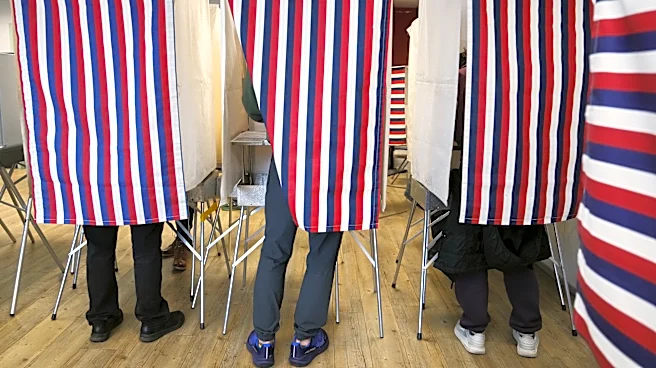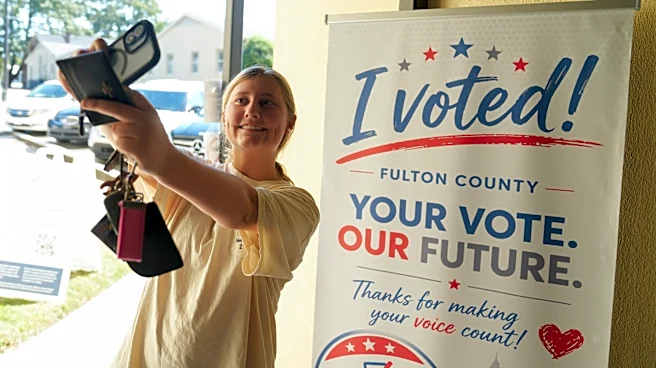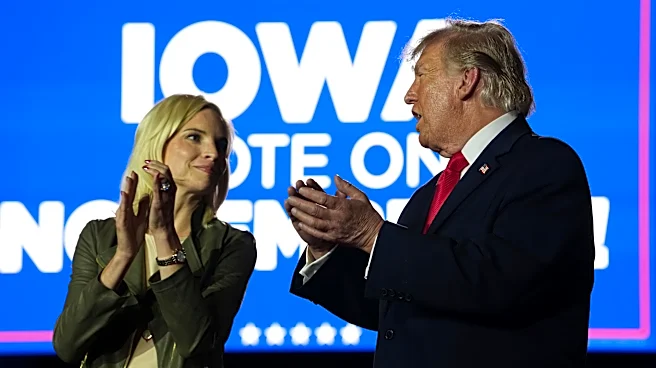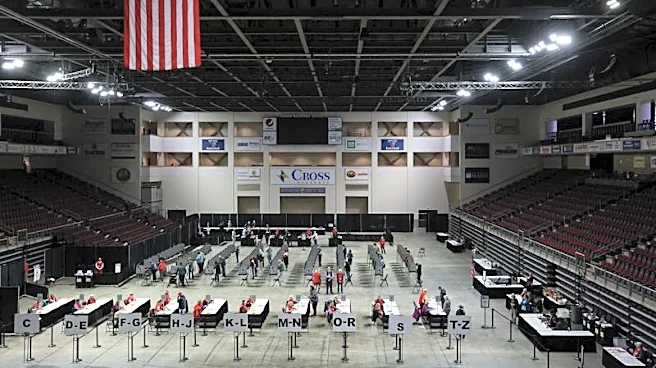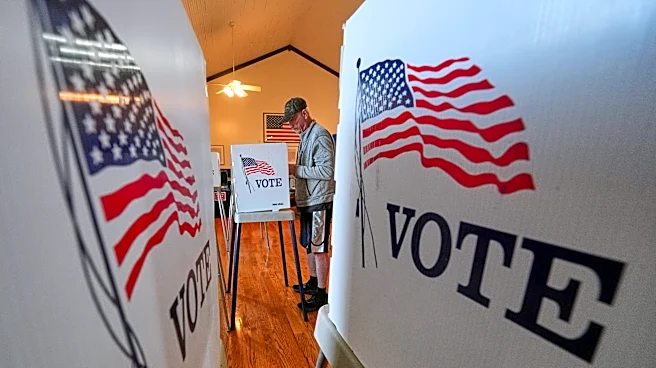







Election Day is here. Voters nationwide will decide control of the U.S. House and Senate . Democrats must flip four seats in the Senate and three seats in the House to wrest control of the chambers from Republicans. Control of Congress would give Democrats a way to push back against President Donald Trump’s agenda during the final two years of his term. The battle for control is playing out mostly in states and districts Trump previously won by wide margins.
All eyes are on Senate contests in Alaska, Iowa, Kansas, Maine, Michigan, Ohio and Texas, while House battlegrounds are scattered across the country.
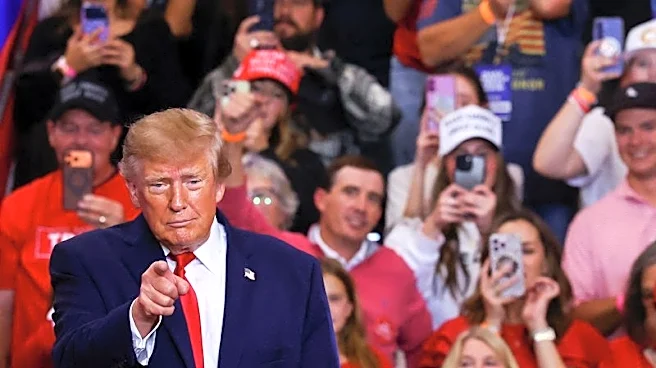
Democrats have homed in on Trump’s poor approval rating, public dissatisfaction with the war in Iran and affordability concerns. Republicans have focused on social issues, while Trump has made himself the central character of the midterms.
The latest:
Outside an early voting site in Dripping Springs, Texas, 25-year-old Ian Brown said he had just voted for a straight Republican ticket.
He referenced some of Democratic Senate candidate James Talarico’s past statements about God and gender, which Republican Ken Paxton has highlighted in attack ads.
“He claims he’s Christian, but he says you know there’s multiple genders. That’s not even biblically accurate,” Brown said.
The self-described Republican Libertarian said he thinks Trump is “the best thing for our country right now.”
Sofia Sites, meanwhile, voted for the first time this election and supported Democrats.
Sites, 21, has a transgender sibling, and Talarico’s stance on transgender and LGBTQ+ rights was something that drew her to him, she said.
“There’s no perfect politician; there’s no one I like to bow down to,” Sites said. “I just think that I’m wanting to see more empathy.
The vote-counting issues bedeviling Westchester County stem from a program update that happened after polling equipment was initially prepared and tested, according to the state Board of Elections.
A change in an unnamed local race required an update that wasn’t made to machines in other counties, the board said. As a result, those tabulators were unable to recognize completed Election Day ballots.
State officials said they’re working with their counterparts in Westchester County to restore ballot-scanning capability to at least one vote-counting machine at every polling location. Voting continues through established emergency ballot procedures.
Westchester County Executive Ken Jenkins vowed to launch a bipartisan investigation into what he called a “debacle.”
John Shaw of Phoenix said he showed up to the polls on Tuesday to support “American values” and “patriotic things.”
Shaw, who declined to say which candidates he picked, said he hoped to see government “be a little more conservative” and to see “less government” overall after the election.
Democratic Arizona Gov. Katie Hobbs is seeking a second term but faces a challenge from Republican Rep. Andy Biggs. Voters will also decide a full slate of contests, including congressional and state legislative races that could shift the balance of power both in Washington and in the state government.
While there were long lines at Shaw’s polling place, he said it was still exciting to talk to fellow voters.
Alaska voters last elected a Democrat to the U.S. Senate in 2008 and as governor in 1998. But Democrats are making strong pushes in both races ahead of the ranked choice general election.
In the Senate race, two-term Republican incumbent Dan Sullivan has gotten support from Trump and Vance as he seeks to fend off Democrat Mary Peltola, a former congresswoman. Peltola finished first in August’s open primary.
Two other candidates, including another Dan Sullivan, also are running but have done almost no campaigning. Trump has directed the Justice Department to investigate the presence of another candidate with the same name as the incumbent, even calling for Peltola’s prosecution. He also continued voicing his opposition to the state’s use of ranked voting.
State Republican leaders have long expressed skepticism about ranked voting but encouraged voters to rank the Republicans. Many Republicans see the strategy as essential to winning the governor’s race, featuring Democrat Jonathan Kreiss-Tomkins and three Republicans, including Trump-backed Bernadette Wilson.
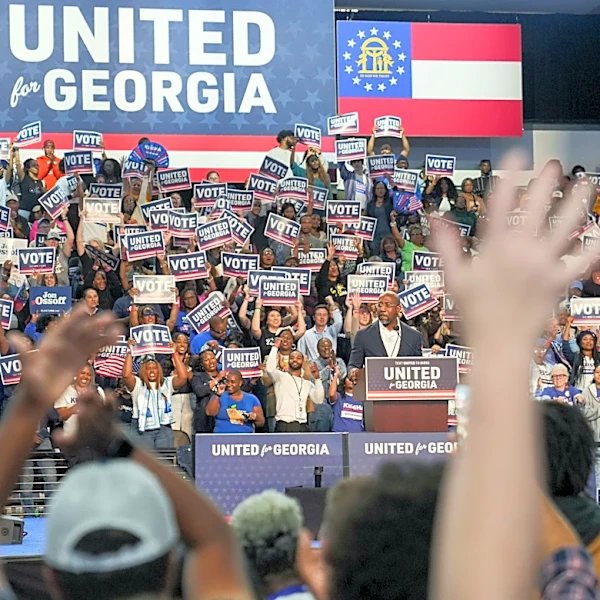
A year ago, Ossoff was considered Democrats’ most vulnerable incumbent. The campaign hasn’t turned out that way.
Ossoff had no primary opposition, and he quickly became a fundraising machine, exciting Democrats nationally with his broadsides against Trump. He collected at least $109 million, tops among all Senate candidates.
Republicans had an extended primary battle. Rep. Mike Collins, a self-declared “MAGA warrior” who echoes Trump’s 2020 election denial, received the president’s late endorsement and defeated Derek Dooley.
Georgia Gov. Brian Kemp, the Republican whom GOP leaders wanted to run, backed Dooley and spent the spring telling voters Collins couldn’t win in November.
Collins struggled to hit the $10 million fundraising mark, and he was dogged by questions about an unresolved House ethics investigation and his ties to white nationalists.
Ossoff is trying to capitalize on Election Day as some Democrats openly hope he runs for president in 2028.
Voters in reliably Democratic Colorado and Washington are deciding on ballot measures that would ban transgender girls from girls’ sports competitions.
Both supporters and opponents say that if one or both are adopted, it could open the door to further measures in Democratic-led states in coming elections.
Similar measures are on the ballot in Arizona, where voters are being asked to apply an existing ban to private schools, and in Nebraska, where a measure would add an existing ban in state law to the state constitution.
Every state where both the legislature and governor’s office are held by Republicans has already passed a law like this. But no state has done it through a ballot question so far.
The votes come at a time when a growing number of Democratic politicians are saying transgender girls shouldn’t be allowed to play girls’ sports.
In a post on X, the vice president sought to remind voters about the Trump administration’s effort to cut taxes over the past year and a half.
“We ended taxes on overtime. We ended taxes on tips. We ended taxes on Social Security,” Vance wrote on the social media platform.
But the changes made by the wide-ranging tax law enacted by Trump are not that clear-cut.
More than 40 states have not implemented the federal law ending taxes on tips, meaning workers who receive a federal tax deduction for tips or overtime still will owe state taxes on those earnings.
As for taxes on Social Security, the legislation targeted seniors’ income with a temporary benefit, not just Social Security.
Opposition to data centers in communities across the U.S. has snowballed from a local issue into a midterm election weapon in statewide races from Texas to Ohio to Florida amid the artificial intelligence revolution.
Candidates spent millions to paint their opponents as data center patsies — giving them nicknames like “Data Nate” — as onetime data center boosters worked to distance themselves or get tough on the industry.
They had an ally: Trump urged communities to accept data centers, as the industry spent millions to boost its image.
Meanwhile, the issue crossed traditional ideological boundaries.
Labor unions became allies of tech giants, as they scrambled to build the behemoth projects.
Clean energy advocates became staunch critics of data centers, as energy-hungry server warehouses set off the biggest-ever construction boom of natural gas-fired power plants. Ranchers and farmers worried about water shortages or losing agricultural land.
Kim Dean, 74, is a Democrat who voted for Kamala Harris in 2024 but says he’s never voted strictly for Democrats — until this year.
Dean has a long list of grievances about how Trump has governed: the way U.S. Immigration and Customs Enforcement is “running around” and deporting people, the president “tearing down” the White House, the war in Iran, the way Trump “berates” people.
“A lot of this stuff, I just don’t agree with it. It just don’t make sense to me,” the retired steel worker from Harrisburg, Pennsylvania, said after dropping off his mail ballot.
“I’ll be honest with you, I would have voted for Pepe the dog this year, you know what I mean? To try to get this administration changed. Yes, I’m voting against the whole administration.”
If Republicans lose ground in Congress, it won’t be because they didn’t have more money than Democrats.
Republicans have held a financial advantage leading up to the midterm elections, owing to GOP-aligned outside groups’ outsized role, notably in Senate races.
Combined, the Republican National Committee, its related congressional committees and corresponding super PACs, including Trump’s MAGA Inc., raised more than $2.2 billion, compared with about $1.3 billion for the Democratic National Committee and its aligned committees and groups.
Democratic candidates, however, have outraised Republicans in their individual races, more than $2.3 billion to about $1.6 billion. That money goes further than super PAC dollars because candidates get lower advertising rates.
The two sides have spent an astronomical amount on the midterm campaigns — more than $11.9 billion, according to Federal Election Commission records. The vast majority of spending has been on advertising: Republicans and allied groups have spent more than $5.5 billion while Democrats and allied groups have spent a little more than $5 billion, according to the media-tracking firm AdImpact.
Federal authorities have charged an Oklahoma man with sending hundreds of letters containing nonhazardous white powder to public officials ahead of the 2024 and 2026 elections.
The powders turned out to be yeast or flour, though not all letters have been fully tested, the FBI said in a court filing made public Tuesday.
Robin Martin is charged with conveying a hoax and mailing threatening communications. Martin was expected to make his initial court appearance Tuesday afternoon in Oklahoma City. Online records do not list an attorney to comment on his behalf.
If they pull it off, it would be the first time in two decades that Democrats hold a majority of the governors’ offices.
All told, 36 states will elect a governor on Nov. 3. Heading into the elections, Republicans held a 26-24 majority. Democrats need to pick up two more states to capture a majority. Democrats last gained a majority in 2006 and lost it four years later.
The parties see about a dozen races as competitive.
Democrats’ best opportunities to pick up a governor’s office are in Alaska, Georgia, Iowa, Nevada and Ohio.
Republicans’ best opportunity to capture an executive suite is in Kansas.
Next on the GOP’s list are Wisconsin’s and Michigan’s open governor’s offices.
Democrats think they have a chance in Texas, Florida, Oklahoma and Nebraska.
Several hundred ballots from South Carolina’s most remote precinct should be counted a lot faster Tuesday night thanks to the local sheriff’s office helicopter.
There are no bridges to Daufuskie Island on the far southern coast of the state. In previous elections, voting officials had to collect ballots and other equipment and wait for the regular ferry schedule or another boat, which could delay results for five hours.
There are stories of one night the Daufuskie Island precinct left everyone waiting until the early morning hours because the person bringing the votes back stopped because the fishing was good.
Patricia Witt, 82, is a registered Democrat in Raleigh, North Carolina. But the retired information technology worker voted for Trump’s handpicked Senate candidate, Republican Michael Whatley, because she wants to maintain GOP support in Congress for Trump and his policies.
“And I do not want to go through what we went through before with the Senate and the House fighting against the man, rather than fighting for what they should be doing — representing us as citizens,” she said.
But David Kastenberg, 65, a physician living in Philadelphia, wants the opposite. He said he voted for Democratic candidates in part over concerns that American democracy is at stake.
“I’m extremely upset with what’s happening in Washington with President Trump’s policies,” he said. “And I want to see Congress change.”
Voters in Los Angeles and Washington, D.C., are considering candidates for mayor aligned with the Democratic Socialists of America.
If Nithya Raman captures the mayoralty in LA and Janeese Lewis George wins in Washington, the two cities would follow New York’s lead, where democratic socialist Zohran Mamdani was elected mayor in 2025 after promising to transform city government to restore power to the working class.
Both cities are heavily Democratic.
Raman is trying to oust Mayor Karen Bass, who’s fighting to keep her job after a rough first term that included the deadly Palisades Fire, which ignited when she was out of the country and caught the fire department unprepared. The former political allies are progressive Democrats.
In Washington, Lewis George is favored after winning the Democratic primary. Her victory would signal a break with a quarter-century of centrist governance in Washington. It would place her in the vanguard of democratic socialists that also includes Katie Wilson, who won an upset victory to lead Seattle last fall.
Daryl Compton, a 73-year-old retired UPS worker, attended a rally in Topeka, Kansas, last week headlined by Vice President Vance wearing a red “Make America Great Again” cap.
Compton said he’s concerned about illegal immigration, the economy and national security, particularly the threat posed by Iran.
He also said fuel prices are too high, “but I put my trust in Trump that they are going to come down.”
“And I think they’ll come down a lot further than we even expect,” he said.
Compton said he’s motivated to vote for Republican Sen. Roger Marshall because if Democratic challenger Adam Hamilton wins, that could put Democrats in charge of the Senate.
“I don’t like Democrats,” he said. “They’re basically not Democrats. They are more like Communists, and I’m against Communism.”
Voting was delayed for 20 minutes at voting sites across Broward County as polls opened because a new safety feature malfunctioned, officials said.
During a news conference, Supervisor of Elections Joe Scott apologized to voters who had to wait and said some left before they were able to vote. The problem was solved by 7:20 a.m., and Scott encouraged those who left to return. He did not have an estimate of how many voters left.
Scott said the state’s late redistricting meant some people within the same precinct voted on different ballots, and the new bar code feature was meant to ensure poll workers did not give people the wrong one.
Some people received an error message that they were voting on the wrong ballot, but they were not, Scott said.
“Nobody voted on the wrong ballot,” Scott said. “None of the counts were impacted.”
More than three dozen voting laws passed in Republican-controlled states are taking effect for the first time this year, many of them containing elements of proposals that Trump tried unsuccessfully to get through Congress.
At the state level, the changes include new requirements to show proof of citizenship. College students in New Hampshire won’t be using college IDs. Iowa voters without ID can’t count on other voters to vouch for them, and some voters in Mississippi might need birth certificates or passports for verification. Naturalized citizens might get to polling places and learn they’ve been purged because databases used to check their citizenship against voter registration lists are outdated.
Opponents say the restrictions make it harder for eligible voters to vote. Republican lawmakers who support the tighter voting laws, especially around voter ID, say they help build trust in elections.
Republican Gov. Greg Abbott, who has comfortably held the governor’s mansion since 2014, is in one of his tougher fights. He faces Democratic state Rep. Gina Hinojosa in an election year favoring her party.
The race, still an uphill slog for Hinojosa, has revolved around the standard concerns of high costs and public education, but the hulking structures that power artificial intelligence butted in. Data centers have drawn bipartisan anger from Americans who live by them and concerns that the buildings guzzle too much water and electricity.
Last year, Abbott celebrated Google’s investments partly to build data centers in the state. Hinojosa hammered him for it, arguing that it represented the influence of wealthy people over everyday Texans. The governor has since shifted his position, ordering the pause of data center permits and saying, “Texans come first.”
Some voters in Florida were being directed to cast their ballots in new places on Tuesday after their polling sites were relocated due to continued rain and flooding.
Florida elections officials said 21 polling places in eight counties were moved. The relocations were mostly along the central and southern Atlantic coast, with some inland counties included. County officials said they notified voters by text and email, and signs were posted at voting locations directing people to the new sites.
Some residents expressed frustration and concern on social media that some voters may not be able to get to the polls because of flooding.
Amy Keith, the Florida state director for Common Cause, said the flooding is a big issue.
“Today it has already been a pretty challenging morning,” she said, urging voters to double-check their voting locations with election supervisors.
After casting his vote at a Brooklyn school, Democratic Senate leader Chuck Schumer said he was optimistic that when polls close, “there will be a new Democratic majority in the United States Senate.”
“We don’t want to count our chickens before they hatch. So I’d characterize our mood as nauseously optimistic,” Schumer said.
He predicted that Democrat Abdul El-Sayed would win the U.S. Senate race in Michigan, despite the decision by his former primary opponent, U.S. Rep. Haley Stevens, to endorse Republican Mike Rogers.
“She’s one vote,” Schumer said. “He’s going to win tonight because he’s talking about what Michiganders care about.”
Schumer said that a year ago, no one thought the Democrats might be in a position to retake the Senate. But he credited the party’s “relentless” focus on affordability and “chaos overseas in a war with Iran that nobody wants” with making Democrats more competitive.