







NEW YORK (AP) — With hundreds of vessels still stuck in the Persian Gulf and costs piling up, shipping companies are being whipsawed by uncertainty over how and when the Strait of Hormuz might reopen more than two months into the Iran war.
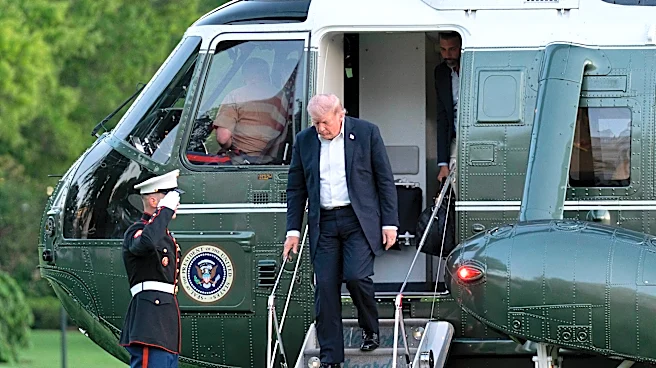
On Sunday, President Donald Trump announced “Project Freedom,” a way for the U.S. to “guide” ships to exit the strait. Two ships made the transit, but by Tuesday Trump abruptly paused the effort to allow time for a deal
to end the war.
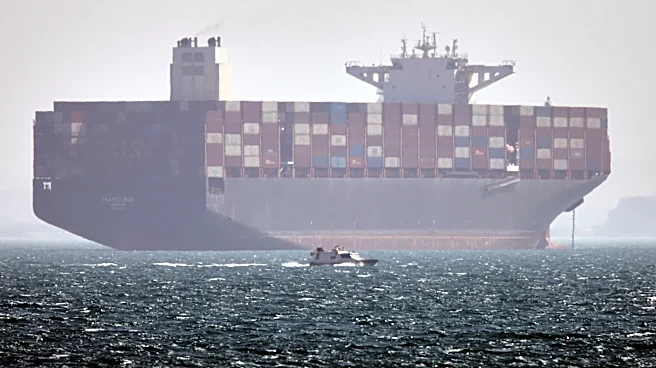
Meanwhile, the risks for ships and crew haven't faded. A cargo container ship operated by the CMA GGM Group was damaged when it came under attack while attempting to transit the strait, the French shipping company said Wednesday, and concerns about Iranian speedboats and drones are leading major ship owners and operators to say the strait remains too dangerous.
“Ultimately, it’s still going to come back to the primary issues of risk and safety," that shippers have to evaluate, said Sean Pribyl, a maritime attorney at Holland & Knight in Washington, D.C. ”It seems as though we’re not anywhere near to returning to a free flow of traffic and navigation through the strait," he added.
Before the Iran war, 100 to 135 vessels passed through the Strait of Hormuz daily, according to research firm Lloyd’s List Intelligence, but that has slowed to a trickle as Iran has demanded that vessels go through a vetting process run by the Islamic Revolutionary Guards Corps that involves passing to the north near the Iranian cost, submitting information on crew and cargo, and in at least some cases paying. Meanwhile, paying the IRGC risks running afoul of sanctions from the U.S. and the EU, which have designated it a terrorist organization.
Goods stranded in the strait include oil and oil products such as fertilizer, not to mention thousands of ship workers. Air Force Gen. Dan Caine, chairman of the Joint Chiefs of Staff, said Tuesday there are more than 1,550 vessels with about 22,500 mariners on them inside the Persian Gulf.
To pressure Iran, the U.S. Navy is blockading Iran's ports, enforcing the blockade outside the strait in the Gulf of Oman and the Arabian Sea.
Holland & Knight’s Pribyl said shippers and ship insurers are likely still assessing the scenario in the strait. Ships carry two main types of insurance: protection and indemnity, which covers property and third party liabilities, and — during a conflict — war risk insurance that covers damage and losses due to war.
Insurance costs have shot up for vessels in the region due to the risk of attack, jumping from less than 1% of the value of goods on a ship to anywhere from 3% to 10% during the conflict, said Ed Anderson, a professor of supply chain and operations management for the McCombs School of Business at the University of Texas. But even with insurance, most shippers have deemed the crossing too unsafe.
“Ferrying out a couple of ships has not really affected the shipping industry in any way whatsoever,” he said.
Hapag-Lloyd AG, one of the world’s largest container shipping companies, says the Hormuz situation is costing it $60 million a week, particularly in skyrocketing prices of fuel and insurance. It has a fleet of 301 ships, including four stranded in the Persian Gulf. The company has also had to suspend some of its transport services and find alternate routes either to safe harbors or over land. “These options are however limited in capacity and cannot completely replace the regular maritime routes through the region,” the company said in a statement.
The Maersk shipping company said its U.S.-flagged Alliance Fairfax vehicle carrier exited the Persian Gulf through the Strait of Hormuz “accompanied by U.S. military assets” on Monday. “The transit was completed without incident, and all crew members are safe and unharmed,” the company said in a statement.
Oil prices and shipping are unlikely to return to normal until it’s clear the risk of attacks in the Strait of Hormuz have receded, cautioned Kaho Yu, head of energy and resources resources at risk intelligence company Verisk Maplecroft.
“Even with diplomatic engagement continuing, energy markets are unlikely to return quickly to pre-crisis assumptions,” he said. “Refiners, shippers, and commodity traders will remain cautious until there is clearer evidence that Hormuz disruptions will not re-escalate.”
A meeting on Wednesday between Iranian and Chinese diplomats emphasized de-escalation. But “Hormuz remains the real metric that will be watched,” Yu added. “Tanker traffic and energy flows over the coming weeks and months are likely to matter more than diplomatic language in assessing whether Beijing can translate influence with Tehran into practical stability.”
If the ceasefire holds and ships gradually begin transiting the Strait of Hormuz again, shipping won't “snap back overnight,” warned Razat Gaurav, CEO of Kinaxis, a supply chain management company.
“Even when conditions improve, carriers, insurers, and shippers need confidence that stability will hold before capacity and routes fully normalize," he said. “Air cargo can recover relatively quickly, but ocean shipping typically takes weeks or months because of longer lead times and contractual constraints.”
He said shipments of certain categories like liquid natural gas and sulphur, where the Middle East is a major source of supply, are likely to move more quickly as backlogs clear, but “most shippers will remain cautious until stability proves durable,” he said.
__
McHugh reported from Frankfurt, Germany.