









Mainers decided to begin using ranked-choice voting in elections for the state Legislature, governor and federal offices all the way back in November of 2016 — the first state in the nation to do so.
But nearly a decade and multiple court cases later, full implementation of that new system approved by 52 percent of voters has languished in a sort of legal and administrative purgatory. Ranked-choice voting is used in state and federal primaries. It
is also used in federal races during the general election. But it is not used in general elections for state representative, state senator or governor.
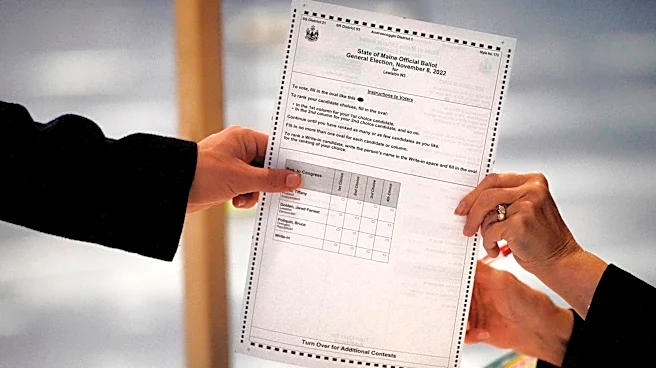
In the Democratic and Republican primaries this June, Maine voters will rank candidates for governor, the state Legislature and federal offices in order of preference. In this system, if one candidate is the first-choice pick of more than half the voters, that candidate is declared the winner. If no one gets more than 50 percent, there could be another round of counting, with candidates in last place eliminated and their votes reallocated to voters’ second-choice picks. That process can continue for multiple rounds until one candidate secures more than 50 percent and wins the election.
However, that same system won’t be employed across the board in November’s general election, where ranked-choice voting could be used for the U.S. Senate and congressional races but won’t determine who serves in the State House or as governor. Those state general elections still feature the more traditional approach of plurality voting, where voters choose one candidate, and the person with the highest initial vote tally wins regardless of whether they get more than 50 percent.
If you’re confused, you’re not alone.
“It is confusing for folks,” said Kate McBrien, the chief of staff for Maine Secretary of State Shenna Bellows. “What we hear from everyone is what’s confusing is which races it applies to and why doesn’t it apply to all of them.”
To that end, the secretary of state’s office, tasked with overseeing Maine’s elections, has been hosting community events to help people learn more about ranked-choice voting.
Chrissy Hart, executive director of the League of Women Voters of Maine, an organization that has been at the forefront of the push for ranked-choice voting in the state, also acknowledged that there is some potential for voter confusion and frustration with the current hybrid landscape.
“We certainly have confidence in the Maine voter and voters’ ability to navigate their ballots, and we do everything we can to support civic education to that end,” Hart said. “But we would vastly prefer to see continuity between what folks experience in the primary and general elections.”
That lack of continuity is not for a lack of public support. Maine voters have twice endorsed a broad use of ranked-choice voting at the polls, both in 2016 and a subsequent statewide referendum in 2018 that prevented lawmakers from delaying implementation. Exit polling conducted by FairVote, an organization that supports ranked-choice voting, suggests that the ranked-choice process has continued to enjoy support from a majority of Maine voters.
But popularity and constitutionality aren’t the same thing. Maine’s supreme court has now twice issued unanimous, non-binding advisory opinions that using ranked-choice voting in the general elections for governor and the State House would be out of step with the Maine Constitution.
For nearly 150 years, the state’s founding document has dictated that Maine lawmakers and the governor be elected by a plurality — meaning that whoever gets the most votes wins, even if that is not more than 50 percent. The justices from Maine’s highest court have found those plurality provisions and the related language laying out how general elections for state office need to be conducted are not compatible with the ranked-choice voting process, which uses multiple rounds until a candidate eclipses 50 percent.
So why does this apply to the state’s general elections, but not the primaries or federal elections?
“Primary elections in Maine and elections for federal offices are governed by statute and not by the Maine Constitution,” the secretary of state’s office explains on its website.
That difference explains why ranked-choice voting can be used in the primaries and congressional races, and was able to be expanded to Maine’s presidential elections in 2020 by the Legislature, but continues to be excluded from state general elections.
The state constitutional concerns surrounding ranked choice didn’t spring up overnight. They predated the 2016 referendum and were voiced by Democrats and Republicans alike.
“We raised those with the people who were originally talking about taking it to referendum long before they even submitted their information for a question,” said Matt Dunlap, the current Democratic state auditor who was secretary of state at the time. “And we looked at some of their proposed language, and we said, ‘This is a problem.’”
Dunlap and his department were not alone in that assessment. Democratic Gov. Janet Mills, then attorney general, also raised concerns that the initial ranked-choice voting referendum could conflict with the Maine Constitution. Legislative Republicans echoed those concerns before the referendum question went to voters.
In the decade that followed, the debate in Augusta over ranked-choice voting has typically split along party lines. Maine Democrats and some independents have been generally supportive of the approach and its expansion, while Republicans have not only resisted its expansion but have repeatedly sought its repeal.
Those who support ranked-choice voting argue that it better allows people to vote based on their preferences and not who they think can win, produces more broadly appealing candidates and promotes more civility within campaigns. Detractors have called it a confusing, cumbersome and drawn-out process that they say has failed to deliver on its promises.
But Republican bills to get rid of ranked-choice voting law haven’t gone anywhere in the Democrat-controlled State House over the past eight years. Repeated attempts by Democrats and a handful of independents to amend the state’s Constitution and expand ranked-choice voting, meanwhile, have encountered vociferous Republican opposition and failed to cross the two-thirds threshold needed to advance a constitutional amendment to voters.
Those dynamics don’t appear likely to change anytime soon.
“The Constitution forces this hybrid approach,” said Jason Savage, executive director of the Maine Republican Party. “If they want ranked-choice voting in some, they can’t get it into all. And so now we’re going to perpetually be on this hybrid track. It’s still confusing.”
Dunlap, who was tasked with implementing the bifurcated version of ranked-choice voting after the successful referendum and subsequent action in court, said he isn’t surprised by the “suspended inertia” that has come to define ranked-choice voting’s partial deployment in Maine elections. And he has had the unique experience of drawing the ire of both sides in this yearslong debate.
“I think I was alternatively accused, falsely in each case, of either trying to smother ranked-choice voting with a pillow in its crib or trying to sneak it through the back door,” Dunlap said. “And actually, what I told people is like, ‘Look, if we’re going to do this, we have to make it work. And it’s got to work right.’”
With the way it has worked out over the past decade, the first state in the nation to approve statewide ranked-choice voting has yet to fully adopt the system. Because the state Constitution trumps state statute, even when that statute is passed directly by Maine voters, ranked-choice voting has never been used in the general election for governor or the state Legislature.
And that will once again be the case this November, with Maine’s highest court pouring cold water this spring on the newest effort from legislative Democrats to expand ranked-choice voting.
After multiple failures to get a constitutional amendment out of the State House and onto the ballot, and after some notable developments elsewhere in ranked-choice litigation, ranked-choice voting proponents tried something different in the most recent legislative session. Rather than trying to amend the state Constitution, Democrats advanced legislation, L.D. 1666, that sought to change language in Maine’s ranked-choice voting law and harmonize it with the Constitution’s plurality requirements.
Given the ongoing questions and the rapidly approaching elections, legislative Democrats turned to a process in the state Constitution that asks the Maine Supreme Court to weigh in on “solemn occasions” to offer advice on “important questions of law.” Online records from the court indicate that this rarely invoked process has led to just four advisory opinions from the justices since 2017, twice on the matter of ranked-choice voting.
In April, the justices responded with a unanimous opinion that closed the door on the recent ranked-choice voting expansion bill. They once again advised that extending ranked-choice voting to general elections for governor and the State House would be unconstitutional.
Not everyone agrees with the supreme court’s interpretation. Ranked-choice proponents have long argued that the process already comports with the state Constitution. And they were hoping their arguments would be buoyed by a 2022 Alaska Supreme Court decision that upheld the broad use of ranked-choice voting in that state, along with federal guidance on the issue that included a U.S. District Court judge in Maine ruling that Maine’s use of ranked-choice voting does not violate the U.S. Constitution.
The ruling in Alaska, the only other state to adopt ranked-choice voting statewide, specifically criticized the 2017 opinion from Maine’s high court. When confronted with those newer arguments and developments, however, the Maine justices remained unconvinced.
The Maine justices found that “L.D. 1666’s conception of a vote as being a series of instructions or rankings that when tabulated pursuant to a ranked-choice process leads to an eventual final vote is inconsistent with the constitutional concept of a ‘vote,’” and opined that the provisions within Maine’s Constitution requiring a plurality of votes do not allow for the additional round of tabulations as laid out in the proposed bill. In the section that describes how the state should elect the governor, for instance, the Constitution states, “they shall determine the number of votes duly cast for the office of Governor, and in case of a choice by plurality of all of the votes returned they shall declare and publish the same.”
The justices’ opinion, while non-binding, essentially scuttled the most recent push for ranked-choice expansion. That bill, which had received widespread support from legislative Democrats but saw notable pushback from Democratic Attorney General Aaron Frey, along with unified opposition from legislative Republicans, officially died when the Legislature adjourned on April 29.
News of the recent advisory opinion has added an additional layer of confusion for some voters, with some erroneously believing that the court struck down ranked-choice voting entirely.
“We’ve been hearing some confusion on social media, but also just comments that we’ve received, that people were misinterpreting the decision thinking that it meant ranked-choice voting was gone completely,” said McBrien, from the secretary of state’s office. “And that’s simply not the case. The court decision keeps in place how the state works with ranked-choice voting now and just simply doesn’t expand it.”
Kyle Bailey, the former campaign manager for the pro-ranked-choice voting committee that led the 2016 ballot initiative, was critical of the court’s recent opinion and emphasized that the existing law remains in place.
“Ranked-choice voting was twice approved by Maine voters,” Bailey said. “It is the law of the land, and it will stay that way in perpetuity unless and until the Maine people decide otherwise.”
Bailey stressed that advisory opinions are non-binding and took issue with the justices’ focus on “obscure” provisions in the state Constitution that outline how votes are supposed to be sorted, counted and finalized.
“Constitutional scholars across the U.S. find the rationale of the Maine Supreme Judicial Court bizarre because it is,” Bailey added.
One national ranked-choice expert, Scott Kendall of Alaska, who successfully argued the 2022 case before that state’s top court, found the Alaska justices’ reasoning much more convincing. But he also wasn’t particularly surprised that the Maine justices hewed closely to precedent here in the Pine Tree State.
“The Maine Supreme Court decides what the Maine Constitution means, so my opinion doesn’t really mean much,” Kendall said. “But I would say, to me, their opinion sort of represented this failure of imagination in the sense of, many states have what they call these plurality clauses. Ours just says the greatest number of votes. I think Maine’s actually uses the word plurality, but it kind of fails to acknowledge that plurality is also inclusive of majority.”
Hart, the League of Women Voters of Maine leader, said her organization disagreed with the court’s interpretation but respects the justices’ role in the process.
“We take the position that we believe that the court and the attorney general could have found a way to square what is laid out in the Constitution with ranked-choice voting, but the court made its decision and made it clear that the court will not be the place to take this up in the future,” Hart said. “So our strategy and our priority right now is regrouping and figuring out what’s next.”
Hart said that a renewed push for a constitutional amendment is “certainly within the realm of possibility.”
Democratic Sen. Cameron Reny, the lead sponsor of L.D. 1666, expected the effort to expand ranked-choice voting to continue. She said that could likely take the form of another attempt to pass a constitutional amendment but wasn’t sure yet what the specifics could be.
“This is my second term in office, and I’ve kind of learned to not be surprised at pretty much anything. I am, however, disappointed that that was the ruling,” Reny said on the Legislature’s final day of work. “That being said, I think that the effort to fully implement ranked-choice voting in the state continues. And perhaps next session, the route taken will look a little different.”
There is no real mystery as to what Maine Republicans’ approach to ranked-choice voting will be moving forward.
Savage, the Maine GOP executive director, said state Republicans have “no interest in advancing ranked-choice voting in any way.” He viewed L.D. 1666 as “a pretty desperate grab at trying to make it happen when it’s unconstitutional” and didn’t expect there to be Republican support for any potential constitutional amendment to expand ranked-choice voting.
“And now we really need to start having a conversation about the fact that we shouldn’t be using ranked-choice voting at all,” Savage said.
Bailey bemoaned the repeated Republican resistance to advancing a constitutional amendment in the Legislature.
“We could go back and forth all day, but there is a simple solution to allow the expansion of ranked-choice voting in Maine: The Legislature can place a constitutional amendment on the ballot for Maine voters to decide if they want the power to rank candidates in state general elections,” Bailey said. “It’s as simple as that.”
But the political path forward appears to be anything but simple.
If Democrats want to expand ranked-choice voting, they would likely need to win a supermajority in both the Maine House and Senate to overcome the entrenched Republican opposition and cross the two-thirds threshold to send a constitutional amendment to voters.
And for Republicans to achieve their goal of repealing ranked-choice voting, they would likely need to take back both the House and Senate and win the governor’s race, or secure a veto-proof majority in both chambers.
Neither of those scenarios seem especially likely. Democrats currently hold a slim majority in the House and enjoy a comfortable advantage in the Senate. Those margins could change in November, but it would take a drastic realignment to open the door to movement on the ranked-choice voting front.
So at least for now, Maine’s hybrid approach to ranked-choice voting will persist. And as ranked-choice supporters and detractors both acknowledge, the lack of conformity between primary and general elections is sure to continue raising questions from the electorate.
Dunlap, who is now running in the Democratic primary for Maine’s 2nd Congressional District, said that using ranked-choice voting in some elections but not others is “absolutely” a recipe for confusion and frustration from voters who may not have been following each and every development in this complicated debate.
“You have to remember that voters are people, people who have lives. And they are thinking about getting their kids to softball practice and soccer practice,” Dunlap said. “They’re not thinking about what we’re doing in Augusta.”
Now that Maine has used ranked-choice voting in several elections, and that voters have repeatedly endorsed it, Dunlap thinks it would be more damaging to get rid of it than to amend the Constitution and expand it. But in a debate that has gotten pretty heated at times, he’s not especially strident in his position on the ranked-choice approach.
“People ask me how I feel about ranked-choice voting, and frankly, even to this day, I’m a little bit agnostic about it,” Dunlap said. “It’s just a different way of electing people. There’s no perfect way to run an election.”
___
This story was originally published by The Maine Monitor and distributed through a partnership with The Associated Press.