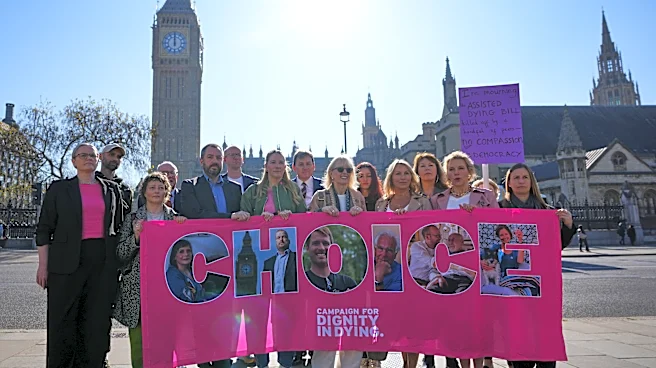

LONDON (AP) — A proposed bill to allow terminally ill adults in England and Wales to choose to end their lives failed Friday as parliamentary time ran out following an effective filibuster by unelected
lawmakers in the revising chamber that blocked the will of elected members.
Though the Terminally Ill Adults (End of Life) Bill was passed by the House of Commons last June, the House of Lords talked it out since then, stoking widespread criticism that it had overstepped the mark.
Proponents of what has been termed “ assisted dying ” — sometimes referred to as “assisted suicide” — hoped it would mark the biggest change to social policy in the U.K. since abortion was partially legalized in 1967.
But opponents in the House of Lords managed to hold up its passing by filing more than 1,200 amendments on a range of concerns. That is believed to be a record high number for a piece of legislation that was brought forward by a backbencher rather than by the government. These so-called private members' bills can only be debated on a Friday as the government largely controls the rest of the parliamentary timetable, thereby limiting the time available.
Campaigners for assisted dying expressed their anger at the sight of unelected politicians holding up the will of the elected chamber. They have insisted that they intend to bring the bill back in the next parliamentary session, which begins after King Charles III outlines the government's upcoming program in a speech to both houses of Parliament on May 13.
The sponsor of the bill in the House of Lords, Charlie Falconer, said he felt “despondent” that a piece of legislation, “so important to so many, has not failed on its merits, but failed as a result of procedural wrangling."
“Much more than letting ourselves down are the very many people who support the bill and who feel we have not treated them properly,” he said.
The bill had proposed allowing adults in England and Wales, with fewer than six months to live, to apply for an assisted death subject to the approval of two doctors and an expert panel.
Those tabling amendments in the House of Lords said they were providing necessary scrutiny to strengthen the legislation, citing an array of concerns, including the potential coercion of vulnerable people and a lack of safeguards for those with disabilities.
Paralympian Tanni Grey-Thompson, who had spoken out against the bill in the House of Lords, said the bill was “not safe” because “there are too many gaps in it.”
Kim Leadbeater, who introduced the Bill to the House of Commons in late 2024, said she was “trying to stay positive” while admitting “a real sense of sadness and sorrow today.”
She said there “will absolutely be appetite" within the Commons to bring the legalization back in the next session of parliament.
Last month, lawmakers in the Scottish Parliament rejected their own assisted dying legislation. Scotland has a semiautonomous government that has authority over many areas of policy, including health.
Assisted suicide — where patients take a lethal drink prescribed by a doctor — is legal in countries including Australia, Belgium, Canada, Luxembourg, the Netherlands, New Zealand, Portugal, Spain, Switzerland and parts of the U.S., with regulations on qualifying criteria varying by jurisdiction.